brainstem
 Call Kai
 Learn
 Practice Test
 Spaced Repetition
 Match
 Flashcards
 Knowt Play
1/117

There's no tags or description
Looks like no tags are added yet.
118 Terms

yellow
midbrain

blue
pons
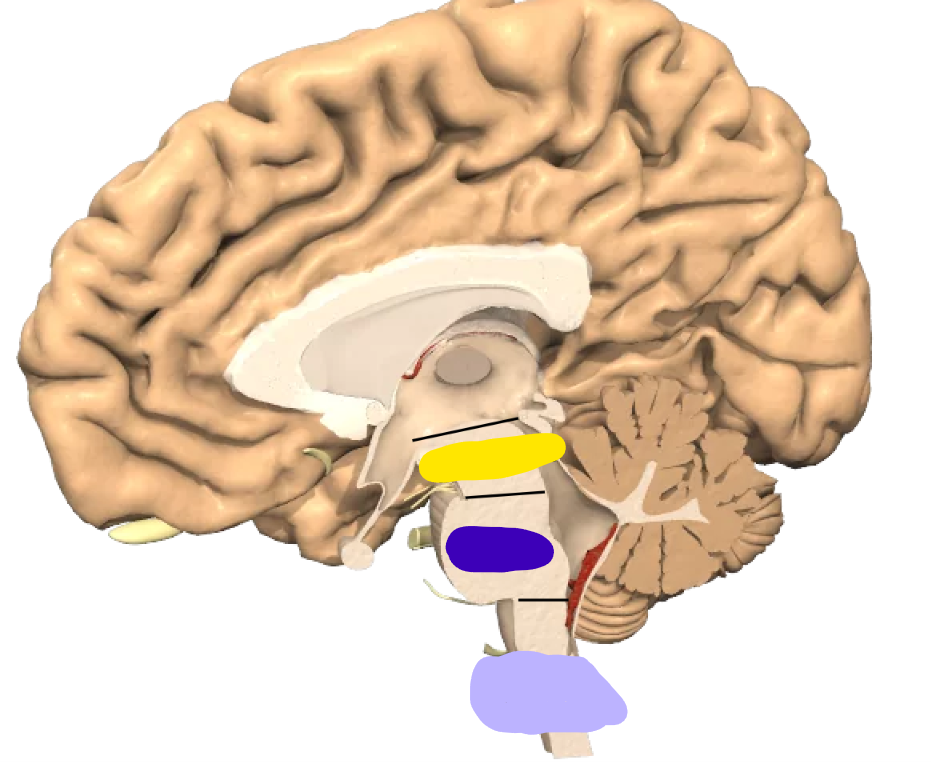
purple
medulla oblongata
6 main jobs of the brainstem
Connect → Passageway → Cranial nerves → Cerebellum → Nuclei → Survival
What does the brainstem connect
The cerebrum to the spinal cord
What travels (pathway) through the brainstem?
All ascending and descending pathways/tracts
Which cranial nerve nuclei are NOT in the brainstem?
Cranial nerves I and II (olfaction/smell and vision).
What does the brainstem connect to the cerebellum?
The rest of the CNS and PNS
What are 3 important nuclei found in the brainstem?
Substantia nigra, red nucleus, and reticular formation.
Which brainstem structure is associated with consciousness?
Reticular formation
What basic survival functions does the brainstem control?
Cardiac function, respiratory function, sleep, hunger, and thirst
The midbrain is the _________ part of the brainstem, about _____ cm long.
smallest; 1.5
Midbrain=
Size + Functions + Connections + Tectum + Sight + Hearing + CN III
What is the smallest (size) part of the brainstem?
The midbrain
What functions are associated with the midbrain?
Visual responses, gustatory functions, and coordination of movement
Midbrain Importartant Structures:
Crus cerebri → Tectum → Superior (sight) → Inferior (hearing) → Cranial nerve III
What do the paired crus cerebri do?
Connect the cerebrum with the rest of the CNS and PNS through the cerebral peduncles.

Where is the tectum located?
On the dorsal (back) surface of the midbrain
What does the tectum contain?
The quadrigeminal bodies
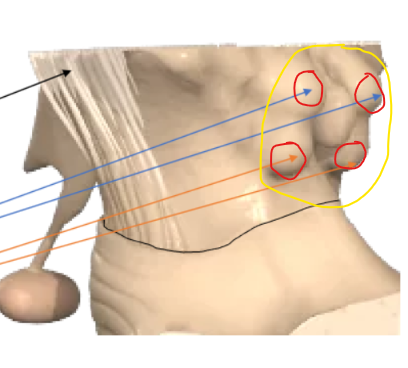
What do the superior colliculi control?
Visual responses

What do the inferior colliculi control?
Auditory responses

Which cranial nerve has nuclei in the midbrain?
Cranial nerve III (oculomotor nerve)
What is the memory trick for the colliculi?
Superior = sight; inferior = hearing
The NUCLEI found in the midbrain are:
Medial geniculate body
Substantia nigra
Superior colliculus
Inferior colliculus
Red nucleus
Oculomotor nucleus (CN III)
Edinger-Westphal nucleus (CN III)
Medial geniculate body (nuclei)
Auditory relay. Processes and relays hearing information
Substantia nigra (nuclei)
Supplies dopamine to the basal ganglia
Superior colliculus (nuclei)
Visual relay. Helps locate visual stimuli.
Inferior colliculus (nuclei)
Auditory relay. Helps locate sounds in space
Red nucleus (nuclei)
Motor coordination; part of the extrapyramidal pathway
Oculomotor nucleus (III) (nuclei)
Controls muscles that move the eye and lift the upper eyelid
Edinger–Westphal nucleus (III) (nuclei)
Controls the sphincter muscle of the iris
The TRACKS Found in the Midbrain are:
Corticospinal tract
Corticobulbar tract
Temporopontine fibers
Frontopontine fibers
Medial longitudinal fasciculus
Medial lemniscus
Spinothalamic tract (anterolateral and ventrolateral)
Trigeminal lemniscus
Corticospinal tract (track)
Motor efferent from cerebral cortex to spinal nerve nuclei
Corticobulbar tract (track)
Motor efferent from cerebral cortex to brainstem cranial nerve nuclei
Temporopontine fibers (track)
Fibers from the temporal lobe that terminate in the pontine nuclei
Frontopontine fibers (track)
Fibers arising from frontal lobe, passing through cerebral peduncle and terminating in pons
Medial longitudinal fasciculus (MLF) (track)
Coordinates eye movements with head movements; helps generate the vestibulo-ocular reflex; connects cranial nerves III, IV, and VI and interacts with cranial nerve VIII.
Medial lemniscus (track)
Carries sensory information from the gracile and cuneate nuclei in the medulla to the thalamus
Spinothalamic tract (anterolateral and ventrolateral) (track)
Carries touch, pain, and temperature information to the thalamus.
Trigeminal lemniscus (track)
Carries pain, touch, and temperature information from the face to the ventral posteromedial (VPM) nucleus of the thalamus
Latin for “bridge”
Pons
Pons cranial nerve nuclei =
Cranial nerves IV, V, VI, and VII.
Pons cerebellar peduncles =
Superior and middle cerebellar peduncles
Originates in the midbrain
Superior cerebellar peduncle
Cerebellopontine angle =
Junction where the cerebellum meets the pons
Tumors at the cerebellopontine angle = vestibular function
Can affect balance
Tumors at the cerebellopontine angle= auditory function
hearing
Tumors at the cerebellopontine angle =
Can affect balance (vestibular function) and hearing (auditory function).
Nuclei of the Pons ARE:
Principal motor nucleus of trigeminal nerve (V)
Principal (pontine) sensory nucleus of trigeminal nerve (V)
Mesencephalic nucleus of trigeminal nerve (V)
Abducens nucleus (VI)
Facial nucleus (VII)
Nucleus of trochlear nerve (IV)
Cochlear nuclei (anteroventral, dorsal, posteroventral)
Vestibular nuclei
Superior olivary complex
Periolivary nuclei
Principal motor nucleus of trigeminal nerve (V) (nuclei)
Controls chewing muscles
Principal sensory nucleus of trigeminal nerve (V) (nuclei)
Feeling in the face and scalp
Mesencephalic nucleus of trigeminal nerve (V) (nuclei)
Senses the position of chewing muscles (proprioception)
Abducens nucleus (VI) (nuclei)
Moves the eye outward
Facial nucleus (VII) (nuclei)
Controls facial expressions
Nucleus of trochlear nerve (IV) (nuclei)
Helps move the eye downward using the superior oblique muscle
Cochlear nuclei (nuclei)
Process hearing information
Vestibular nuclei (nuclei)
Control balance and orientation in space
Superior olivary complex (nuclei)
Helps locate where sounds come from
Periolivary nuclei (nuclei)
Help send signals that adjust hearing sensitivity and protect the auditory system.
Tracts Found in the Pons ARE
Superior cerebellar peduncle
Anterior (ventral) spinocerebellar tract
Posterior (dorsal) spinocerebellar tract
Medial longitudinal fasciculus (MLF)
Tectospinal tract
Lateral lemniscus
Middle cerebellar peduncle
Pontocerebellar fibers
Corticopontine fibers
Corticospinal tract
Superior cerebellar peduncle (Tract)
Carries information out of the cerebellum toward the thalamus and red nucleus
Anterior (ventral) spinocerebellar tract (Tract)
Carries information about lower-body movement to the cerebellum.
Posterior (dorsal) spinocerebellar tract (Tract)
Carries information about muscle position and movement from the lower body to the cerebellum
Medial longitudinal fasciculus (MLF) (Tract)
Coordinates eye movements with head movements.
Tectospinal tract (Tract)
Helps coordinate head and neck movements in response to visual and auditory stimuli.
Lateral lemniscus (Tract)
Carries hearing information toward the midbrain.
Middle cerebellar peduncle (Tract)
Carries information from the pons to the cerebellum.
Pontocerebellar fibers(Tract)
Carry information from the pons to the cerebellum.
Corticopontine fibers(Tract)
Carry movement plans from the cerebral cortex to the pons.
Corticospinal tract(Tract)
Carries movement commands from the cerebral cortex to the spinal cord.
Corticobulbar tract (Tract)
Carries movement commands from the cerebral cortex to cranial nerve nuclei.
Important Structures and Landmarks of the Medulla Oblongata:
Anterior median fissure
Pyramids
Pyramidal decussation
Ventrolateral sulcus
Dorsolateral sulcus
Nucleus solitarius (CN X)
Nucleus ambiguus (CN IX, X, XI)
Hypoglossal nucleus (CN XII)
Olive (inferior olivary nuclear complex)
Reticular formation
Nuclei associated with respiration, blood pressure, and wakefulness
Fasciculus gracilis
Fasciculus cuneatus
Inferior cerebellar peduncle
Medulla oblongata — Anterior median fissure =
Groove that continues from the spinal cord between the pyramids.
Medulla oblongata — Pyramids =
Contain descending motor fibers from the corticospinal tract.
Medulla oblongata — Pyramidal decussation =
Where most corticospinal motor fibers cross to the opposite side in the lower medulla.
Medulla oblongata — Ventrolateral and dorsolateral sulci =
Grooves where cranial nerves IX, X, XI, and XII exit the medulla.
Medulla oblongata — Nucleus solitarius (CN X) =
Processes sensory information, including information from internal organs.
Medulla oblongata — Nucleus ambiguus (CN IX, X, XI) =
Controls muscles involved in swallowing and speaking.
Medulla oblongata — Hypoglossal nucleus (CN XII) =
Controls tongue movements.
Medulla oblongata — Olive (inferior olivary nuclear complex) =
inferior olivary nuclear complex
Relays motor and proprioceptive information to the cerebellum.
between the ventrolateral and dorsolateral sulci
olive
Medulla oblongata — Reticular formation =
Helps regulate alertness and other body functions; extends through the brainstem.
Medulla oblongata — Medullary nuclei =
Help regulate breathing, blood pressure, and wakefulness.
Medulla oblongata — Fasciculus gracilis =
Carries touch, vibration, and body-position information from the lower body.
Medulla oblongata — Fasciculus cuneatus =
Carries touch, vibration, and body-position information from the upper body.
Medulla oblongata — Inferior cerebellar peduncle =
Carries information between the medulla and cerebellum.
Medulla oblongata NUCLEI
Cuneate nucleus
Gracile nucleus
Inferior olivary nucleus (cerebellum)
Hypoglossal nucleus (XII)
Nucleus ambiguus (IX, X, XI)
Spinal nucleus of trigeminal (V)
Dorsal motor nucleus of vagus (X)
Vestibular nuclei (VIII)
Nucleus solitarius (VII, IX, X)
Superior and inferior salivatory nuclei (VII, IX)
Lateral reticular nucleus
Cuneate nucleus
Receives fine touch and proprioception information from the upper body
Gracile nucleus
Receives kinesthetic and light-touch information from the lower body.
Inferior olivary nucleus
Sends information to the cerebellum to help coordinate and learn movements
Hypoglossal nucleus (CN XII)
Controls tongue muscles for tongue movement.
Nucleus ambiguus (CN IX, X, XI)
Controls muscles involved in swallowing and phonation, including muscles of the pharynx and larynx
Spinal nucleus of the trigeminal nerve (CN V)
Processes pain, touch, and temperature sensations from the face.
Dorsal motor nucleus of the vagus (CN X)
Provides parasympathetic control of organs in the chest and abdomen.
Vestibular nuclei (CN VIII)
Help maintain balance and coordinate head and eye movements.
Nucleus solitarius (CN VII, IX, X)
Receives taste information and visceral sensory information; helps regulate reflexes and autonomic functions.
Inferior salivatory nucleus (CN IX)
Helps control salivary gland secretion.
Superior salivatory nucleus (CN VII)
Helps control salivary and lacrimal (tear) gland secretion.
Lateral reticular nucleus
Part of the reticular formation; helps coordinate motor activity and movement
Tracts Found Within the Medulla
Inferior cerebellar peduncle
Posterior spinocerebellar tract
Anterior spinocerebellar tract
Spinal lemniscus (spinothalamic tract)
Medial longitudinal fasciculus
Trigeminothalamic tract (spinal tract of V trigeminal)
Medial lemniscus
Fasciculus gracilis
Fasciculus cuneatus
Pyramidal decussation
Lateral corticospinal tract
Anterior corticospinal tract
Decussation of lemnisci
Lateral spinothalamic tract
Spinotectal tract
Rubrospinal tract
Tectospinal tract
Tractus solitarius