Physics Chapter 5 and 6 Study Guide
 Call Kai
 Learn
Learn Practice Test
 Spaced Repetition
 Match
Match Flashcards
 Knowt Play
1/100

There's no tags or description
Looks like no tags are added yet.
Name | Mastery | Learn | Test | Matching | Spaced | Call with Kai | Chat |
|---|
No analytics yet
Send a link to your students to track their progress
101 Terms
What is the main parameter when talking about bioeffects in tissues?
Intensity
What is the most commonly referred to and the most relevant in regards to bioeffects ?
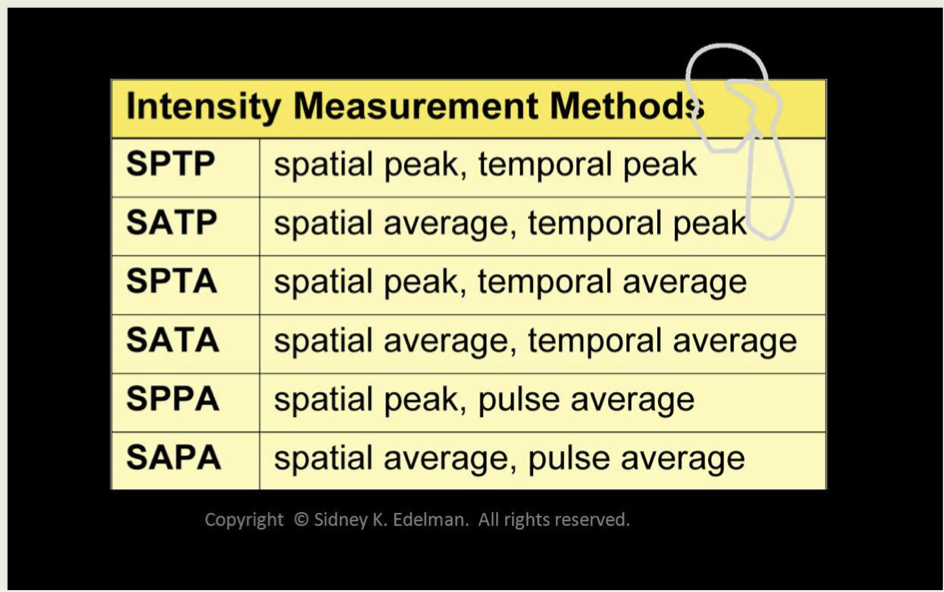
SPTA
_____ is always greater than _____
peak, average
What has the lowerst value ?
SATA
Intensities reported in various ways with respect to
time and space
__ are important when studying bioeffects
Intensities, (SPTA most relevant)
3rd commandment Edelman
Units for ALL intensities w/cm2
__ has highest value
SPTP (peaks are higher then averages)
The beam uniformity coefficient (SP/SA factor) describes the…
spread of beam in space- it is unitless with a value greater than 1.
Duty factor describes
relationship of beam intensity with time- unitless between 0 and 1
Continuous wave- beam is always on so…
pulse average and temporal average are the same. SPTA=SPPA and SATA=SAPA
When pulsed and continuous have the same SPTP intensities,
the continuous wave will have the higher SPTA intensity (b/c continuous wave is always on)
Temporal peak intensity is
max intensity in time
Spatial peak intensity (Isp) is the
maximum in space
Im intensity is averaged….
over the most intense half-cycle
Temporal average intensity (Ita) is averaged…
during PRP (both on and off time)
Spatial average intensity (Isa) is averaged…
is averaged over the cross-sectional area of the beam
Intensity Measurements table
k
intensity (concentration of energy) =
power/beam area (W/cm²) OR (mW/cm²)
Highest to lowest values : Ipa, Imax, Itp, Ita
Itp, Imax, Ipa, Ita
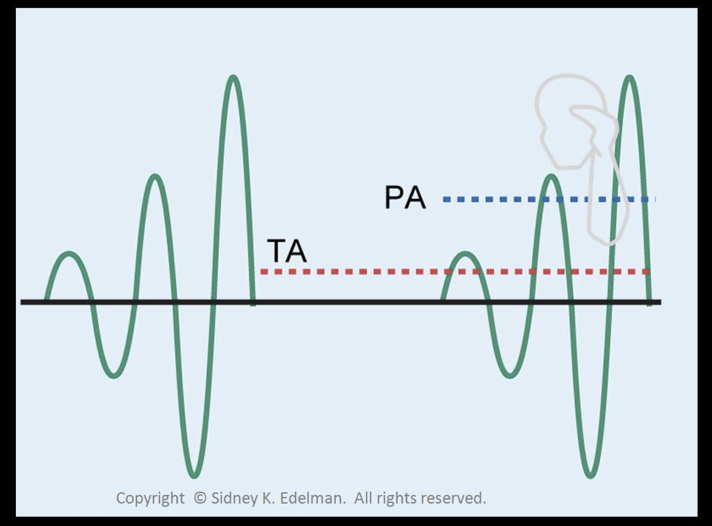
Average intensities
Pulse average intensity (blue line) measured during the transmit time only
Temporal average (red line) is measure during both the transmit and receive times
Diagnostic medical imaging relies on this physical principle:
As an ultrasound wave moves through human anatomy, small echoes return from the boundaries between different mediums.
Behavior of sound
waves move from one medium to another and can change
directions
As sound hits different tissue types and reflect back to the transducer, the signal is then strengthened or AMPLIFIED to be processed and displayed clearly.
• Reflections are created at boundaries between two media (tissue types) which create images
Attenuation & Amplification
• Attenuation- The decrease in the bigness of a sound as it travels (further/deeper = more attenuation)
• Not ALL sound attenuates - some is reflected back to the transducer
• reflected signals are weak and must be AMPLIFIED
• amplified signals become an image
How do we measure the degree of attenuation or amplification
• Need a beginning and ending intensity to calculate the change
• Decibel notation- way to express changes in sound intensity or power (logarithmic scale - the basis of decibel notation)
Logarithms
• How many times do I need to multiply a number to get another number??
• Example: log10(100)
• 10 x 10
• Log10(100) = 2
• So, a logarithmic increase of 2 means that the signal is 100 times larger.
Logarithms
• Log of 100 is 2
• Log of 1000 is 3
• Log of 10,000 is 4
Decibels
strength of the sound beam created by transducers
Decibel notation measures relative change and requires two intensities:
1) reference or starting intensity
2) actual intensity at time of measurement
dB equation


dB=10xlog10of(100)
log10(100)=2
10×2=20dB
Decibels - Typical values
• When signal strength doubles = 3 dB
• When signal strength is cut in half = -3 dB
• When signal strength increases 10 times = 10 dB
• When signal strength reduced one tenth = -10 dB

intensity was cut in half: dB=-3dB
Decibel Shortcuts - Memorize!

Attenuation will result in
a negative value because the wave is a WEAKENING as it travels
REMEMBER: attenuation and speed are
NOT related
What determines attenuation?
1. The distance traveled/path length
2. The frequency of sound
Attenuation and distance
Directly related:
• MORE distance = MORE attenuation
• Less distance = less attenuation
Attenuation and Frequency
Directly related:
GREATER frequency = GREATER attenuation (less penetration)
• Lower frequency = less attenuation (better penetration)
Sound is attenuated in 3 ways:
1. Reflection
2. Scattering
3. Absorption
Reflection
• Reflection occurs when sound strikes a boundary between two mediums, a portion of the wave may be reflected back toward the sound source.
• The beam weakens as energy is reflected back to the source, hence the need for amplification (the reflection reduced the strength of the propagating sound wave)
What is the basis for ultrasonic imaging ?
reflection
Reflection in soft tissue depends on
the tissue interface that it strikes
• Two types of reflection:
1. Specular reflection
2. Diffuse reflection also called backscatter
Specular Reflection
When sound hits a smooth boundary, it reflects in only one direction, in an organized manner
angle of incidence is equal to the angle of reflection
Sound that strikes a boundary at a 90 degree angle will
reflect back to the transducer
• Sound that strikes at other angles will not reflect back to the
transducer
Specular reflectors cause
strong echos that are easily detected by the sound source.
• Why?? Because if the beam is perpendicular, the echo comes straight back to the source

Diffuse Reflection
• Reflection that results from sound hitting an irregular surface
• Most surfaces in the body are not completely smooth and reflected sound
waves will travel in various directions.
• Only some of the reflected sound will return to the source
• The rest will propagate out into the tissue

Diffuse Reflection advantage :
allows for reflections from suboptimal angle
Diffuse reflection disadvantage:
Backscatter produces lower strength signals than specular reflectors
Scattering
• when tissue interface is small (same or less than the wavelength of the incident sound beam)
• Think chaos and disorganized
Rayleigh Scattering
• Occurs when the structure is MUCH smaller than the beams wavelength.
redirects the sound wave equally in all directions
Rayleigh Scattering and frequency relationship
directly related:

If you increase the frequency by a factor of 2 what will be your total of Rayleigh scattering?
16 (2^4)
What is the primary cause of attenuation in soft tissue ?
absorption
Absorption
• Ultrasound energy is converted to another form of energy (usually heat)
• Absorption does not give us any diagnostic information.
Absorption and frequency
• Directly related to frequency
• Higher frequency absorb a lot and scatter a lot causing POOR PENETRATION
• Slightly increasing frequency can cause a great increase in absorption
More absorption=
• less imaging depth due to less penetration and higher risk of bioeffects
Media and attenuation
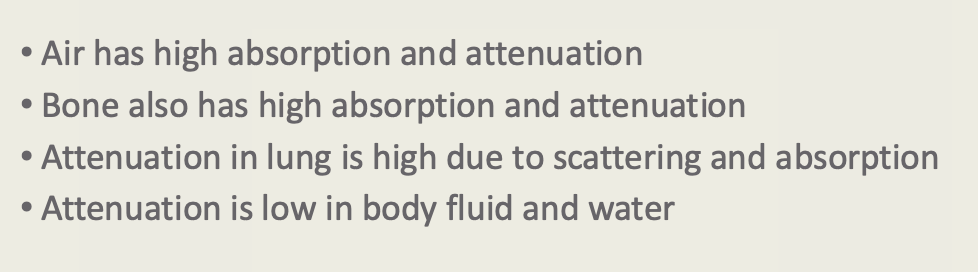
Attenuation Coefficient
• the number of decibels of attenuation that occurs when sound travels one centimeter (dB/cm)
• value is constant regardless of distance sound wave travels
Total attenuation equation

Attenuation coefficient example:
AC= 2 dB/cm, find total attenuation at 5cm depth.
2×1=10 dB/cm
Attenuation Coefficient in soft tissue
Or you can say…. .5dB/cm per MHz

Example of Total attenuation in soft tissue: • In soft tissue what is the attenuation of a beam that travels 10cm with a 5MHz transducer?
• Total attenuation= attenuation coefficient x distance x frequency
• Attenuation coefficient in soft tissue = .5 dB/cm-MHz
• Distance=10 cm
• Frequency = 5 MHZ
• Total atten= .5 db/cm-MHz x 5 MHz x 10 cm
• 25 dB of attenuation (or -25dB)
Attenuation in other media (low to high)

Half Value Layer Thickness
The distance sound travels in a soft tissue that to reduce the sound to half it’s original strength
OR
The distance required for -3dB attenuation
Half Value Layer Thickness
• Units: of length/distance (cm)- how far does the sound have to travel?
• Typical values: .25 to 1.0 cm
• Synonyms: Penetration depth, Depth of penetration, Half boundary layer
• 3dB rule
HVL (cm)= 3dB/atten coeff.
Half Value Layer • Dependent on 2 factors:
1. Tissue (medium)
2. Frequency
Half Value Layer and tissue (medium)
•greater attenuation of tissue = less distance sound needs to travel to decrease by 1/2
• Low attenuation in fluids → sound can travel further in fluids than bone before it is reduced to ½ its intensity.
Half Value Layer and Frequency
• When the frequency is higher, the HVL will be smaller
• When frequency is lower, the HVL will be larger
• The higher the frequency the shorter the distance before the intensity is (bc the higher the frequency the greater the attenuation happens faster)
Reflection and Transmission
• Reflection-redirection of sound to the transducer to create an image
• Transmission- the portion of the wave that continues on into the tissue
What determines how much sound will reflect and how much sound with transmit?
Impedance
Impedance
the acoustic resistance to sound traveling in a medium
• Calculated not measured
• Units: rayls (z)
• Determined by: the medium
• Values: 1,250,000- 1,750,000 rayls (or 1.25-1.75 Mrayls)
• AKA: characteristic impedance
Reflections depend on….
the difference of acoustic impedance between two mediums
• The greater the difference, the greater the reflection
• If the media have identical acoustic impedance there WILL NOT BE A REFLECTION
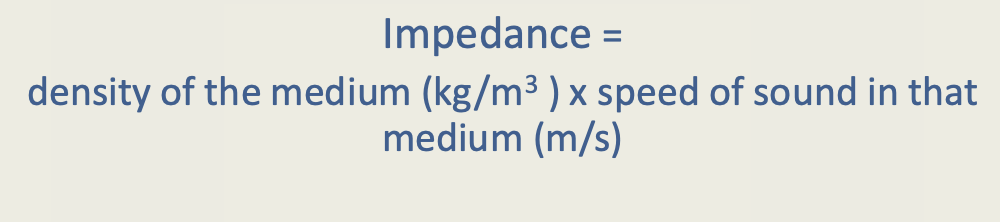
Impedance equation
Angle of Incidence
• The angle at which the wave strikes the boundary or interface
• This determines the behavior of the pulse
Oblique angles
ANY angle that is not 90 degrees.
• acute and obtuse angles are oblique
Incident angles Normal incidence (include synonyms)
Sound beam strikes boundary at exactly 90 degrees
• MUST = 90 degrees
• Synonyms: Perpendicular, Orthogonal, Right angle, 90 degrees

Incident Angles • Oblique Incidence
• Sound beam strikes boundary at an angle other than 90 degrees
Must NOT equal 90 degrees
• Synonyms: Not at right angles, Non-perpendicular

Incident Intensity
the soundwave’s intensity the instant before it strikes a boundary
reflected intensity + transmitted intensity

• More reflection (greater percentage) occurs between
two very different media like soft tissue and bone
• A smaller percentage is transmitted between
two very different media like soft tissue and bone
• Most of a sound’s intensity keeps going and is transmitted at a boundary between two soft tissues (99% or more)
As sound strikes a boundary, energy is conserved, so 100% of the intensity must be accounted for in some way. We know that some transmits and continues on, and some reflects back the way it came.
100%= IRC (%)+ ITC (%)
Reflection with normal incidence
reflection can only occur if the media on either side of the boundary have different impedances
No reflection will occur if the two media have
identical impedances
Small reflection occurs if the impedances are
slightly different
Large reflections occur if the impedances are
VERY different
Transmission with Normal Incidence
the percentage of transmission that continues forward when a beam reaches a boundary between two media.
• Value: 0-100%
• Equals 1- intensity reflection coefficient
• In clinical imaging less than 1% of the incident sound beam is reflected at a soft tissue-soft tissue interface. This leaves 99% of the intensity transmitted at the same boundary.
Reflection and Transmission of oblique
incidences
• Literally unpredictable what the sound will do at a boundary with an oblique
incidence
• With oblique incidences, even two media with the same impedances can produce a reflection AND
• Even when there are differences in impedance, with oblique incidences sometimes there may be no reflection at all.
These two principles always apply to reflection of oblique incidences
1.Conservation of energy (all energy must be accounted for)
2. Reflection angle = incidence angle (think of looking in a mirror)

Conservation of Energy

Reflection angle= incidence angle
• When the reflection occurs with oblique incidence, the sound beam is not redirected back the way it came, rather it reflects in a different direction that is equal and opposite to the direction of the incident beam
Refraction
transmission with bending of the beam)
(think of pencil in water)
• Two conditions MUST be satisfied for refraction to occur:
1. Oblique incidence (CANNOT BE NORMAL)
AND
2. Different propagation speeds of the two media
When do we see refraction in ultrasound?
Sound beams will bend just a few degrees in media that are similar
• Examples:
• Tissue/fat
• Muscle/blood
• Soft tissue/fluid
• The bending will be more pronounced at bone/soft tissue due to the significant difference in media

every angle has
an associated sine (unitless number between 0 and 1)
• Snell’s Law quantifies the physics of refraction
Equal transmission angle and incident angles
• If one of the two conditions are not met:
• If the two media have identical propagation speeds, refraction cannot occur
• If the angle is not oblique, refraction cannot occur

Transmission angle greater than incidence angle

Transmission angle less than incident angle

Important table #1
