Peasants, Zamindars, and The State
 Call Kai
 Learn
Learn Practice Test
 Spaced Repetition
 Match
Match Flashcards
 Knowt Play
1/19

Earn XP
Description and Tags
1500s to 1600s CE
Name | Mastery | Learn | Test | Matching | Spaced | Call with Kai | Chat |
|---|
No analytics yet
Send a link to your students to track their progress
20 Terms
Delhi Sultanate ruled
From 1206 till 1526
5 dynasties ruled
Mamluk (Slave) Dynasty: 1206 - 1290
Khilji Dynasty: 1290 - 1320
Tughlaq Dynasty: 1320 - 1413
Sayyid Dynasty: 1414 - 1451
Lodi dynasty: 1451 - 1526
Last sultan: Ibrahim Lodi (1517–1526)
Babur & establishing the Mughal empire
From Fergana Valley, Uzbekistan
He formed a partnership with Safavid emperor: 1511
Daulat Khan Lodi and Alam Khan both negotiated with Babur and he captured Lahore: 1524
Babur didn’t fulfill his ends of the deal, giving back power to the Lodis, and every group was now fragmented.
Babur launched a full-scale invasion of northern India, and won with Ibrahim dead(1st Battle of Panipat, Haryana): 20 April 1526
He won because of his innovative tactics and superior cavalry.
Mughal Empire and its first 6 rulers
1526 till 1857
Babur: 1526 - 1530
Humayun: 1530 - 1540 & 1555 - 1556
overthrown by his rival Sher Shah Suri
Regained empire after the death of Islam Shah Suri, the son of Sher Shah Suri
Akbar: 1556 - 1605
Jehangir: 1605 - 1627
Shan Jahan: 1628 - 1658
Aurangzeb: 1658 - 1707

Mughal population & taxation
15% Urban
85% Rural: Major source of taxation
Agriculture
Artisanal Activity
Forest produce & tribes
Safavid
Iran/Persia
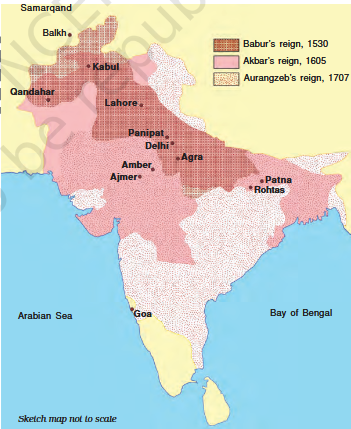
Main map
Babur’s reign, 1526 - 1530
Kabul
Qandahar
Lahore
Panipat
Delhi
Agra
Akbar’s reign, 1556 - 1605(Additions)
Amber
Ajmer
Patna
Rohtas
Bombay
Bengal
Aurangzeb’s reign, 1658 - 1707
Mysore
Madras
Rural society: overview
85% of the total population lived in villages
Both peasants and Landed elites were involved in agricultural production
Created cooperation, competition and conflict among them
Mughal state derived most of its revenue from agricultural production
Agents of the state were put to control rural society and make sure the the state got its regular share of taxes
Revenue assessors
Collectors
Record keepers
These crops were grown for sale, hence linking agrarian society and economy with towns and the state

Fig 8.1
A rural scene
Dated 1600s
A Mughal painting
Agrarian society: Settled peasant production
The basic unit is the village
Peasants did the tasks that produced raw material
Tilling the soil
Sowing the seeds
Harvesting the crop when it was ripe
Also worked to produce and process agro-based goods, such as sugar and oil

Agrarian society: Topography(mapping of surface features)
Large zones of dry land or hilly regions
Not as fertile as other tracts of land
Substantial amount territory was made up of forest areas

Sources used to understand the Mughal empire(16-17cent.)
Major sources are the chronicles and documents from the Mughal court
Ain-i-Akbari by Akbar’s court historian, Abu’l Fazl
Its central purpose was to link social harmony and peace with the presence of a strong ruling class
To supplement and cross-check
Contemporary sources from regions away from the Mughal empire
Detailed revenue records from Gujarat, Maharashtra and Rajasthan(17-18cent)
Extensive records of the East India Company of agrarian relations in eastern India
The alternative sources provide
Instances of conflict between peasants, zamindars and the state
Insight into peasants’ view and expectation of the state
Ain-i-Akbari
By Akbar’s court historian, Abu’l Fazl
Provided records of the arrangement made by the state to
Ensure cultivation
Enable the collection of revenue by the agencies of the state
Regulate the relationship between the state and rural magnates (Wealthy, influential and powerful leaders), Zamindars
Ain-i-Akbari: Limitations
It central purpose and bias
To provide a vision of Akbar’s empire, that was from the top, or only coming what the ruling class deemed right
Where social harmony was provided by a strong ruling class
This was to discourage or delegitimize any revolt or assertion of autonomous power against the Mughal empire
Terms to denote peasants/Available labour
Indo-persian sources of Mughal period
Raiyat, plural raiya
Muzarian
Kisan
Asami: in Bengal
Sources of 1600s
Khud-kashta: Cultivator on one’s own land
Pahi-kashta: Migrant/non-resident cultivator of another’s land on a contractual basis
Reasons to become pahi-kashta
Out of choice
Terms of revenue in a distant village are more favourable
Out of compusion
Forced by economic distress after a famine
What did a peasant possess?
Average peasant of north India had a pair of bullocks and two ploughs
Regional differences
Gujarat
Peasants who had 6 acres of land were considered rich
Bengal
5 acres was the upper limit of an average asami
10 acres to be considered rich
Cultivation was based on the principle of individual ownership
Peasants were able to buy and sell land the same way any other property(comp. with Bernier’s account)
How do peasants work the land
Asamis ploughed the field
marked the limits of each field
for identification and demarcation
with borders of raised earth/mud, brick and thorn
Thousands of such fields were in a village
Feature that Babur mentions of agrarian society/ Mobility of peasants
In the Babur Nama, his memoirs
Towns and villages populated and depopulated very quickly
The resting places and houses were built using temporary and natural materials
Most crops were grown using the rain as main water source
A well or tank would be build to store water
Building materials, huts were made
Khas-grass, meaning grass, hay, leaves, anything strewn about
Wood
factors for the constant expansion of agriculture
Abundance of land
Available labour
Mobility of peasants