Week 1: Choosing How to Compete
 Call Kai
 Learn
 Practice Test
 Spaced Repetition
 Match
 Flashcards
 Knowt Play
1/54

There's no tags or description
Looks like no tags are added yet.
55 Terms
**Business strategy** (how do we compete in this market? e.g. AH vs Jumbo, Dirk, Lidl)
**Functional strategy** (how does each function support the business strategy? e.g. AH's Bonus card, app, distribution centres)
Sport vs Business competition
Sport competition: about being the BEST competitor; "best" is clearly defined by the rules.
Business competition: about being a DIFFERENT competitor; "best" can't even be defined.
E.g., AH, Dirk & Ekoplaza compete differently because of different choices about how to compete, not better products or size.
Operational Effectiveness vs Strategy
Operational effectiveness (OE): doing the same things better than rivals; competing to be the best; necessary for competitive performance. (e.g., AH faster checkout)
Strategy: doing different things, or the same things differently; competing to be unique; aims for (sustainable) competitive advantage. (e.g., AH premium positioning vs Dirk discount (strategy)).
Prof's point: rivals eventually copy efficient processes, so OE is necessary but NOT enough.
Productivity Frontier (Porter, 1996)
The sum of all existing best practices; the max value a firm can create at a given cost. Improving OE moves a firm toward the frontier.The frontier keeps moving outward with new technologies & management approaches.
OE competition raises the bar for everyone → absolute improvement, but relative improvement for no one.
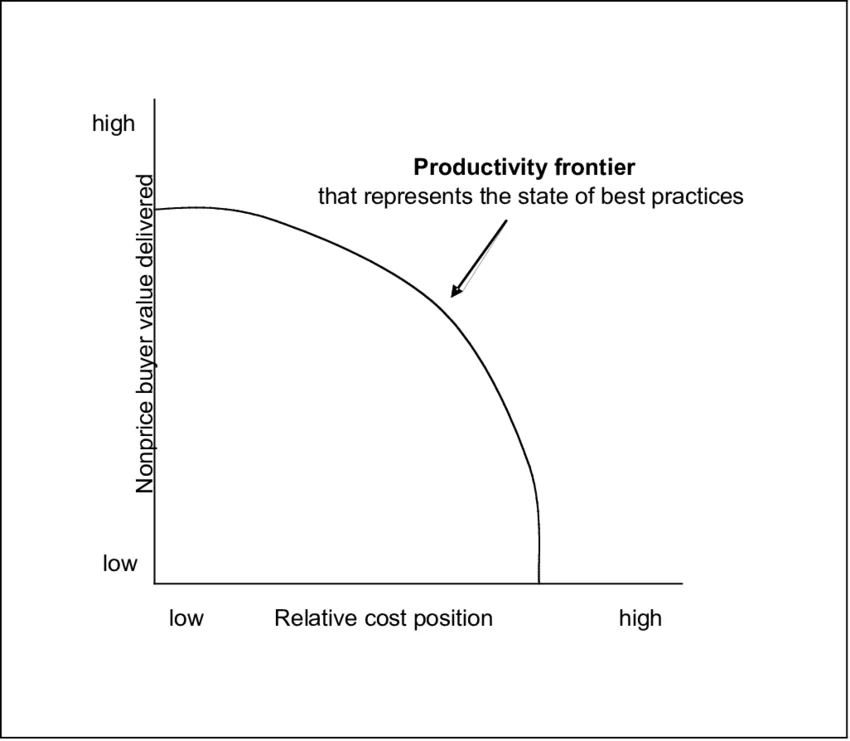
**Competitive convergence** (benchmarking & outsourcing to the same third parties make rivals look alike → races down identical paths no one wins)
Result: zero-sum competition, static or falling prices, pressure on costs.
**Valuable**: customers want what you offer.
**Different activities**: how you deliver that value.
**Unique market position**: different from rivals.
**Key point**: strategy isn't just SAYING you're different; it's DOING different activities than competitors.
**So**: your value must stay different from rivals over time, not just at one moment.
**The challenge**: create value in a way that can't be imitated away.
**Exchange value**: the price; monetary amount realized at a single point in time when the exchange takes place.
**Rule**: exchange value is only realized for the firm if an exchange (sale) actually happens.
**Rule**: customers select the product that gives them the greatest consumer surplus.
**Bargain**: use value far higher than the price → big consumer surplus.
**Prof's point**: "customer first" really means maximizing the consumer surplus you create.
**Theme parks**: price = ticket + travel; Efteling biggest surplus (WTP €100 – €70 = €30).
**Europa-Park**: €190 > WTP €130 → no purchase.
**Key point**: surplus is relative; for a student in Paris the answer flips.
**Rule**: firms create economic returns by creating AND capturing value.
**Prof's point**: not just about maximizing profit; at minimum a firm (even an NGO) must cover its costs to keep creating value.
**Rule**: successful value capture depends on the existence of isolating mechanisms.
**Prof's point**: they let real firms sit between monopoly (max capture) and perfect competition (zero profit) and price above cost.
**Switching costs** (customer: loyalty programs, habit, learning costs; supplier: relationship-specific investments, contracts)
**Bargaining relationships** (brand strength & differentiation reduce buyer power; scale & integration reduce supplier power)
**OpenAI**: ≈ $2.5 bn cash burned in H1 2025 on ≈ $4.3 bn revenue.
**Users**: 800 m+ weekly users; most pay $0.
**Why Nvidia captures it**: hard to imitate (chips + decades of R&D), switching costs (CUDA software developers know), bargaining power (few alternative suppliers).
**Prof's point**: customers can easily switch from OpenAI to rivals or open models, so OpenAI's value capture is in doubt.
**Which customers?**: end-users, channels.
**Which needs?**: products, features, services.
**What relative price?**: premium or discount.
**Prof's point**: for any business ask "what's the value proposition?" AND "how defensible is it?"
**Too Good To Go** (bargain hunters who hate food waste; good cheap food, less waste; ≈ 1/3 of normal price)
**Wikipedia** (anyone with internet; free, ad-free knowledge; free, funded by donations)
**Primary activities**: inbound logistics, operations, outbound logistics, marketing & sales (create the product & bring it to the customer).
**Support activities**: firm infrastructure, HRM, technology development, procurement (make the primary activities possible).
**Porter (1996)**: activities are the basic units of competitive advantage.
**Cost leadership**: lower cost → lower price; surplus rises without raising use value.
**Key point**: the two routes optimize different parts of the value chain (different activity drivers).
Porter's 4 Generic Strategies
Source of advantage (low cost vs differentiation) × scope (total market vs niche): Cost leadership (low cost, total market) Differentiation (differentiation, total market) Cost focus (low cost, niche) Differentiation focus (differentiation, niche)

**Prof's point**: generic strategies are "summaries of activity systems"; they drive everyday choices like who you hire and how stores are set up.
**Porter (1996)**: they characterize positions at the simplest & broadest level.
**Albert Heijn** (differentiation; broad mainstream market; prime locations, fresh range, Bonus card; trade-off: higher prices)
**Ekoplaza** (differentiation focus; health- & sustainability-minded shoppers; organic range, specialised suppliers; trade-off: higher prices, smaller customer base)
**Note**: Dirk & AH both target the whole market; they differ on source, not scope.
**Rule**: activities must fit each other AND their environment.
**Effect**: fit substantially reduces cost or increases differentiation; it grows out of the entire integrated system.
**Prof's point**: a world-class HR department that hires the wrong people for the strategy doesn't help at all.
**Second-order fit** (activities reinforce each other; one activity raises another's value or lowers its cost)
**Third-order fit** (beyond reinforcement → "optimization of effort": coordination & info exchange to eliminate redundancy and wasted effort)
**Math**: probabilities compound (.9 × .9 = .81; .9⁴ = .66).
**Rule**: more second- & third-order fit → more sustainable advantage.
**Effect**: imitating only some activities gains rivals little; fit makes a chain "as strong as its strongest link."
Activity-System Maps (Porter, 1996)
Maps showing how a firm's strategic position is contained in a set of tailored activities.
higher-order strategic themes implemented through clusters of tightly linked activities.
Use: check consistency, strengthen reinforcement, and find activities that could eliminate others.
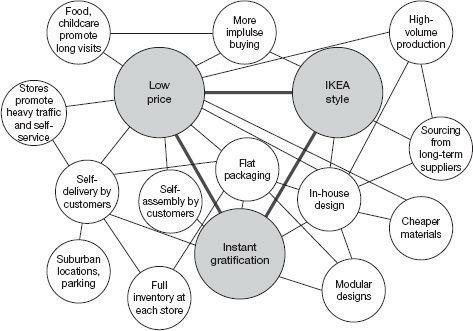
**Choice**: choose among market positions and their associated activities.
**Best strategy**: valuable for customers AND uniquely differentiates you from competitors.
**Prof's point**: not the highest peak at one moment, but a high peak you can hold long; no single best strategy.
**Closed**: OpenAI = mass-market assistant; Gemini = built into Search & Android; Anthropic = business & coding.
**Open**: Meta = free AI in WhatsApp & Instagram; DeepSeek = low-cost & open; Mistral = European & open.
**Key point**: different peaks, different ways to win.
Stuck in the Middle
Pursuing cost leadership AND differentiation at once often → inferior performance, unless the activities still fit, different strategies need different activity configurations; can't optimize for both; organizational confusion about priorities.
Prof's point: a low-cost activity system can hardly fund the R&D & innovation differentiation needs.
**Source**: doing unique things or similar things in a unique way; if everyone does the same, prices & costs end up the same.
**Challenge**: how to sustain it over time.
**Prof's point**: the ability to provide value over time without getting imitated.
**Differentiation advantage** (unique activity system & value chain creating SUPERIOR value customers will pay for)
**Tailored value chain** (activities set up differently from rivals'?)
**Trade-offs** (what do you deliberately not do?)
**Fit across the value chain** (do activities reinforce each other?)
**Continuity over time** (do you hold the position long enough to build it?)
**Slides**: a unique position requires trade-offs = deciding what NOT to do; without them a firm ends up stuck in the middle.
**Porter (1996)**: trade-offs create the need for choice and protect against repositioners & straddlers.
**The activities themselves** (different positions need different products, equipment, skills & systems; value destroyed if activities are over- or under-designed)
**Limits on internal coordination & control** (trying to be all things to all customers confuses employees)
**Straddling**: a rival keeps its existing position while grafting on features of a successful one; far more common.
**Risk**: straddling fails when trade-offs exist between the two positions.
False Trade-offs (Porter, 1996)
Apparent cost-vs-quality trade-offs caused by poor OE (wasted effort, poor control, weak coordination). Improving cost AND differentiation at once is only possible far behind the productivity frontier or when it shifts outward.
**Trade-offs**: making trade-offs in competing; choosing what not to do.
**Fit**: creating fit among a company's activities.
3 Sources of Strategic Positions (Porter, 1996)
Variety-based (producing a subset of an industry's products/services with distinctive activities)
Needs-based (serving most or all needs of a particular customer group)
Access-based (segmenting customers reachable in different ways, e.g. geography or scale) Positioning always needs a tailored set of activities (supply-side differences); the sources often overlap.
**Broadly targeted**: serves a wide array of customers by meeting their common needs.
**Key point**: positioning isn't only about a niche; any position can be broad or narrow.
**Causes**: a misguided view of competition, organizational failures, and especially the desire to grow.
**Why firms avoid choosing**: trade-offs feel frightening; herd behavior; mistaking "customer focus" for serving every need.
**Effect**: compromises erode advantage → profits fall → more broadening.
**Fix**: deepen the strategic position rather than broaden & compromise it.
4 Profitable Growth Methods (Porter, 1996)
Deepen: make activities more distinctive, strengthen fit, communicate strategy better.
Extend: offer features rivals find costly to match because of your existing activity system.
Globalization: can grow a focused strategy consistently.
Broadening: if needed, use stand-alone units with their own brand & tailored activities.
**Leader's job**: provide discipline, teach others about strategy, and say no.
**Strategic agenda**: unique position, clear trade-offs, tightening fit; demands discipline & continuity.
**Enemies of strategy**: distraction and compromise.
**Horizon**: strategic positions should last a decade or more, not one planning cycle.
**Values** (what we believe in & how we behave)
**Vision** (what we want to become)
**Strategy** (what we will do to win)
Statements get more concrete, practical & unique going down; most firms have a mission & values, few can state their strategy (Collis & Rukstad, 2008).
Statement Hierarchy: Slides vs Article (Trap!)
Slides: 4 levels; mission, values, vision, strategy.
Article: adds a 5th level, the balanced scorecard (how we monitor & implement the plan).
**Scope** (the domain: which customers & offering, which locations, how much of the value chain)
**Advantage** (the means: why customers choose you; the value proposition & the activities that deliver it)
Rule of thumb: about 35 words every employee can repeat (Collis & Rukstad, 2008).
**Not**: the mission, values or vision; firms in the same business often share those, but rarely an objective.
**Values**: govern how to behave ("doing things right"), not what the firm should do.
**Key point**: must choose, e.g. growth OR profitability.
Defining the Scope (Collis & Rukstad, 2008)
3 dimensions: customer or offering, geographic location, vertical integration.
You should state where the firm will NOT go, within the bounds it still encourages experimentation & initiative.
Defining the Advantage (Collis & Rukstad, 2008)
Importance: the most critical part of the statement, since sustainable competitive advantage is the essence of strategy.
External part: customer value proposition (why customers should buy from you).
Internal part: the unique activities or combination of activities that let only your firm deliver it.
**Effect**: aligns behavior so individual choices reinforce each other.
**Benefits**: formulation gets easier; implementation simpler since the strategy is easily communicated & internalized.
**Elements**: customers' needs, competitors' offerings, company's capabilities, and context (technology, industry demographics, regulation).
**Involve**: employees at all levels; debate the wording word by word.
**Attach**: annotations, the value proposition chart & activity-system map; cascade it level by level.
**Rule**: a strategy works when every link hol