Anatomy II: Smell, Taste, Ear
 Call Kai
 Learn
 Practice Test
 Spaced Repetition
 Match
 Flashcards
 Knowt Play
1/24

There's no tags or description
Looks like no tags are added yet.
25 Terms
Where are the Senses of the ear housed in the brain?
Hearing = auditory cortex of the temporal lobe
Equilibrium = in the cerebellum
Mechanoreceptors = receptors in the ear
Sections of the Ear
Outer
Middle Ear (ossicles)
Inner ear (labyrinth and equilibrium)
Eustacian Tube
Connects the middle ear to the throat
Allows for equalizing pressure during yawning or swallowing (otherwise collapsed)
Middle ear
3 ossicles (malleus, incus, stapes)
Oval Window: Cochlea (sound enters)
Round Window: Pressre release in the cochlea
Vibration Effect on the Inner ear
The stapes vibrates from the tympanic membrane and it pushes and pulls on the oval window
This results in the movement of the perilymph in the oval window
Organ of Corti
In the cochlea
Inner Stereocilia: Goes to the Brain
Outer Stereocilia: Controls amplification
Properties of Sound
Range of Human Hearing: 20-20,000 Hz
Intensity: Amplitude of Height
Decibels: Loudness
Hz: Frequency of the sound
Equilibrium
Static Equilibrium: In the vestibule
Dynamic equilibrium: In the semicircular canals
Static Equilibrium/vestibule
Maculae - Receptors in the vestibule
Body Position
Linear movement
Sends information to the vestibular nerve
Houses the otolith organs: utricle (horizontal movement) and the saccule (vertical movement)
Maculae
hair cells are in the otolithic membrane
Otolith - stones floating in the gel around hair cells
Movement: Otolith bend the hair cells (gravity moves the rocks over the hair cells)
Dynamic Equilibrium
WHOLE structure is the ampulla
Crista Ampullaris - receptors in the semicircular canals
Cupula = gel cup that covers the hair cells in the semicircular canals
Cupula
Cupula = stimulate the hair cells
Movement of the endolymph pushes the cupula over and pulls the hairs
An impulse is sent to the brain
Homeostatic Imbalance
Motion Sickness
Sensory inputs are mismatched
Visual input is different from equilibrium input
Conflicting information
Hearing Loss
Conduction Deafness
Blocked because of fluid in the ear
Sensorineural Deafness
Damage to the auditory hair cells
Central Hearing Loss
Damage in the brain but ears are fine
Tinnitus
Ringing, buzzing, clicking, in the absense of auditory stimulation
Chemical Taste
Chemoreceptors
5 Types
Sense of taste and smell complement each and are made of the same stimuli
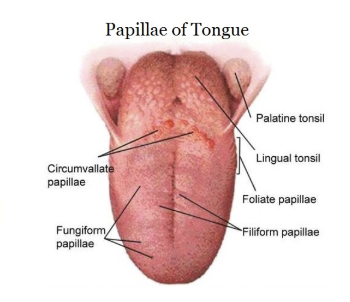
Anatomy of the Tongue
Taste buds are covered with papillae
Filliform = No taste buds
Taste Buds
20,000 - 10,000 on tongue
Made of epithelial cells
Taste receptors cells = on taste buds and are also gustatory cells
Microvili are bathed in saliva = the receptor cels react to the dissolved molecules and generate impulses in sensory nerve fibers of the brain
Where are impulses carried in tongue
To the parietal lobes by three different craniel nerves
Taste Recepetors
Sweet
Sour
Bitter
Salty
Umami
What do we use our sense of smell for besides food
Chemical detection without the danger of ingesting poisen
Object identification
Sexual signaling
Smell Sensory
Olfactory receptors are in the roof in the nasal
Neurons with long cilia
Chemicals must be dissolved in the mucus for detection
Olfaction Transmitted
Olfactory area of temporal lobe
Transmitted via in the olfactory nerve
Anosmia
Absense of sense of smell
Trauma
Colds of allergies
Blockage