Wildlife Forensics & Spatial Analysis
 Call Kai
 Learn
 Practice Test
 Spaced Repetition
 Match
 Flashcards
 Knowt Play
1/96

Earn XP
Description and Tags
Comprehensive practice flashcards covering wildlife forensics, sign and track analysis, hair morphology, dental aging criteria, chemical immobilization, and radio telemetry concepts.
97 Terms
Forensics
Analyzing physical evidence to determine presence/absence of different species/behaviors/demographics
Indices of Presence
Physical evidence or field signs confirming an animal's occurrence in an area, including nests, dens, beds, scratches, caches, feathers, tracks, scats, hair, and auditory calls.
Bear scat
Largest, lots of seeds

Rabbit scat
Smaller, often contains grass and plant material, pellets; like deer

Deer scat
Large pellets often dark brown or black, usually found in groups; indicative of herbivorous diet.

Bobcat scat
Line of balls, rounded and clump sections

Coyote scat
Like dog, long and tapered at the end

Hare scat
Small, round pellets; larger and more flattened than rabbit
Fox scat
Like coyote but smaller and even more tapered at the end, crinkle fingers

Skunk scat
Smooth and seal-like

Opossum scat
Similar to turkey; single piece with little holes

Turkey scat
Looks like opossum, think sea sponge fossil or crinoid fossil

Mouse scat
Small, cylindrical pellets with pointed ends.

Cache
A hidden or buried food cache left behind by wildlife that serves as an index of presence.
Auditory Data
Recorded or observed wildlife vocalizations and species-specific calls used to confirm animal presence.
Diagonal Gait (Perfect Walkers)
An energy-conserving walking gait where the rear foot lands directly in the print of the front foot, leaving a clean zig-zag trail (e.g., deer, moose, fox, coyote, bobcat).

Pace Gait (Waddlers)
A movement pattern where an animal shifts both limbs on one side of the body before the other, producing four distinct prints per cycle in a waddling stride (e.g., bear, raccoon, skunk, beaver, porcupine); front foot next to hind

Bound Gait
A movement pattern in which the front feet touch down and the rear feet land together in the exact spot previously occupied by the front paws, leaving paired sets of side-by-side tracks (e.g., otters, weasels); hind behindf ront

Gallop Gait
A leapfrog motion where the rear feet push off ahead of the front feet, creating clustered print groups that often produce a classic 'Y' configuration in rabbits, rodents, squirrel; rear ahead of front feet, push off

Canine vs. Feline Track Toe Count
A tracking metric where both canines and felines show 4 toes per footprint, contrasting with bears which show 5 toes; feline lack claw
Rodent Footprint Toe Count
A diagnostic track pattern displaying 4 toes on the front paws and 5 toes on the hind paws.
Canine Heel Pad Shape
A concave, diamond-like or triangular pad print allowing an 'X' to be drawn through the negative space between pads without touching pad margins.
Feline Heel Pad Shape
A three-lobed heel pad resembling a bubble-letter 'M' that produces a 'C'-shaped negative space curve between toes and pad.
Determining track species
Stride and straddle
Stride
Measurement of the distance between consecutive footprints of the same foot (front-back), length of track
Straddle
Width of track (inside of one foot to inside of other)
Individual track measurement
width and length (no include claw)
Hair Cuticular Scales
Microscopic, overlapping keratinized scales comprising the outer protective sheath of mammalian hair used in wildlife forensic species identification.

Part of hair that contains DNA
Root, can be caught with barbed wire
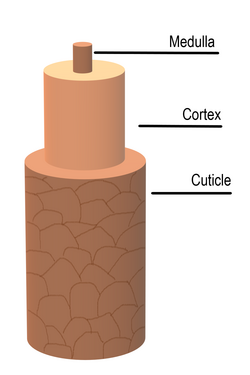
Cuticle
Outside of hair, made up of scales

Cotex
Middle of hair, pigment

Medulla
Inner hair, contains cells and sometimes air
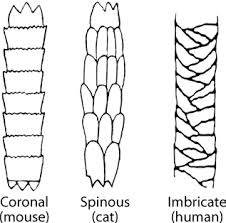
Common hair scale types
Coronal, imbricate, and spinous.
Cornonal scale
Crown-like, lego

Imbricate scale
Flat + overlaps

Spinous scale
Sticks out of shaft, pinecone
Dentate Scale Margin
A cuticular scale edge morphology displaying sharp, tooth-like serrations.
Crenate Scale Margin
A cuticular scale edge characterized by rounded, scalloped, or wavy margins.
Chevron Scale Pattern
A cuticular scale pattern displaying V-shaped zigzag bands across the hair shaft, organized into single or double chevrons.
Mosaic Scale Pattern
A cuticular scale pattern characterized by interlocking tile-like or cobblestone arrangements, classified as regular or flattened irregular.
Scale Margin Spacing Categories
The relative distance between adjacent hair cuticular scale margins, classified as distant, near, or close.
Average White-Tailed Deer Population Age
The typical demographic age of hunted deer populations, which averages less than 221years.
Fawn
6 month old deer
Yearling
18 month old deer
Adult deer
<18 (since born in june, could be 30 minutes, 42 months, +12, etc)
Antler Size Limitation for Aging
The principle that antler dimensions and point counts are influenced by nutrition and genetics, making them inaccurate indicators of buck age.
Deciduous Dentition
The initial set of juvenile 'baby' teeth that erupt early and are shed at predetermined developmental stages (6 month loose front teeth, 18 month have full grown teeth)
Incisors
Front teeth of deer, followed by diasterna
Premolars
Middle teeth
Molars
Last 3 teeth of deer (

Diastema
The pronounced toothless gap in the jaw between the front incisors and the rear cheek teeth.
Lingual Side of tooth
The inner anatomical surface of a tooth facing toward the tongue.
Buccal (Labial) Side of tooth
The outer anatomical surface of a cheek tooth facing toward the cheek or lips. (cheek side)
Tooth Enamel
The hard, outer white calcified mineral layer covering the crown and cusps of teeth, wears down as it ages

Dentin (Dentine)
The dark, softer inner core of the tooth exposed on the grinding surface as the outer enamel wears down; amount of dark exposed by enamel can be used to determine age (more dark, more older)
Crest (Tooth Anatomy)
The elevated, pointed peak or cutting ridge located along a deer cheek tooth.
Cusp (Tooth Anatomy)
The primary rounded or pointed grinding unit or crown projection on a premolar or molar tooth.

Lingual Crests
The sharp row of pointed ridges on the lower jaw cheek teeth facing the tongue side.
Infundibulum
The crescent-shaped central enamel depression or well located on the occlusal grinding surface of deer cheek teeth.
Cementum Annuli Method
The most precise method of aging deer, performed by cross-sectioning the tooth root and enumerating annual microscopic growth rings.
Tooth Replacement and Wear Technique
The rapid and practical wildlife management method of aging deer jaws by evaluating tooth eruption status and occlusal attrition.
Wolf Teeth in Deer
Rare upper canine teeth occasionally retained into adulthood by older white-tailed deer.
Deer Incisor Replacement Schedule
The developmental timeline where the middle two incisors are replaced at 5–6months of age and the remaining lower incisors are replaced at 10–11months.
Deer Premolars
The first three cheek teeth in the deer jaw; deciduous third premolars possess three cusps before being replaced by two-cusped permanent teeth.
Deer Molars
The last three permanent cheek teeth in the jaw that erupt without deciduous precursors.

Six-Month-Old Deer Dentition
A deer mandible showing only one erupted molar and a tricuspid (three-cusped) deciduous third premolar.

Eighteen-Month-Old (121-Year-Old) Deer Dentition
A deer mandible where the third molar is partially erupted or erupting, and the third premolar possesses either 2 or 3 cusps during shedding.

Two-and-a-Half-Year-Old (221-Year-Old) Deer Dentition
A deer mandible with all permanent molars fully erupted, premolars having two cusps, and lingual crests remaining sharp with slight wear.

Three-and-a-Half-Year-Old (321-Year-Old) Deer Dentition
A deer mandible where lingual crests display moderate wear and the posterior cusp of the third molar is worn flat.
Dietary Influence on Dental Wear
The principle that tooth wear rates vary geographically based on soil composition and coarseness of forage, potentially skewing age estimates.
Fawn (PA Game Commission Definition)
A deer class identified by the complete absence of fully emerged permanent molars.
Yearling (PA Game Commission Definition)
A deer class characterized by the presence of a three-cusped third deciduous premolar in the cheek tooth row.
Reproductive Adult Deer (PA Game Commission Definition)
A deer aged at least 121years whose third premolar exhibits two cusps.

Suspensory Tuberosities
Paired bony projections on the ischial pelvis of male deer aged ≥2.5years providing attachment points for penis ligaments.
Ilio-Pectineal Eminence (IPE)
A pelvic landmark in 1.5year-old deer that is rounded and elevated above the pubis margin in males, but flattened and flush with the edge in females.
American Woodcock Bill Length Sexing
A sexing standard where bill lengths ≤63–66mm classify males (95–100% certainty) and bill lengths ≥71–73mm classify females (95–100% certainty).

American Woodcock Primary Feather Widths
Combined unflattened width of the outer three primary feathers taken 2cm from the tip, measuring ≤12.4mm in males and ≥12.6mm in females.
American Woodcock Inner Secondaries
Wing flight feathers evaluated for terminal band, subterminal bar, and subterminal zone patterning to distinguish adult woodcocks from immatures.

Baculum (Os Penis) Raccoon Aging
The male penile bone evaluated for ossification, weight, and distal tip curvature to separate immature raccoons from fully grown adults.

White-Tailed Deer Fetus Scale
A forensic rule measuring crown-to-rump fetal length to determine days or weeks from conception and projected time until birth.
Parturition Estimation
The back-calculation of an animal's projected delivery date based on harvest date and developmental fetal measurements.
Cap-Chur Syringe
A remote chemical delivery syringe dart equipped with a tailpiece, ejection charge, plunger, medication reservoir, and collared needle.

Dart Ejection Charge
An impact-activated propellant mechanism consisting of a sharpened weight, coil spring, and explosive primer that drives the plunger forward upon striking tissue.
Collared Needle
A projectile injection needle fitted with an exterior ring or barb to hold the syringe in muscle until the chemical payload is expelled.
Pole Syringe (Stick Syringe)
A manual drug administration tool mounted on an elongated rod used for safe intramuscular injection of restrained or caged animals.

Projector Safety Protocol
The safety rule mandating that blowguns and dart rifles must always be handled as firearms, never pointed toward humans, and never discharged when people are near or behind the animal.
Intramuscular Darting Target Sites
Large, thick muscle groups—specifically the shoulder and rear hindquarters—targeted to ensure intramuscular drug absorption while avoiding bone impacts.


Drop-Off Collar
A tracking collar equipped with a biodegradable spacer or expander designed to rot and break away naturally as a growing animal expands.
Motion Detection Collar
A radio transmitter collar equipped with internal motion sensors that alter pulse rates to indicate activity or mortality.
Self-Release Collar
A wildlife telemetry collar incorporating an electronic timed mechanism that uncouples and falls off the animal on a scheduled date.
Terrestrial Mammal Transmitter Weight Rule
The ethical tracking standard specifying that radio transmitters must weigh less than 10% of a terrestrial mammal's body mass.
Bat Transmitter Weight Rule
The tracking payload guideline stating that transmitters must weigh less than 5% of a bat's total body mass.
Triangulation
The spatial procedure of pinpointing an animal's location by taking directional bearings from multiple receiver stations and plotting their point of intersection.

Error Polygon
The geometric area of uncertainty that forms around intersecting telemetry bearing lines due to measurement variation.
VHF (Very High Frequency) Telemetry
A radio tracking system where animal-borne transmitters pulse on dedicated MHz frequencies requiring manual human tracking using directional antennas.
GPS (Global Positioning System) Telemetry
An automated satellite-based telemetry system that logs accurate spatial coordinates directly to an onboard receiver collar.
Signal Bounce (Multipath Error)
A common telemetry problem where radio waves reflect off steep topography or obstacles, misdirecting researchers away from the true transmitter location.