L10 - The Pyruvate Dehydrogenase Complex
 Call Kai
 Learn
Learn Practice Test
 Spaced Repetition
 Match
Match Flashcards
 Knowt Play
1/16

There's no tags or description
Looks like no tags are added yet.
Name | Mastery | Learn | Test | Matching | Spaced | Call with Kai | Chat |
|---|
No analytics yet
Send a link to your students to track their progress
17 Terms
Once pyruvate is generated from glycolysis, it's going to be moved to the matrix of the mitochondria via
a mitochondrial pyruvate carrier to be processed further by the pyruvate dehydrogenase complex
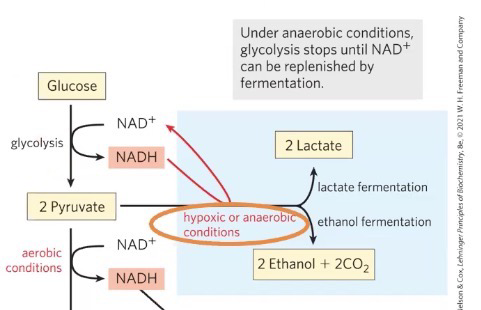
How is pyruvate processed under anaerobic conditions? Why is this necessary?
Under hypoxic/anaerobic conditions, pyruvate accumulates, and there’s a low level of NAD+ necessary to continue glycolysis. Lactate/ethanol fermentation solves this issue by processing pyruvate into lactate or ethanol and CO2, and producing NAD+; this allows glycolysis to continue
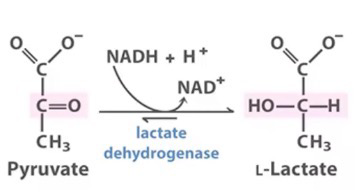
Lactate dehydrogenase
Pyruvate + NADH + H+ → L-Lactate + NAD+; certain parts of the body produces lactase for certain processes
The Warburg Effect
The observation that tumor cells have high rates of glycolysis, with fermentation of glucose to lactate, even in the presence of oxygen - basis of PET scans to diagnose tumors
Pyruvate Dehydrogenase Complex (PDH); Basic information
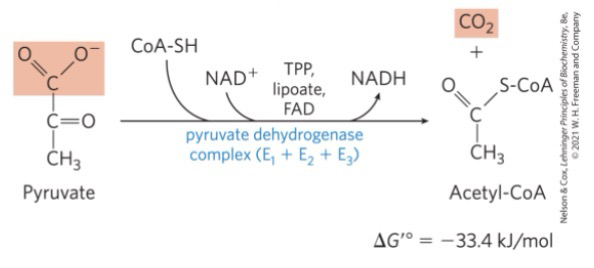
Function: Processes pyruvate into Acetyl-CoA and CO2 (First CO2 releasing process)
Three main enzymes: E1, E2, and E3
Also contains regulatory kinase and phosphatase; Each complex contains several subunits of the E complex; Overall reaction is a large -ΔG
E1 name, function, and cofactor information
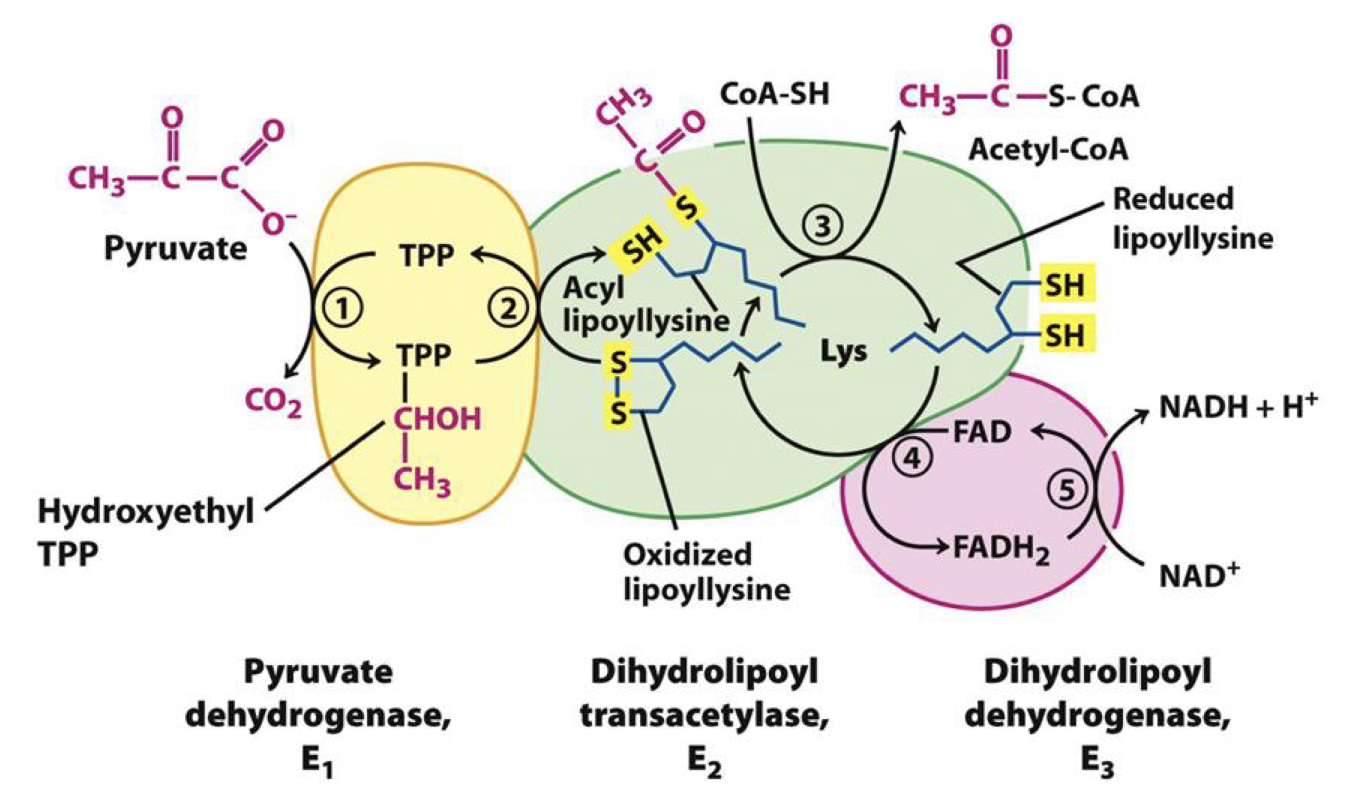
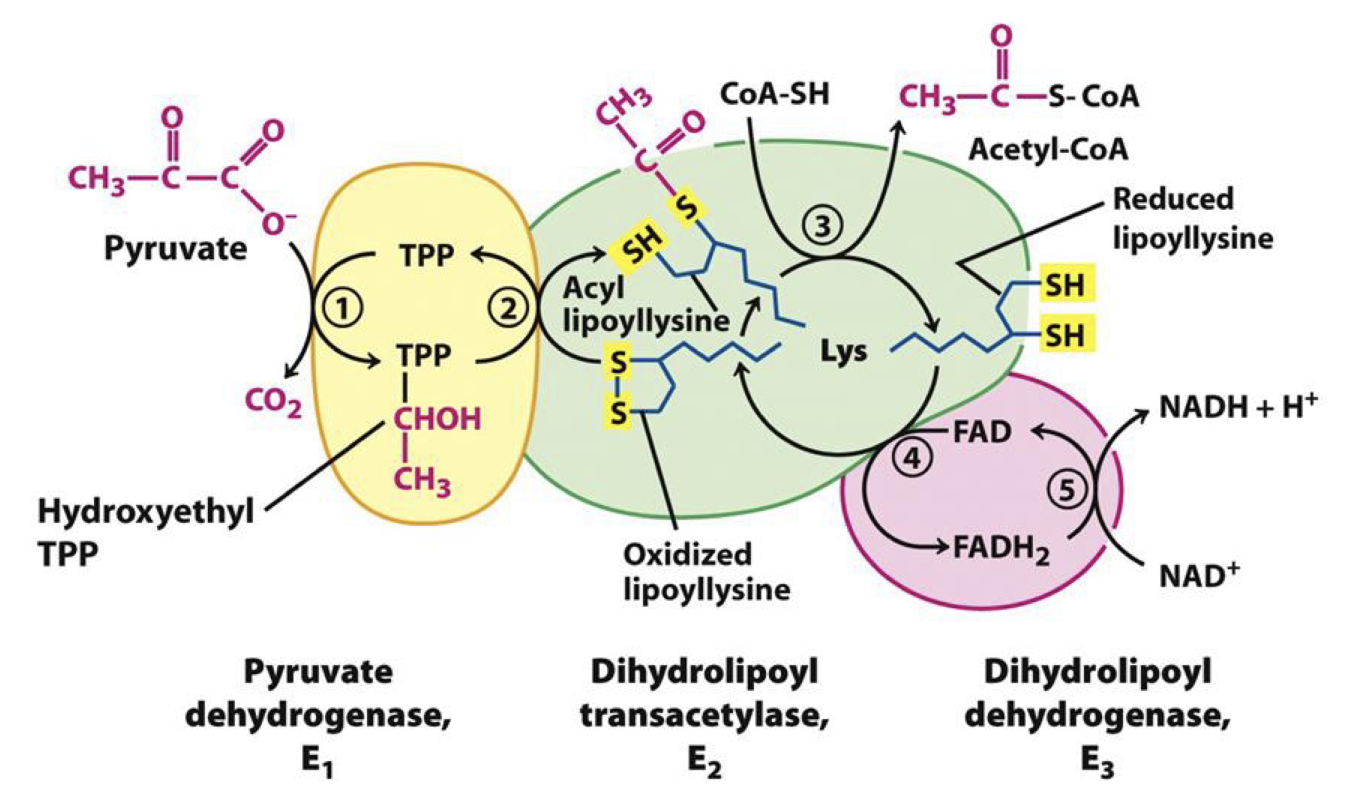
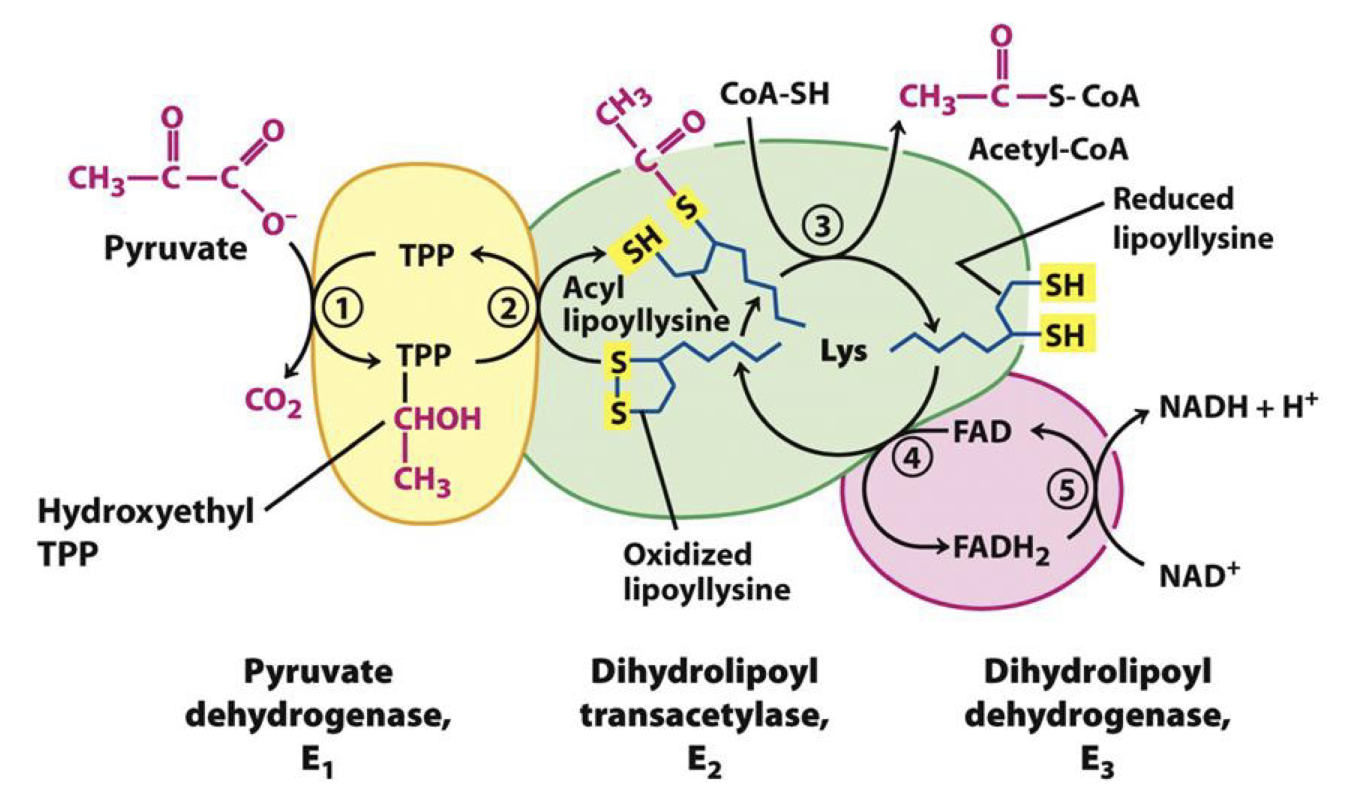
Pyruvate Dehydrogenase: Pyruvate goes through decarboxylation reaction, releasing CO2 and generating Hydroxyethyl TPP
Cofactors - Thiamine pyrophosphate (TPP)
From Thiamine/Vitamin B1; Contains C-H group on thiazolium ring that participates in E reaction
E2 name, function, and cofactor information
Dihydrolipoyl transacetylase: Oxidized lipoyllysine (on E2) takes the hydroxyethyl group from TPP and reduces it to form acyl lipoyllysine (Thiol ester). The acetyl structure is then transferred onto CoA-SH to form Acetyl-CoA. Leaves lipoyllysine in reduced state.
Cofactor - Coenzyme A (CoA-SH) and Lipoic acid (lipoate)
CoA-SH: From pantothenic acid/Vitamin B5; Contains a reactive thiol group (thiazolium ring) that forms a thioester with acetate to produce acetyl-CoA; written as CoA-SH to show it hasn’t yet formed a thioester bond
Lipoate: Provides reactive disulfide that can participate in reaction; Bound to Lys in E2; Oxidized has ring structure → reduced to two disulfide bonds → acetylated in the E2 reaction; Is on the enzyme
E3 name, function, and cofactor information
Dihydrolipoyl dehydrogenase: Reoxidizes lipoyllysine to restore function via FAD. The FADH2 formed is reduced using NAD+, creating NADH + H+
Cofactor - Flavin adenine dinucleotide (FAD) and NAD+
FAD: From Riboflavin/Vitamin B2; B2 is also a precursor to flavin mononucleotide (FMN); FAD and FMN both participate in redox reactions; Tightly bound to enzyme so reduction and oxidation occur in the same spot; Can be reduced twice: FAD → FADH (Semiquinone intermediate) → FADH2
NAD+: From Niacin/nicotinic acid/vitamin B3; Accepts 2H at once: NAD+ → NADH (no intermediate); mobile electron carrier
Inhibitors and Activators of PDH complex
Inhibited by ATP (PDK) and products of enzyme (Acetyl-CoA and NADH)
Activated by AMP (PDP), CoA-SH, and NAD+
NADP+ is phosphorylated form of
NAD+
PDH is located in the
mitochondria
___ inactivates PDH
PDK (Pyruvate dehydrogenase kinase); Regulated by high ATP
___ activates PDH
PDP (Pyruvate dehydrogenase phosphatase); Activated by high AMP
Insulin signalling will ____ PDP
activate
In high glucose concentration, the liver and adipocytes will do what in relation to PDH
High glucose releases insulin that will cause PDP to activate and use up the high blood glucose
PDP is also activated by what from the muscle
Calcium, signals a need for energy which causes acetyl-CoA production
Glucagon does OR does not impact PDH
DOES NOT