criminal law - exam 5
 Call Kai
 Learn
 Practice Test
 Spaced Repetition
 Match
 Flashcards
 Knowt Play
1/54

Earn XP
Description and Tags
CJUS345
55 Terms
LA RS 1st degree murder §30
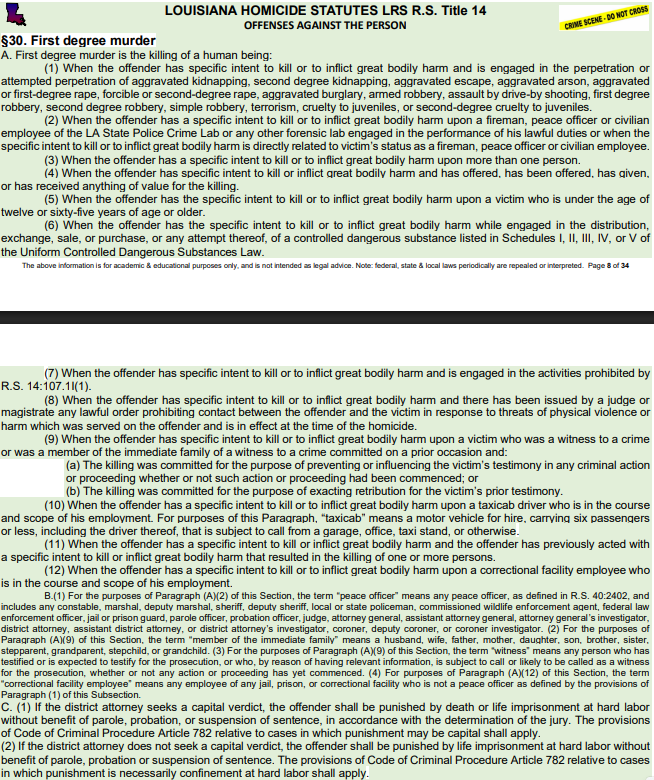
LA RS 2nd degree murder §30.1

LA RS Manslaughter §31

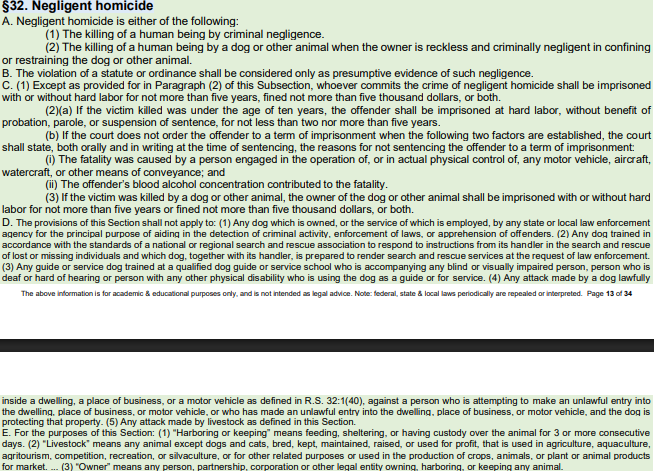
LA RS Negligent Homicide §32
the killing of a human being by criminal negligence. Criminal negligence exists when there is such a gross deviation below the standard of care expected to be maintained by a reasonably careful person under like circumstances.
LA RS Vehicular Homicide §32.1
the killing of a human being caused directly by an offender operating a vehicle, aircraft, watercraft, or other means of conveyance while under the influence of alcohol or drugs (BAC of 0.08% or higher, or under the influence of controlled substances).

felony murder
a homicide committed when the defendant prepares an inherently dangerous felony regulated by statutes, like burglary, rape, robbery, arson, or kidnapping
felony murder rule
a Δ also may face a murder charge if a death occurred during the course of a specific felony in which they participated. Some states classify felony murder as 1st-degree murder and others as 2nd-degree murder. The Δ does not need to have intentionally caused the victim’s death. They might even be convicted if a co-felon caused the victim’s death. The felony murder rule often applies only to certain dangerous felonies enumerated by statute.
1st degree murder
the killing of a human being with the specific intent to kill or inflict great bodily harm under one of several statutory aggravating circumstances (e.g., during specific major felonies, killing a public safety officer, killing a victim under 12 or over 64, or contract killing).
*only form of homicide that can be punished by the death penalty*
2nd degree murder
the killing of a human being when the offender has a specific intent to kill or inflict great bodily harm (but without the additional statutory aggravating factors of 1st-degree). It also covers felony murder, where a death occurs during the commission of certain dangerous felonies (like armed robbery or burglary), even if there was no intent to kill.
manslaughter (definition)
homicide that would otherwise be first- or second-degree murder, but the offense is committed in sudden heat of passion or heat of blood caused by provocation sufficient to deprive an average person of self-control. It also includes killings committed without specific intent during nonenumerated felonies or simple misdemeanors.
voluntary manslaughter
occurs when an individual kills another person in the heat of the moment without the opportunity for cool reflection; resembles a partially excused form of murder. It generally involves an intentional homicide committed in response to a severe provocation. The Δ must have acted in the “heat of passion” under an extreme emotional disturbance, which could have provoked a similar response in a reasonable person. One traditional example of a severe provocation (although not universally recognized) is discovering a spouse in the act of adultery
involuntary manslaughter
involves unintentionally causing the death of another person while engaging in a negligent or reckless act. The prosecution must establish that the defendant’s actions exhibited a lack of reasonable care and directly led to the death of another person; involves an unlawful but unintentional homicide. The prosecutor usually must prove that the Δ acted with negligence, or with recklessness that does not rise to the level of a “depraved heart.” Negligence in these cases may be a more culpable mental state than negligence in a civil lawsuit. The prosecutor may need to prove a significant deviation from the applicable standard of care.
heat of passion
under an extreme emotional disturbance, which could have provoked a similar response in a reasonable person; an intentional killing committed in sudden passion or heat of blood caused by provocation sufficient to deprive an average person of self-control.
malice aforethought
Under modern law, any 1 of 4 mental states that reveal the intent to (1) kill, (2) inflict great bodily harm/injury, (3) show extreme reckless disregard for human life, or (4) commit a felony that results in another’s death.
*Louisiana does not use the common-law term malice aforethought in its criminal statutes*
aggravated and aggravating factors
These factors include the manner in which it was committed or the victim who was its target. It also involves intentionally and with premeditation killing another person.
ex)
Killing a police officer, peace officer, fireman, judge, parole or probation officer, coroner, district attorney, someone employed by the Louisiana State Police Crime Lab, prison employee, or person with a similar occupation
Killing someone while committing another crime such as kidnapping, arson, rape, armed robbery, burglary, a drive-by shooting, cruelty to children, or terrorism
Killing more than one person or a child under the age of 12 or a senior aged 65 or older
Killing someone as a hired assassin
Killing someone while engaged in drug dealing
Killing a person under the protection of a restraining order when the offender is the one named to be restrained
Killing a witness to a crime to prevent his or her testimony or as retribution for testimony