Science 8 — Chapter 7 Study Guide: The Animal Kingdom
 Call Kai
 Learn
 Practice Test
 Spaced Repetition
 Match
 Flashcards
1/35

Earn XP
Description and Tags
Question and answer review flashcards covering animal characteristics, tissue types, classification, invertebrates, chordates, and vertebrate classes from Chapter 7 of Science 8.
36 Terms
What is the lesson from the story of Balaam’s donkey regarding God and animals?
God can use even animals to carry out His purposes, and He cares for His creatures. Balaam’s donkey saw the angel and tried to stop Balaam from going forward.
According to the study guide, what is God’s goal for mankind?
God desires that people know Him, love Him, serve Him, and be happy with Him in Heaven.
What are the six characteristics of organisms in the Kingdom Animalia?
Animals are multicellular
Their cells have nuclei
Their cells are organized into tissues and organs (except sponges)
They obtain food from other sources
They digest food internally
Most can move from place to place at some stage of life.
Which animal serves as an exception to the rule that all animals have tissues and organs?
Sponges.
What are the four basic types of tissues found in animals and their functions?
Epithelial tissue covers body surfaces and lines cavities
Connective tissue supports, connects, and protects structures
Muscle tissue contracts to produce movement
Nerve tissue receives and transmits signals
How is epithelial tissue structured, and what does it form?
It is made of closely packed cells that cover body surfaces, line cavities, and form glands.
What characterizes connective tissue, and what are four examples?
It connects and supports body parts with cells and fibers spread through material outside the cells (examples include bone, cartilage, blood, and fat)
What are the three types of muscle tissue in animals?
Cardiac muscle
Skeletal muscle
Smooth muscle

What is the function of nervous tissue, and what cell types does it include?
It receives stimuli and transmits electrical impulses. It includes neurons and supporting glial cells.
What are ganglia?
Clusters of nerve-cell bodies (neurons) outside the brain and spinal cord.
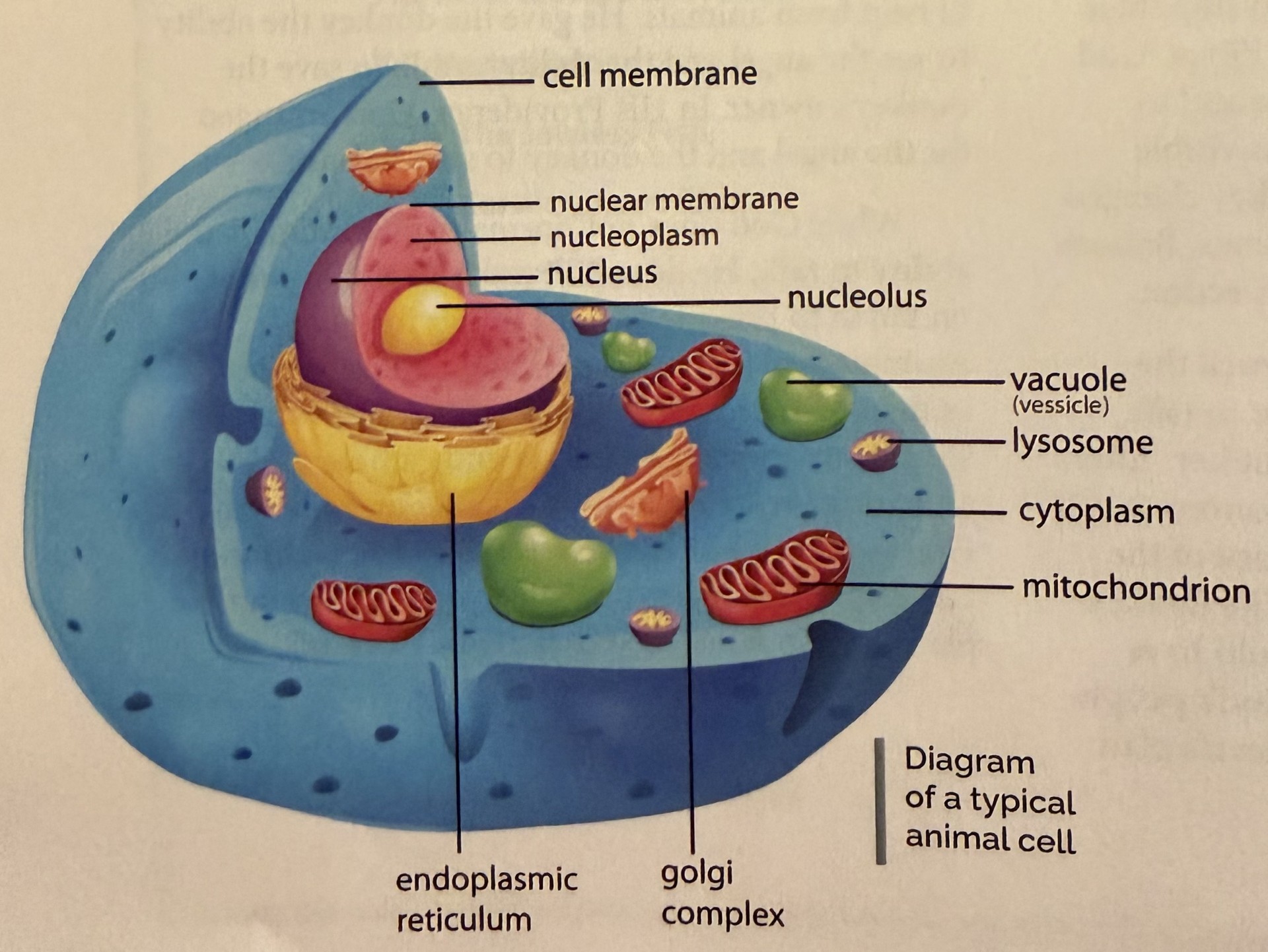
Draw and label a typical animal cell?
Cell membrane
Nuclear Membrane
Nucleoplasm
Nucleus
Nucleolus
Vacuole
Lysosome
Cytoplasm
Mitochondrion
Endoplasmic reticulum
Golgi Complex
Endoplasmic reticulum
What are the three main characteristics that scientists use to classify animals?
Symmetry
Segmentation
The presence or absence of a backbone.
What characteristic is shared by 95% of all animal species?
They are invertebrates (animals without a backbone).
What are three characteristics of stingers (such as jellyfish, corals, and anemones)?
They have tentacles with stinging cells
The cells discharge a threadlike structure that can inject toxin
They use them to capture prey and for defense
In what habitats do mollusks live?
Most live in marine environments, some live in freshwater, and some live on land in moist places.
What are the three main types of mollusks and examples of each?
Gastropods (snails and slugs)
Bivalves (clams and oysters)
Cephalopods (squid and octopuses).
What are three benefits that mollusks provide to mankind?
They are used as food
Shells are used for jewelry and other items
Some produce substances used in medicine
What are the four types of arthropods?
Centipedes and millipedes
Insects
Arachnids
Crustaceans.
How do centipedes and millipedes differ in their number of legs per body segment?
Centipedes have one pair of legs per body segment, while millipedes have two pairs of legs per body segment.
What four basic anatomical features do all chordates share at some stage of development?
A notochord
A dorsal hollow nerve cord
Pharyngeal slits or pouches
A post-anal tail.
Why are invertebrate chordates, such as lancelets and tunicates, important to the ecosystem?
They are important members of aquatic food webs that filter or consume plankton and help transfer energy through the ecosystem.
What five features do all vertebrates share in common?
A backbone (vertebral column)
An internal skeleton,
A head with a brain,
A central nervous system
A closed circulatory system.
What structures make up the central nervous system of chordates, and what protects them in vertebrates?
The brain and spinal cord, which are protected by the skull and backbone in vertebrates.
What are the physical characteristics and feeding habits of lampreys?
Lampreys are jawless, eel-like fish with a round, sucker-like mouth and no paired fins or scales; many are parasites that attach to other fish and feed on blood and tissue.
What are three examples of cartilaginous fish?
Sharks
Rays
Chimaeras
What does the term 'cartilaginous' mean?
Having a skeleton made of cartilage rather than bone.
What is the function of the lateral line system in sharks?
It is a sensory system running along each side of the shark that detects vibrations and movement in the water.
How do bony fish differ from cartilaginous fish?
Bony fish have an internal structure made up of bones
How do ray-finned fish differ from lobe-finned fish?
Ray-finned fish have bony rays, or spines, that support their fins. The lobe-finned fish also have fins supported by rays, but the fins are more fleshy and attached to the body with a single bone.
What are the three main types of amphibians?
Frogs and toads
Salamanders
Caecilians.
What are the four major types of reptiles?
Turtles,
Lizards
Snakes
Crocodilians (crocodiles and alligators)
What is the scientific name for birds?
Aves.
What feature is responsible for the name 'mammals' and what is its significance?
Mammary glands; they are specialized glands that produce milk to nourish the young and serve as the defining feature of mammals.
Which group of mammals is the largest?
Placental mammals.
Which mammals do not bear live young, and how do they reproduce?
Monotremes; they reproduce by laying eggs.
What is the purpose of the placenta in developing mammals?
The placenta connects the developing offspring to the mother, allowing oxygen and nutrients to pass to it and wastes to pass away.