Module 3. Protein Structure
 Call Kai
 Learn
Learn Practice Test
 Spaced Repetition
 Match
Match Flashcards
 Knowt Play
1/40

There's no tags or description
Looks like no tags are added yet.
Name | Mastery | Learn | Test | Matching | Spaced | Call with Kai | Chat |
|---|
No analytics yet
Send a link to your students to track their progress
41 Terms
T or F: alpha helices and beta sheets have repeating psi and phi angles
T
alpha helix characteristics
- right handed (clockwise)
- core tightly packed
- 3.6 AA/turn
what stabilizes secondary structures
hydrogen bonds
2 main classes of beta sheets
1. parallel
2. anti-parallel
parallel beta sheets
both n-termini are on the same side

antiparallel beta sheets
align in opposite directions
- on one side, one strand's terminus is N while the other is C
how many residues are involved in a beta turn
in a beta turn, ____ residues are involved and the backbone bends by nearly ______ degrees
4, 180
why are beta turns important
contributes to the globularity of proteins
what residues are preferred for a beta turn
proline and glycine
irregular structure
structure with no psi , phi angle pattern
random coil
no structure, denatured
circular dichroism (CD)
determines protein secondary structure
motifs
short, recurring patterns of AA sequences or 3D structures
-based on the secondary structure

βαβ motif
helix that connects 2 PARALLEL strands of a beta sheet

β hairpin
antiparallel strands of β sheet connected by a tight turn

β barrels
β strands in a sheet roll up to form a barrel

what IMF bonds AA side chains with each other and AA side chains with peptide backbones
hydrogen bonds
where are disulfide bonds common in
extracellular proteins
- interior usually has reducing conditions
what contributes to protein stability
hydrophobic effects
- required to have 2 layers of structure
protein domains
single polypeptide chain that has separate units
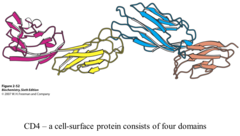
what 2 ways determine protein structures
1. xray crystallography
2. NMR
X-ray crystallography
results in an electron density map
- determines the structure of a crystal
- very static picture of protein
- you can't see any flexible regions of the protein
NMR
- purified protein is placed in solution
- no crystals needed
- shows flexibility of protein
The _________ the angstrom (minimum distance), the better the resolution
lower
alphafold
theoretical way to determine protein structure through AI
-input protein sequence and it'll make predictions of the protein's structure
denaturation
loss of structure sufficient to cause loss of function
what does an s-shaped curve (sigmoidal) mean for protein folding
cooperative = all or none
- 50% folded, 50% unfolded
- loss of structure in one part makes other parts more likely to lose structure
common denaturants
1. chaotropic agents
- guanidium and urea
2. organic solvents
- acetone, MeOH, EtOH
3. increased temp
4. detergent
Anfinsen's experiment
he used BME and urea to denature a small single domain protein (pure RNase) then renatured it by removing the urea and oxidizing it
- >90% of the protein were active

key implications of anfinsen's experiment
all the info that required for folding is found in the primary structure (AA sequence)
- primary structure dictates tertiary structure
levinthal's paradox
It is mathematically impossible for protein folding to occur by randomly trying every conformation until the lowest-energy one is found
- there must be folding pathways
chaperones
proteins that help other proteins achieve correctly folded structures
- prevent aggregation
- protect exposed hydrophobic regions
- provides right environment for folding, by isolation
2 types of chaperones
clamp type chaperones and chamber type chaperones
protein disulfide isomerase (PDI)
catalyzes interchange of incorrectly formed disulfide bonds unticl the correct ones are formed
peptide prolyl cis-trans isomerase (PPI)
catalyzes conversions of cis/trans isomers of prolines
intrinsically disordered proteins (IDP) or intrinsically disordered regions (IDR)
- very dynamic and flexible
- does not have a set form until it binds to specific partners
- important in cell signaling
- implicated in diseases like diabetes, cancer, and neurodegenerative diseases
1st known protein folding disease
sickle cell anemia
sickle cell anemia
HBB E6V mutation that favors polymerization if the Hb into rigid fibers instead of globular proteins
where does the cystic fibrosis mutation take place
the cystic fibrosis transmembrane conductance regulator (CFTR), ΔF508
cystic fibrosis effect
normally maintains salt/water balance, but CF thickens mucus (mainly in the lungs) to build up and weaken the immune system
most common mutation for cystic fibrosis
ΔF508 (deletion of Phe at position 508)