AP BIO- Unit 2 Organelles
 Call Kai
 Learn
 Practice Test
 Spaced Repetition
 Match
 Flashcards
 Knowt Play
1/45

There's no tags or description
Looks like no tags are added yet.
46 Terms
The organelle in which photosynthesis occurs
chloroplast
Process plants use to transform solar energy into chemical energy. Like sugars.
What is the photosynthesis?
Cellulose
What is the polysaccharide we find in plants?
Powerhouse of the cell, organelle that is the site of ATP (energy) production
Mitochondria
Carbohydrates and fats for now.
What are the energy sources we get ATP from?
Eukaryote cell "ate" an oxygen using prokaryotic cell. They became an endosymbiont. A cell living within a cell.
Endosymbiont theory
Inner convoluted membrane of mitochondria.
Cristae
Cristae
What divides the inner membrane of mitochondria into two internal compartments?
Mitochondrial matrix
What is within the second inner compartment?
Cytosol
What is the semi-like fluid that suspends/ holds up all subcellular components.
Nucleus
In a eukaryotic cell, where is most of the DNA stored?
non-membrane enclosed nucleoid.
In a prokaryote where is most of the DNA found?
How structure relates to function.
What is the whole point of biology and cell strucutre?
plasma membrane (cell membrane)
What is the selective barrier of the cell? The boundry of every cell.
Internal membranes that COMPARTMENTALIZE for various functions.
What is specific for eukaryotes?
area specific for rRNA synthesis
Nucleolus
Proteins assembled with rRNA give us what?
large and small ribosomal subunits
outside the nucleus what happens to the small and large subunit glob?
it becomes a Ribosome!
what does a ribosome make?
Proteins
Double lipid bilayer that surrounds the nucleus is called the
Nuclear envelope
What is special about the endomembrane system
The membranes either touch or transfer vesicles to each other.
Receives, Sorts & organizes, shipping of proteins. The warehouse of the cell.
The Golgi
what builds proteins?
Ribosomes
a membranous sac of hydrolytic enzymes that can digest macromolecules. Also digest other smaller organisms.
Lysosomes
The process of lysosomes digesting macromolecules and organisms are called?
Phagocytosis
The ability for lysosomes to recycle cellular material is called?
Autophagy
touches the nuclear envelope. Also made of 2 different structures.
Endoplasmic reticulum
Synthesis of lipids, metabolizes carbohydrates, detoxification of drugs, storage of calcium ions.
Smooth ER
makes its own membrane and membranes for other organelles, has ribosomes studded on it
Rough ER
3 different types of vacuoles. All vacuoles deal with selective transportation of solutes.
Vacuole
vesicle carrying monosaccharides or amino acids ready for digestion via phagocytosis.
food vacuole

Plants only vacuole. contains water and minerals for plant growth.
central vacuole
Cells need a high surface area to volume ratio. The smaller a cell is the bigger the surface area to volume ratio is.
Surface area to volume ratio
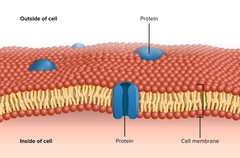
Proteins imbedded in the lipid bi-layer
Integral proteins
Go through the entire lipid bi-layer.
Transmembrane proteins
They are amphipathic
Both integral and transmembrane proteins touch the inside of the lipid bi-layer and the watery cytosol what can we say about them both?
Proteins loosely bound to the surface of the lipid bi-layer.
Peripheral proteins
No. Energy is not used, mostly concentration gradients.
Is energy used for passive transport?
A form of passive transport for movement of molecules from high concentration to low concentration. think cold air flowing outside your house when the door is open.
What is a concentration gradient?
Yes it does. Uses ATP.
Does active transport use energy?
the movement of ions or molecules across a cell membrane into a region of higher concentration, assisted by enzymes and requiring energy.
What is active transport?
passive transport that is activated by using integral proteins.
what is facilitated diffusion?
Exocytosis
How do we transport large molecules outside the cell or organelle?
Endocytosis
How do we take in large molecules into a cell or organelle?
Good!
Remember how the phospholipids align due to the water sides.
Facilitated diffusion, concentration gradient, osmosis
What are the 3 types of passive transport?