Week 2 — Approximations, Extrema & Proof Ideas
 Call Kai
 Learn
 Practice Test
 Spaced Repetition
 Match
 Flashcards
 Knowt Play
1/21

Earn XP
Description and Tags
Key ideas from 12–16 October slides and both videos. Conceptual recall and conditions; no calculation drills. Complements Limits & Continuity and Differentiation.
22 Terms
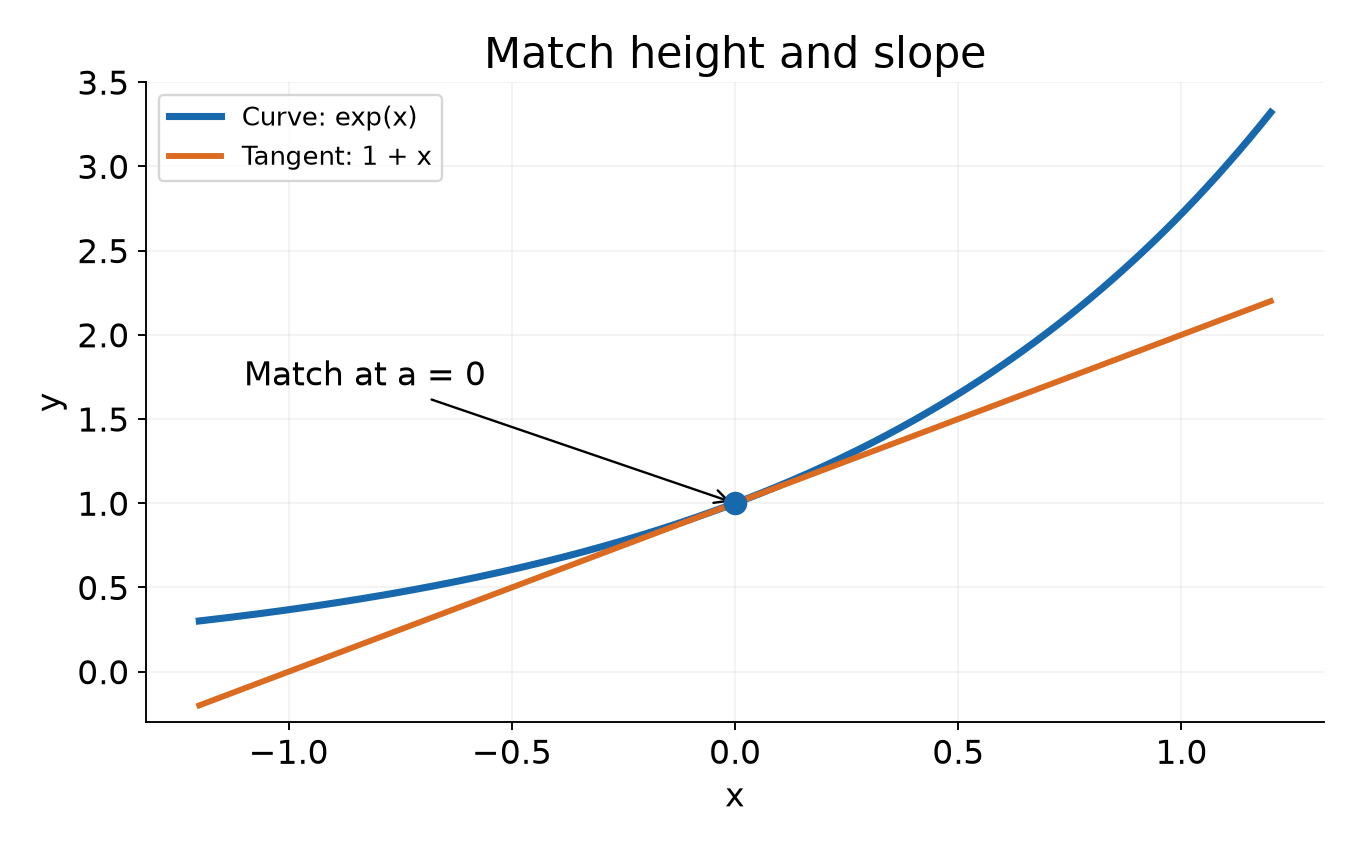
What is the linear approximation to f(x) near x = a, and what does it represent?
f(x) ≈ f(a) + f'(a)(x - a). It uses the tangent line: known height + slope × change in input.
What is the quadratic approximation to f(x) near x = a?
f(x) ≈ f(a) + f'(a)(x - a) + (1/2)f''(a)(x - a)^2. The extra term accounts for local curvature.

Why is there a factor of 1/2 in the quadratic approximation?
The approximating polynomial must match f(a), f'(a) and f''(a). Differentiating C(x - a)^2 twice gives 2C, so matching the second derivative requires C = f''(a)/2.
When should you trust a linear or quadratic approximation?
Use it near the expansion point a, with the required derivatives available. It is a local approximation, not an exact identity or a guarantee of accuracy far from a.
What conditions and conclusion belong to the local 0/0 version of L'Hôpital's rule used in this week's lecture?
If f and g are differentiable at a, f(a) = g(a) = 0, and g'(a) ≠ 0, then lim as x → a of f(x)/g(x) = f'(a)/g'(a). Differentiate top and bottom separately; do not use the quotient rule. This is the lecture's special local form, not the full general theorem.
Why does the lecture's local 0/0 limit rule follow from linear approximation?
Near a, f(x) ≈ f'(a)(x - a) and g(x) ≈ g'(a)(x - a), because f(a) = g(a) = 0. The common (x - a) cancels, leaving f'(a)/g'(a), provided g'(a) ≠ 0.
What does f^(n)(x) mean in higher-derivative notation?
The nth derivative of f, not the nth power of f. Each derivative is obtained by differentiating the previous derivative; f'' is the second and f''' the third.
How does a local maximum or minimum differ from a global one?
Local compares f(a) with values at nearby points; global compares it with every value in the domain. At a local maximum nearby values satisfy f(x) ≤ f(a); at a local minimum they satisfy f(x) ≥ f(a).
What is a stationary point, called a critical point in these lectures?
A point a where f'(a) = 0, so the tangent is horizontal. It is a candidate for a local extremum and still needs classification.
Does a zero first derivative guarantee a local maximum or minimum?
No. For a differentiable function, a local extremum at an interior point requires f'(a) = 0, but that condition is not sufficient. For example, x^3 has a stationary inflection at 0.
What does the second-derivative test say at a stationary point?
For a twice differentiable function with f'(a) = 0: f''(a) > 0 gives a local minimum; f''(a) < 0 gives a local maximum. Check stationarity before applying this test.

What can you conclude if f'(a) = 0 and f''(a) = 0?
The second-derivative test is inconclusive. It could be a minimum, maximum or neither; use further analysis, such as the sign of f' on each side. Do not automatically call it an inflection point.

How does the sign of f' classify an isolated stationary point?
As x passes through a: negative to positive gives a local minimum; positive to negative gives a local maximum. If f' has the same strict sign on both sides, there is neither a local maximum nor a local minimum there.
Why does the second-derivative test work?
At a stationary point the linear term vanishes, so f(x) - f(a) ≈ (1/2)f''(a)(x - a)^2. The squared factor is positive away from a: a positive f'' puts nearby values above f(a), while a negative f'' puts them below.
What are the two essential steps in proof by induction?
Prove a starting case, usually n = 1. Then assume the statement for an arbitrary n and prove it for n + 1. The starting case begins the chain; the implication carries it to every later positive integer.
What is the add-and-subtract trick in the product-rule proof?
Insert -f(x+h)g(x) + f(x+h)g(x), which is zero. Regroup the numerator as f(x+h)[g(x+h)-g(x)] + g(x)[f(x+h)-f(x)]. Dividing by h exposes the two difference quotients, whose limits give fg' + gf'.
How does the induction proof of the power rule use the product rule?
Start with (x)' = 1. Assuming (x^n)' = nx^(n-1), write x^(n+1) = x^n × x. The product rule gives nx^(n-1) × x + x^n = (n+1)x^n, proving the next case for positive integer powers.
What do log x and ln x mean in MATH0045?
Both mean the natural logarithm, base e. In this course log does not mean base 10; its derivative is 1/x for x > 0.