X-Ray Generator (first part of Exam 3 Concepts)
 Call Kai
 Learn
 Practice Test
 Spaced Repetition
 Match
 Flashcards
 Knowt Play
1/18

Earn XP
Description and Tags
Will add transformers later
Name | Mastery | Learn | Test | Matching | Spaced | Call with Kai | Chat |
|---|
No analytics yet
Send a link to your students to track their progress
19 Terms
X-Ray Tube (Contains + Function)
Contains: thermionic vacuum diode
cathode
anode
Function: converts electrical energy into electromagnetic energy
Conditions to Produce X-Ray Photons
source of electrons (large amount)
high PD
vacuum
kVp
Kilovoltage Peak
beam: energy level (penetrability) of the X-ray beam
sets PD (voltage) between anode & cathode
mAs
Milliamperage per Second
beam: # of photons produced & length of exposure
sets the amount of current (or e-) per second during exposure
mA x exposure time (s)
X-Ray Circuits
Filament Circuit - determines filament current (mA setting)
current that heats filament
measured in Amps (low voltage & high amperage)
6-12 V & 3-5 A
Tube Circuit - determines the tube current during the exposure
passes between 2 electrodes & produces x-rays
measured in mA (high voltage & low amperage)
50-120 kV & 0.1.0.5 A
e- produced by filament are driven across the gap by the voltage applied to the cathode & anode
a small change in filament current produces a large change in tube current
Generator Divisions
Sections
low voltage (primary side)
high voltage (secondary side)
tube
Circuits
tube circuit (high voltage to tube)
filament circuit (high amperage, low voltage to filament)

Primary Side (Low Voltage)
adjusts incoming voltage to the technical factors we choose
tube circuit - adjust kVp
filament circuit - adjust mAs
Components
autotransformer
rheostat
kVp meter
timing circuit

Main Switch
2-Stage Switch
current to induction motor & filament
closes tube circuit & begins exposure
Autotransformer & kVp Selectors
variable transformer (single coil); adjusts incoming supplied voltage to the desired voltage for the X-ray tube (also operates using self-induction)
kV selector - taps on secondary side of the autotransformer
kV major - adjusts in units of 10
kV minor - adjusts in units of 1

kVp Meter
voltmeter that prereads the kVp going to step-up transformer (to be applied to the tube) & ensures correct voltage reaches it
wired in parallel
if there are voltage fluctuations, autotransmitter is adjusted (V not kV here)
lets you know if something is wrong

Timing Circuit
responsible for terminating the exposure

Rheostat
variable resistor (mA selector); adjusts incoming current to the desired amperage to be sent to the step-down transformer (filament)
3-5 amps & 6-12 volts

Focal Spot Selector
determines which filament receives current
dual focus tube

Step-Up (High Tension) Transformer
increases voltage (from autotransformer) to tube as it leaves from primary to secondary coil
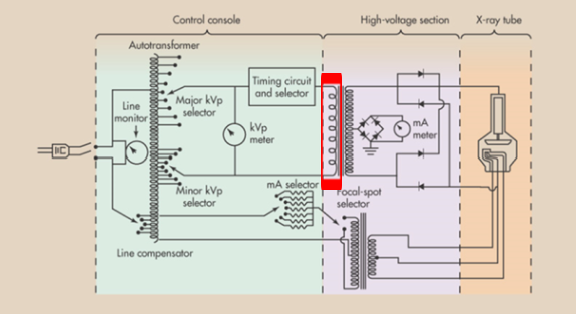
Secondary Side (high voltage) (distinction)
primary vs. secondary distinction made at step-up, high tension transformer
primary side - incoming volts adjusted by autotransformer
secondary side - high voltage to be sent to the tube

Step Down (filament) Transformer
sends increased amperage to filament for thermionic emission

mA Meter
measures tube current
wired in series on secondary side of high tension (step-up) transformer
mAs Meter (not in diagram) - needed for short exposure times less than 100 ms because ammeter will not measure it accurately

Rectification Circuit
converts AC → DC
enhances heating capacity of X-ray tube, permitting larger exposures
DC ensures electrical current flows in one direction (cathode → anode)

X-Ray Tube (+ Components)
utilizes high voltage to accelerate electrons toward the target and produce x-rays
filament - thermionic emission (boiling off of electrons when metal is heated)
cathode - negative diode to create high PD
anode - positive diode to create high PD
