Equations To Remember For Ch01.02.03 Test
 Call Kai
 Learn
 Practice Test
 Spaced Repetition
 Match
 Flashcards
 Knowt Play
1/15

There's no tags or description
Looks like no tags are added yet.
16 Terms
x = A / B
A = 8.400km2
B = 55.67𝜇m5
1.1 {e-Notation} Solve for x.

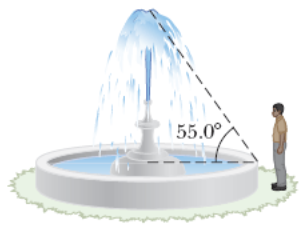
A high fountain of water is located at the center of a circular pool, as shown in the figure below. Not wishing to get his feet wet, a student walks around the pool and measures its circumference [C] to be 24.00m. Next, the student stands at the edge of the pool and uses a protractor to gauge the angle of elevation [𝜃] at the bottom of the fountain to be 53.0°.
2.1 {Standard Form} How high [h], in meters, is the fountain?


A surveyor measures the distance across a straight river by the following method:
- Starting directly across from a tree on the opposite bank, he walks x = 106.0 m along the riverbank to establish a baseline.
- Then he sights across to the tree. The angle from his baseline to the tree is 𝜃 = 34.4°.
3.1 {Standard Form} How wide [w], in meters, is the river?


A map suggests that Atlanta is 729.0miles {Δd1} in a direction 3.00° {𝜃1} north of east from Dallas. The same map shows that Chicago is 558.0miles {Δd2} in a direction 20.0° {𝜃2} west of north from Atlanta. The figure below shows the location of these three cities.
4.1 (a) {Standard Form} Modeling the Earth as flat, use this information to find the Magnitude (in miles) of the displacement [|R|] from Dallas to Chicago.
{Δd1} = A; {𝜃1} = 𝜃A; {𝜃1}; {Δd2} = B; {𝜃2} = 𝜃B
Ax = Acos(θ); Bx = Bcos(θ); Ay = Asin(θ); By = Bsin(θ)
For Bx and By= 90°+ 𝜃B
𝜃A = °NofE
𝜃B = °WofN

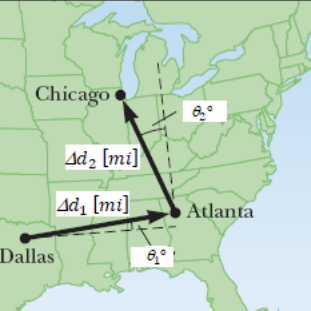
A map suggests that Atlanta is 729.0miles {Δd1} in a direction 3.00° {𝜃1} north of east from Dallas. The same map shows that Chicago is 558.0miles {Δd2} in a direction 20.0° {𝜃2} west of north from Atlanta. The figure below shows the location of these three cities.
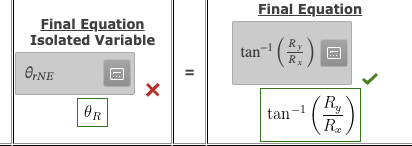
4.2 (b) {Standard Form} Modeling the Earth as flat, use this information to find the Direction, in ° North of East of Dallas, of the displacement [𝜃R] from Dallas to Chicago.?
Variable solving for = Find direction, in ° North of East [𝜃R] = 𝜃rNE
To qualify for the finals in a racing event, a race car must achieve an average speed of 255km/hr on a track with a total length of 1,800.0m.
5.1 If a particular car covers the first half of the track at an average speed of 213km/hr, what minimum average speed, in kilometers per hour, must it have in the second half of the event in order to qualify? (i.e., (vavg)2 = ?)
Average speed = (vavg)f
Total length = XTotal
1st Half of Track Average Speed = (vavg)i
ttotal = total distance/required average speed times 1km/hr / 0.278m/s
t1 = half distance/(vavg)i times 1km/hr / 0.278m/s
t2 = ttotal - t1
vavg)2 = half distance/t² times 1km/1000m / 3600s/1hr


A graph of position versus time for a certain particle moving along the x-axis is shown in the figure below.
6.1 (a) {Standard Form} Find the instantaneous velocity of particle (i.e., slope [m] of line segment) at t = 1.00s


A graph of position versus time for a certain particle moving along the x-axis is shown in the figure below.
6.2 (b) {Standard Form} Find the instantaneous velocity of particle (i.e., slope [m] of line segment) at t = 3.00s

A 53.0g Super Ball traveling at 26.5m/s bounces off a brick wall and rebounds at 18.0m/s. A high-speed camera records this event.
7.1 If the ball is in contact with the wall for 3.85ms, what is the magnitude of the average acceleration of the ball during this time interval? (i.e., |aavg| = ?)
Average acceleration = m/s²
Initial - v0; Final - vf
Gives us ms = t
1ms = 10^-3

A certain aircraft has a liftoff speed of 119km/hr.
8.1 {Standard Form} How long does it take the aircraft to become airborne after a takeoff run of 229m? (i.e., Δt = ?)
Liftoff speed = vavg
Takeoff run = Δd
1000m = 1km
1hr = 3600s
vavg = vf + vi / 2
d/ vavg

A cougar jumps to a height of 3.35m when leaving the ground at an angle of 41.6°.
9.1 {Standard Form} What is its initial speed the cougar leaves the ground?
v2oy = 2(g)(h) POSTIVE
voy = √v2oy
Involves gravity

A car is parked on a cliff overlooking the ocean on an incline that makes an angle of 19.0° below the horizontal. The negligent driver leaves the car in neutral, and the emergency brakes are defective. The car rolls from rest down the incline with a constant acceleration of 2.93m/s2 for a distance of 40.0m to the edge of the cliff, which is 35.0m above the ocean.
10.1 (a) {Standard Form} Find the length of time [tflight] the car is in the air.
Car rolls = aroll
Cliff above ocean = -h
Length of time = s
Involves gravity
d = xroll

A car is parked on a cliff overlooking the ocean on an incline that makes an angle of 19.0° below the horizontal. The negligent driver leaves the car in neutral, and the emergency brakes are defective. The car rolls from rest down the incline with a constant acceleration of 2.93m/s2 for a distance of 40.0m to the edge of the cliff, which is 35.0m above the ocean.
10.2 (b) {Standard Form} Find the car's position relative to the base of the cliff [Δxflight] when the car lands in the ocean.
vox = vedge times cos(θ)

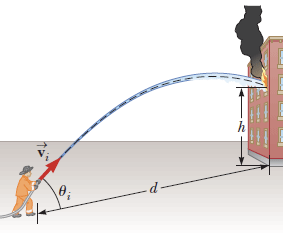
A fireman, a distance [d] of 44.0m away from a burning building, directs a stream of water from a ground-level fire hose at an angle theta [𝜃i] which is, as shown in figure, 26.0° above the horizontal.
11.1 {Standard Form} If the speed [vi] of the stream as it leaves the hose is 39.0m/s, at what height [h] will the stream of water strike the building?
Asking for height = meters
Involves gravity
voy = v1sin(θi)
vox = v1cos (θi)
t = d / vox

An airplane maintains a speed [v0avg] of 621.0km/hr relative to the air it is flying through as it makes a trip to a city a distance [y] of 801.0km away to the north. (Assume north is the positive y-direction and east is the positive x-direction.)
12.1 {Standard Form} What time interval, in hours, is required for the trip if the plane flies through a headwind [vhw] blowing at 33.3km/hr toward the south?
Asking for time interval - t

An airplane maintains a speed [v0avg] of 621.0km/hr relative to the air it is flying through as it makes a trip to a city a distance [y] of 801.0km away to the north. (Assume north is the positive y-direction and east is the positive x-direction.)
13.1 {Standard Form} What time interval, in hours, is required if there is a crosswind [vcw] blowing at 34.5km/hr to the east relative to the ground?
