Neuroendocrine control of energy
 Call Kai
 Learn
 Practice Test
 Spaced Repetition
 Match
 Flashcards
 Knowt Play
1/14

There's no tags or description
Looks like no tags are added yet.
15 Terms
Neuroendocrine regulation of appetite
refers to how peripheral (metabolic) hormone inform the brain about available energy levels and change appetite in order to maintain a normal body weight
brain gets info from peripheral tissues
adipose tissue/ fat produces leptin that suppresses appetite
Stomach produces ghrelin that stimulates appetite
Pancreas produces insulin that suppresses appetite
Intestine produces Cholecystekinin, (CCK), Glucagon like peptide (GLP1), oxyntomodulin (OXN) Peptide YY (PYY). first 2 promote fullness that other 2 suppresses appetite
List the (5) important hypothalamic nuclei and their roles
Nucleus | Role discussed |
|---|---|
Arcuate nucleus (ARC) | Major site integrating peripheral appetite-related signals |
Ventromedial hypothalamus (VMH) | Historically associated with satiety |
Lateral hypothalamus (LH) | Historically associated with hunger and feeding |
Dorsomedial hypothalamus (DMH) | Contributes to appetite-regulating circuits |
Paraventricular nucleus (PVN) | Receives projections from arcuate neurons and regulates feeding |
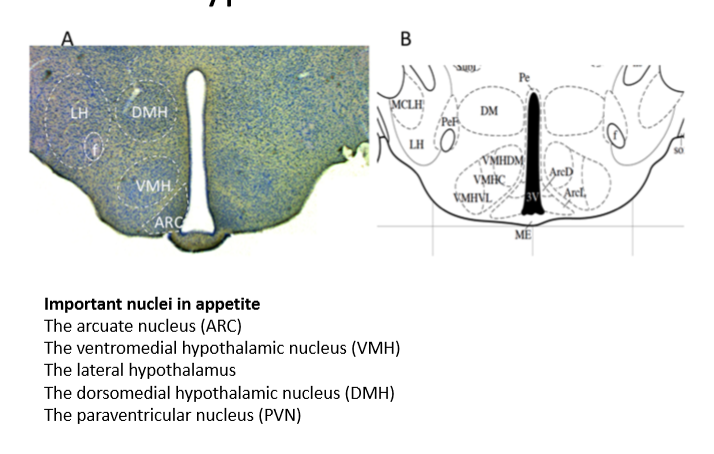
What can lesions in the VMH, LH and in both result in
VMH: excessive feeding and obesity as VMH suppresses
LH: reduced feeding and develop starvation as LH contributes to stimulating feeding
both: suppression of excessive feeding as obesity reversed
Arcuate nucleus ARC
2 neuronal population in it and their roles
2 neuronal populations:
Neuropeptide Y (NPY)/Agouti-related peptide (AgRP) neurons: orexigenic so stimulates appetite and increases food intake
Proopiomelanocortin (POMC) neurons. Alpha-melanocyte stimulating hormone (α-MSH) is the main anorectic peptide from POMC neurons. anorexigenic so suppresses appetite and decreased food intake
NPY/AgRP neurons
expresses NPY, AgRP and gaba
active during negative energy balance like fasting
produces strong drive to eat
POMC neurons
POMC is a precursor that can be processed into different biologically active peptides particularly α-MSH (alpha-melanocyte-stimulating hormone)
activates melanocortin receptors to suppress food intake
POMC neurons most active during positive energy balance especially after food consumption
More free radicals than AgRP which can cause susceptibility to degeneration
POMC cells degenerate faster over time resulting in net food intake causing weight gain as we age
other products of POMC include γ-MSH Melanocortin signalling, ACTH Regulation of the adrenal stress hormone axis, β-Endorphin Pain regulation and reward-related functions, γ-Lipotropin Additional POMC-derived peptide
Briefly explain the experiment that used Optogenetic Activation of Appetite Neurons
NPY-cre mouse so mouse that expressed cre recombinase bred with mouse with channelrhodopsin expression blocked by stop cassette between 2 lox p sites to produce NPY animal with channelrhodopsin expressed
1. activate NPY/AgRP neurons using optogenetics, mice began eating, intake dramatically increased
2. activate POMC neurons, food intake reduced, magnitude of suppression was smaller than increase in feeding
Genetic removal of AgRP and POMC neurons
cre lox p used to express diphtheria toxin receptor in some neuronal population. when the toxin was administered, neurons expressing it were eliminated
1. removal of AgRP, reduction in food intake, significant loss of body weight
2. removal of POMC neurons, increased food intake and increased body weight
Inhibition of POMC neurons
AgRP neurons are GABAergic and can inhibit POMC neurons
hunger promoting neurons can suppress satiety promoting neurons
What happens when AgRP and POMC neurons are stimulated at the same time
food intake increases which shows that AgRP mediated hunger signals dominate POMC mediated satiety signals
What are the 3 mechanisms NPY/AgRP promote hunger
POMC release α-MSH that activates melanocortin-4 receptors (MC4R) to suppress feeding. AgRP opposes this pathway by blocking MC4R signalling
NPY activates Y1,Y5 receptors in the PVN to increase food intake
NPY/AgRP releases GABA onto POMC neurons inhibiting POMC activity
Hormonal regulation of arcuate neurons
NPY/AgRP neurons express GHSR (growth hormone secretagogue receptor), leptin receptor and insulin receptor. POMC neurons express leptin and insulin receptors.
Ghrelin secreted by the stomach binds to GHSR and activates NPY/AgRP neurons to increase appetite (neurons activated by ghrelin will show Fos staining) It indirectly suppresses POMC
Leptin binds to leptin receptors and inhibits NPY/AgRP neurons and activates POMC neurons
Insulin binds to the insulin receptors and inhibits NPY/AgRP neurons and activates POMC neurons
ob/ob mice and leptin experiment
ob/ob mouse has mutation that prevents normal leptin production so mice have obesity
when mice were exposed to circulating factors form normal mice they lost weight which shows that leptin informs brain about energy stores
pSTAT3 marker for leptin activated neurons, leptin administration increased pSTST3 labelling
ROS in POMC and AgRP
POMC produce more RIS during their matbolism. POMC more vulnerable to oxidative damage and age related degeneration
AgRP produce less ROS than POMC
Shift towards AgRP so increased feeding as we age