Chapter 16
 Call Kai
 Learn
 Practice Test
 Spaced Repetition
 Match
 Flashcards
 Knowt Play
1/51

There's no tags or description
Looks like no tags are added yet.
52 Terms
arrhenius vs. bronsted lowry vs. lewis acids and bases
Arrhenius:
Acid - substance that, when dissolved in water, increases concentration of protons (H+)
Base - Substance that, when dissolved in water, increases concentration of hydroxide (OH-) ions
Bronsted-Lowry:
Acid - Proton donor (H+)
Base - Proton acceptor (H+)
Lewis:
Acid - Electron-pair acceptor (ex. Fe(3+) is now an acid)
Base - Electron-pair donor
broadest definition that allows for molecules without hydrogen ions
oxoacid
chemical compound containing hydrogen, oxygen, and at least one other central element

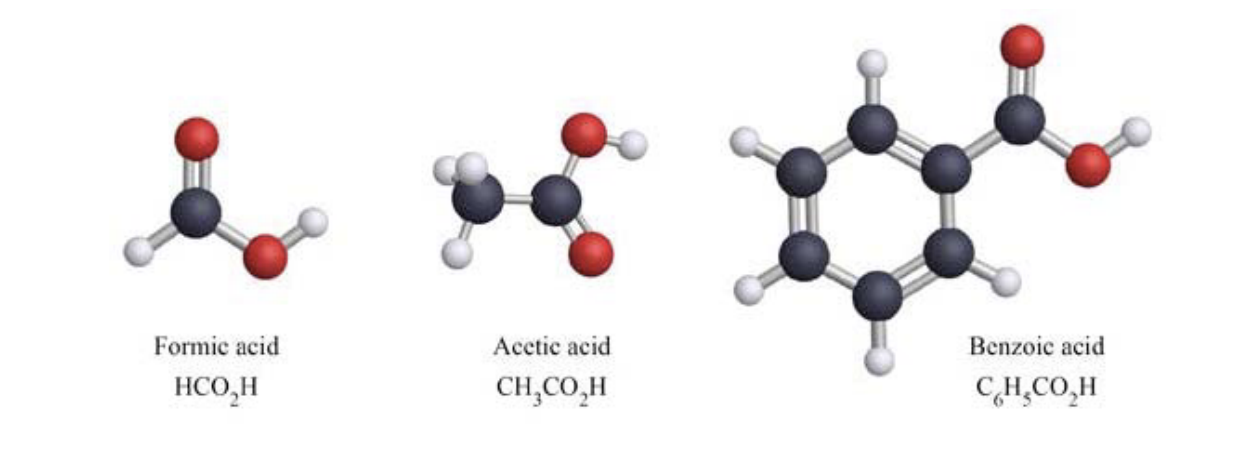
Carboxylic acids
contains a carboxyl group (CO2H or COOH)
Non-oxygen containing acids
Named with hydro-
ex. Hydrofluoric acid, hydrocyanic acid

Any cations dissolved in solution are acidic except left 2 columns (akali metals and alkaline earth metals) of periodic table
Group 1 Cations: have a low +1 charge and relatively large radii. They do not pull hard enough on water molecules to release H+ ions, leaving the solution neutral
Heavy Group 2 Cations: also have large enough radii to offset their +2 charge
strong vs. weak bases
strong:
soluble metal hydroxides
weak:
most contain nitrogen
Conjugate bases of weak acids result in what kind of base?
weak
conjugate acid-base pair, acid, and base
conjugate acid-base pair - two substances related by transition of single H+
conjugate base - what is left over of acid when H+ leaves
conjugate acid - what is formed from base when H+ is added
ex. HA(aq)+H2O(l)<->H3O+(aq)+A-(aq)
acid base CA CB
K for general acid base reaction
HA(aq) + H2O(l) H3O+(aq) + A-(aq)
K(a) = [H3O+][A-] / [HA] = [H+][A-] / [HA] ([H+] and [H3O+] interchangeable)
Amphoteric definition and common example
-can act as acid or base
-water is amphoteric
-ex. H2O(l)+H2O(l) <-> H3O+(aq)+OH-(aq)
K(w)
-K of water = [H3O+][OH-] = 1.0x10^-14 (only works at 25C but we will always assume this temp. in chem 111)
-gives us a link between [OH-] and [H3O+]
-For a neutral solution, [OH-] = [H3O+] and both equal 1.0×10^-7 M
pH scale
-Neutral water has [OH-] = [H3O+]=1x10⁻⁷M
-Acidic solution has [H3O+]>1x10⁻⁷M
-Basic solution has [H3O+]<1x10⁻⁷M
pX = -logX
pH = -log[H3O+]
pOH = -log[OH-]
pK(w) = pH+pOH = 14
pH = -log[H3O+] = -log[1.0x10^-7] = 7
larger X means lower pX
acidic solutions have pH between 1 and 7
larger X means _____ pX
acidic solutions have pH between _ and _
lower
1, 7
sig figs of pH/pOH values
-only count sig figs to the right of the decimal point
-any values to the left of the decimal point represent the power of 10
-ex. pH of 12.2 has 1 sig fig because it comes from a hydronium concentration around 10^-13 M
What mass of solid sodium hydroxide (40.0 g/mol) is needed to make 1L 12.200 (3 sig figs) pH basic solution?
14.000 - 12.200 = 1.800 = -log[OH-]
[OH-] = 10^-1.8 = 0.01585 M
0.01585 mol OH- / 1 L x 1 L x 40.0g / 1 mol = 0.634g NaOH
polyprotic acid
-acid that donates more than 1 proton per molecule of solution
-multiple steps and K values (step for each proton donated and K for each step)
-ex. H2SO4(aq)+H2O(l)<->HSO4-(aq)+H3O+(aq)
A B CB CA
HSO4-(aq)+H2O(l)<->SO4(2-)(aq)+H3O+(aq)
A B CB CA
Sodium fluoride dissolved in water
NaF(s)<->Na+(aq)+OH-(aq)
F-(aq)+H2O(l)<->HF(aq)+OH-(aq)
B A CA CB
Na+ is spectator
strength of conjugates of strong acids/bases vs. weak acids/bases
strong acid → extremely weak CB (negligible basicity)
strong base → extremely weak CA (negligible acidity)
weak acid → weak CB
weak base → weak CA
conjugates of weak acids/bases are always stronger than conjugates of strong acids/bases
list of strong acids
HNO3, HClO3, HClO4, H2SO4, HCl, HBr, HI
Kb tells us about _____ of a base, Ka tells us about _____ of acid
strength, strength
higher K → stronger
general acid equation and K
HA(aq)+H2O(l)<->H3O+(aq)+A-(aq)
Ka = [H3O+][A-] / [HA]
general base equation and K
Kb: A-(aq)+H2O(l)<->HA(aq)+OH-(aq)
Kb = [HA][OH-] / [A-]
Kw =
Ka x Kb = [H3O+][OH-]
pKw =
14 = pH + pOH = pKa + pKb
Acetic acid (CH3CO2H) and HCN are both weak acids. Acetic acid is a
stronger acid than HCN.
Arrange these bases from weakest to strongest and explain your answer:
A: H2O
B: Cl–
C: CN–
D: C2H3O2–
B is weakest base
A
D
C is strongest base
pH of weak acid:
Acetic acid has the chemical formula CH3CO2H and Ka value of 1.8x10⁻⁵ at 25oC.
What is the pH of a 0.050 M solution of acetic acid?
What is the concentration of acetate ions in solution?
What is the % dissociation?

pH of weak base:
What is the pH for a 15.0 M solution of NH3? The Ka for NH4+ is 5.56x10⁻¹⁰

Meaning of pKa
-pKa is intrinsic property substance
-pH is property of solution
-must have concentration to find pH
-pKa can be found from textbook
-if pH < pKa, it will be mostly protonated (adding of H+ to atom/molecule)
-if pH > pKa, it will be mostly deprotonated
-when pH=pKa, [HA]=[A-]
How do cations affect solution pH, and how can an ion without hydrogen make a solution acidic?
Group 1 & 2 Cations (Na⁺, K⁺, Ca²⁺): Do not affect pH. Their low charge density is too weak to pull electrons from water.
Small, Highly Charged Cations (Al³⁺, Fe³⁺): Decrease pH (make the solution acidic).
Mechanism (Cation Hydrolysis): The positive metal ion pulls electron density away from the oxygen in surrounding water molecules. This weakens the water's O–H bonds, allowing a hydrogen ion (H⁺) to break off into the solution and lower the pH.
A cation that is the conjugate acid of a weak base (ex. NH4+) will decrease the pH
How do anions affect solution pH?
Conjugate bases of strong acids (Cl-, NO3-): No effect on pH. They are too weak to pull protons from water.
Conjugate bases of weak acids (F-, C2H3O2-): Increase pH (basic). They pull a hydrogen ion (H+) off water molecules, leaving behind hydroxide ions (OH-)
An acid-base equilibrium always favors the side with the ____ acid/base
weaker
Equilibrium mixture contains:
•More of the weaker acid
•More of the weaker base
•Less of the stronger acid
•Less of the stronger base
The Two Competitors: In every reversible acid-base reaction, there is a base on the reactant side and a conjugate base on the product side. Both are trying to grab and hold onto the available proton.
The Stronger Base Wins: A stronger base has a much greater attraction for protons than a weaker base. Because it binds the proton more tightly, it successfully pulls the proton away from the weaker base and refuses to let it go.
What "Winning" Looks Like: When the stronger base captures the proton, it turns into its weak conjugate acid. Meanwhile, the weaker base is left behind without a proton, meaning the weaker base and weaker acid accumulate at equilibrium.
Where will the equilibrium lie for the following reactions?
(CH3CO2H: Ka=1.8x10⁻⁵ HF: Ka=7.2x10⁻⁴)
HF (aq) + CH3CO2 → CH3CO2H+ (aq) + F– (aq)
product side (HF is stronger acid)
When one of the reactants is a strong acid/base, and the other is a weak acid/base, we can also assume that _____
the reaction goes to completion
Where will the equilibrium lie for the following reactions?
HCl (aq) + CH3CO2- (aq) → CH3CO2H (aq) + Cl– (aq)
HCl is strong acid and CH3CO2- is weak base
rxn goes to completion
steps in complete deprotonation of H2CO3
H2CO3(aq)+H2O(l)->HCO3-(aq)+H3O+(aq)
Ka1 = [H3O+][A-]/[H2A]
HCO3-(aq)+H2O(l)->CO3(2-)(aq)+H3O+(aq)
Ka2 = [H3O+][A(2-)]/[H1A-]
Ka1 x Kb2 = Kw
Ka2 x Kb1 = Kw

2nd dissociation is always _____ than 1st
If Ka1>>Ka2 by factor of 1000 or greater –> can treat as ______ acid
weaker
monoprotic (2nd step basically doesn’t change pH)
ex. citric acid can’t be treated as monoprotic while ascorbic can

for solution of H2CO3 (Pka1=6.37, Pka2=10.25) that has a pH of 2.5, what is predominant form of the acid?
H2CO3
Because the solution pH of 2.5 is much lower than the first pKa of 6.37, the acid stays fully protonated. The pKa value of 6.37 marks the tipping point where the acid begins losing its first proton.
most important acid/base reactions/relationships
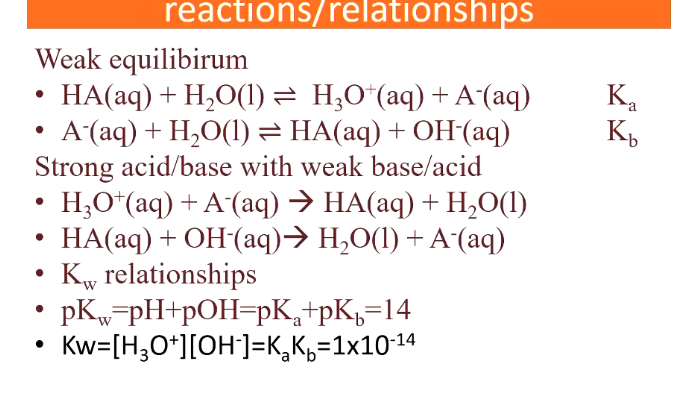
strong + weak acid/base goes to completion
yep
pH < pKa vs. pH > pKa vs. pH=pKa
pH < pKa (Protonated dominates): The solution has plenty of H⁺ ions, so the molecule mostly keeps its proton (e.g., HA), acidic form dominates
pH = pKa (50/50 split): The molecule exists in equal amounts of its protonated (HA) and deprotonated (A⁻) forms.
pH > pKa (Deprotonated dominates): The solution has fewer H⁺ ions, so the molecule mostly loses its proton to become its conjugate base (A⁻), basic form dominates
all cations are acidic except first two columns
all anions are basic except anions from strong acids
yep
What is the pH of 65 mM carbonic acid (aq) (H2CO3)?
Ka1 = 4.3x10^-7
Ka2 = 5.6x10^-11
what amount of acid is ionized?
H2A(aq)<->H+(aq)+HA-(aq)
I: 0.065 0 0
C: -x +x +x
E: 0.065-x x x
4.3x10^-7 = x^2/0.065 (5% rule)
x = [H+] = 1.67 x 10^-4 M
pH = 3.78
HA-(aq) <-> H+(aq) + A(2-)(aq)
I: 1.67x10^-4 1.67x10^-4 0
C: -x +x +x
E: 1.67x10^-4 -x 1.67x10^-4 +x x
5.6x10^-11 = (1.67x10^-4 +x)x / (1.67x10^-4 -x) = x (5% rule)
[H+] = 1.67x10^-4 + 5.6x10^-11 (concentration and pH changed so little that 2nd deprotanation can often be ignored)
amount ionized = [CO3(2-)] = 5.6×10^-11 M
buffer
-used to resist change to pH when adding an acid/base
-buffered solution is often a mixture of a weak acid/base and it’s weak CB/CA
-ex. the strong H3O+ still reduces pH by reacting to produce weak HA, but because the H3O+ reacts completely and leaves behind only a weak acid, the pH doesn’t drop much

general equations for:
strong acid with weak base
strong base with weak acid
SA/WB: H3O+(aq)+A-(aq)→HA(aq)+H2O(l)
SB/WA: OH-(aq)+HA(aq)→A-(aq)+H2O(l)
Henderson-Hasselbalch Equation
-used to determine pH of SA/WB and SB/WA rxns
-log(Ka )= -log([H3O+][A-] / [HA])
pKa = -log[H3O+] - log([A-]/[HA])
pH = pKa + log([A-]/[HA])


C
pH = 4.74 + log(0.10/0.12) = 4.66
don’t need to do math - you know that there is more acid than base, so pH should be slightly less than pKa

strong base to buffered solution
OH-(aq)+HA(aq)->H2O(l)+A-(aq)
I: 0.01 mol 0.12 mol 0.10 mol
C: -0.01 -0.01 +0.01
F: 0 0.11 0.11
pH = 4.74 + log(0.11/0.11) = 4.74 = pKa
must use moles for ICF (initial, change, final)
ICF charts go to completion instead of equilibrium
change can easily be determined because one component always gets fully consumed
yep
Acid/Base Titrations
-Solution of known concentration of base (or acid) - titrant (always strong)
-titrant slowly added to another solution of acid (or base) - analyte (weak or strong)
-analyte is what you’re analyzed
-indicator is added that turns one color when protonated and another when deprotonated
-if it’s a good indicator it changes color when equivalence point is reached (add correct moles of titrant to completely neutralize the analyte)
-end point of titration is when indicator changes color
-good indicators have same equivalence point and end point
titration curve: strong titrant and strong analyte
-From the start of the titration to near the equivalence point, the pH goes up slowly
-Just before and after the equivalence point, the pH increases rapidly
-equivalence point of 7 if both are strong
-At the equivalence point, moles acid = moles base
-Solution contains only water and the salt from the cation of the base and the anion of the acid

titration curve: Weak Acid/Strong Base
-as weak acid reacts, weak CB is created, which affects pH
-this weak base and remaining weak acid mixture form a buffer
-at equivalence point, pH > 7 because all of weak acid is now weak base
-flat region right before equivalence point is buffer zone
