Lab Practical 1
 Call Kai
 Learn
Learn Practice Test
 Spaced Repetition
 Match
Match Flashcards
 Knowt Play
1/97

There's no tags or description
Looks like no tags are added yet.
Name | Mastery | Learn | Test | Matching | Spaced | Call with Kai | Chat |
|---|
No analytics yet
Send a link to your students to track their progress
98 Terms
Phenotype
Physical characteristics
Genotype
Genetic sequence
Allele
variant of a gene
evolution
change in frequency of alleles in a population overtime
Natural Selection
individuals with favorable traits are more likely to survive
Adaptation
heritable trait that is beneficial to survive and reproduce
fitness
one’s ability to survive and reproduce (S+R)
Genetic Variation
Differences in genotype or alleles in a population
Hardy-Weinberg Principle
A population’s allele frequencies are stable unless acted upon by some evolutionary force
Hardy-Weinberg Principle assumptions?
infinitely large population, no mutations, no migration/emitgration, no selective pressure(being hunted)
How to calculate freq. of alleles?
You have to add both BB from dominant and the B from the heterozygous So BB(Black) survivors 9: 9X2 + 7= 25
Bb (Brown) Survivors: 7 +32= 39
bb(white) survivors: 16: 16 ×2 =32
Independent variable (x-axis)
what changed or compared in the experiment
Dependent variable (y-axis)
what you measured in response
Photoautotroph
photosynthesis
Chemoautotroph
energy from inorganic chemical source
Heterotroph
energy from organic carbon source (must break down)
Symbiotic relationships
living on or inside another organism and obtaining nutrients
What are the two major groups of prokaryotic organisms?
Bacteria and Archaea
Prokaryotes and eukaryotes similarities
ribosomes, DNA, cell membrane, cell wall
Prokaryotes and Eukaryotes differences
P: No nucleus, small more diverse, cells are simpler, flagella
Euk: Nucleus, bigger, less diverse, cell division is diff. membrane bound organelles
3 Shapes of Prokaryotic cells?
Coccus = spherical ex: streptococcus
Bacillus = rod-shaped ex: lactobacillus
Spirillum = spiral ex: Rhodospirillum
Lactobacillus and Streptococcus
Yogurt forming Bacteria
Bacillus - Coccus
Chemoheterotroph
Nonmotile - randomv vibration due to molecules bumping into one another
Used for food processing
Rhodospirillum rubrum
Domain: Bacteria
Spirillum
Motile (flagellum): spiral motion
Photosynthesis under low O2 (turns purple red when low)
Oscillatoria
Phylum: Cyanobacteria
Filamentous
Bacillus
Whip-like motion
Binary fission
Autotrophic
Gloeocapsa
Phylum:Cyanobacteria
Domain: Bacteria
Coccus
Nonmotile
Photoautotrophic
Anabaena
Phylum: Cyanobacteria
Heterocyst= nitrogen-fixing cell
Coccus
Non-motile
Filamentous
Photoautotrophi
Halobacterium salinarum
Archaea
Bacillus
Motile (flagellum) Jerky/wiggly movement
Extremophile/halophile (thrive in high salt environment
Pinkish color when low o2 environment in anaerobic conditions
Symbiotic mutualistic relationship: gives Azolla plant nitrogen, lives on azollo (protection)
What is a protist?
a eukaryotic organism that isn’t an animal, plant or fungus
Monophyletic
includes common ancestors and descendants
Paraphyletic
common ancestors but not all descendants
Polyphyletic
no common ancestor
Unicellular
Single cell organism
Colonial
identical cells that are independent but live together
Multicellular
more than one cell, dependent on each other
What are 3 ways protists can contain food?
Photosynthesis, consuming organic matter(absorption), phagocytosis (eats it)
Primary endosymbiosis
cyanobacteria was engulfed and became mitochondria (all euS
Secondary endosymbiosis
bacteria engulfed and became chloroplast (not all euks)
Chlamydomonas
Lineage Archaeplastida (Plantae)
Phylum Chlorophyta
Common name: Green algae
Single-celled
Photosynthetic
Motile (flagella)
Volvox
Lineage Archaeplastida (Plantae)
Phylum Chlorophyta (Green algae)
Colonial
Motile (flagella)
Photosynthetic Autotroph
Spirogyra
Lineage Archaeplastida (Plantae)
Phylum Chlorophyta (green algae)
Colonial - Nonmotile (free floating) - Spirally arranged chloroplasts
Photosynthetic—autotroph
Ulva
Lineage Archaeplastida (Plantae)
Phylum Chlorophyta (green algae)
Multicellular - Nonmotile - Photosynthetic Autotroph
Chondrus
Lineage Archaeplastida
Phylum Rhodophyta (red algae)
Irish Moss
Multicellular - Nonmotile - Photosynthetic Autotroph
Fucus
Lineage Stramenopila
Phylum Orchophyta (brown algae)
Multicellular - Air Bladders- Nonmotile - Autotroph
Nereocystis (bull kelp)
Lineage Stramenopila
Phylum Orchophyta (Brown algae)
Multicellular - Air bladders - Nonmotile - Autotroph
Diatoms
Lineage Stramenopila
Phylum Ochrophyta
Unicellular - Silica cell walls - Diverse shapes
Class: Bacillariophyta
Some nonmotile, some motile (gliding)
Euglena
Lineage Excavata
Phylum Euglenozoa (Euglenoids)
Autotrophic &/or Heterotrophic
Unicellular - Motile (flagella)
Paramecium caudatum
Lineage Alveolata
Phylum Ciliophora (Ciliates)
Heterotrophic - Unicellular - Motile (cilia) (for feeding and movement)
(grayish)
Paramecium bursaria
Lineage Alveolata
Phylum Ciliophora (Ciliates)
Heterotrophic - Unicellular - Motile (Cilia) - Contains endosymbiotic algae (green purple)
Chaos
Lineage Amoebozoa
Phylum Amoebozoa (Amoebozoans)
Heterotrophic - Unicellular - Motile (pseudopodia/amoeboid motion)
Plant Diversity Evolution
Green Algae → Nonvascular ( complex gametangia)→ vascular seedless (embryo retention; vascular tissue; sporophyte dominated life cycle) → gymnosperms (pollen; seeds) & angiosperms (flowers; fruit)
Sporophyte
the diploid (2n) stage of a plant’s life cycle that produces haploid (n) spores through meiosis: basically produces spores that can grow into gametophyte generation
Spore
a reproductive cell that can develop into a new organism without fertilization
Sporangia
structures of plants and fungi where spores are produced and stored.
Gametophyte
Is the haploid (n) stage of a plant’s life cycle that produces gametes (sperm & eggs) through mitosis; produces sex cells needed for fertilization and the formation of a new sporophyte.
Gamete
a haploid reproductive cell such as sperm or egg, that joins with another gamete during fertilization to form a diploid (2n) zygote.
Gametangia
Structures in plants and algae where gametes (sperm and eggs) are produced.
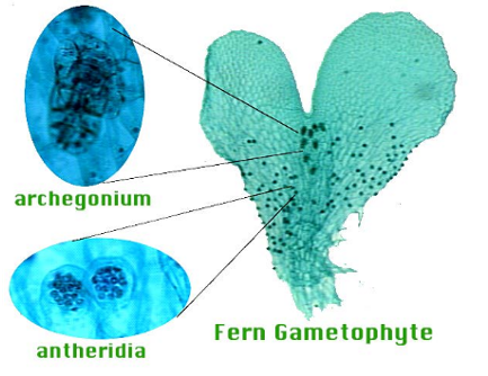
Antheridia (moss)
Male- sperm

Archegonia (moss)
female- eggs

Alternation of generations life cycle
Two gametes get fertilized → zygote which undergoes mitosis → sporophyte, which undergoes meiosis→ spores which germinate and go under mitosis to produce→ Gametophyte (generation) which goes under mitosis to produce → gametes → fusion to zygote
Homosporous
only one type of spore produced (nonvascular and seedless vascular)
Heterosporous
two types of spores produced
microspores - male gametophyte megaspores- female gametophyte
(all seed plants and some seedless vascular )
Phylum Bryophyta
Nonvascular (Mosses)
Contain gametangia, where gametes develop
Archegonia have a bulge in the center
Antheridia are shorter and darker in color
Homosporous - Fertilization requires water

Phylum Monilophyta
Seedless vascular plants: ferns
Phylum Monilophyta
Sporophyte is dominant stage
Gametophyte contain gametangia, where gametes develop
Antheridium(sperm) and Archegonium (egg)
Homosporous - Fertilization requires water
Sori contain sporangia: undergo meiosis (one sorus (dot))
Selaginella (clubmoss)
Seed plants
All heterosporous - seeds have 2n embryo, store fat and seed coat
Female gametophytes and eggs develop in ovule, males are called pollen grain
Fertilization NOT dependent on water
Microspores & Megaspores

Phylum Coniferophyta (Pines)
Seed plants: Gymnosperms
Ovules and polled produced in cones
Male (pollen cones) are small yellow (microspores)
Female (ovulate cones) are the big pine cones (megaspores)
Seed is small spinning thing

Phylum Anthophyta: Flower
Seed plants: Angiosperms - Sepals (leaf part under petal) Receptacle the stem under ovary
Male Parts: Stamen - Anther: produces pollen - Filament
Female Parts: Carpel/pistil - Stigma - Style -Ovary (contains ovules)

Main organs of plants?
Roots, stems, leavesD
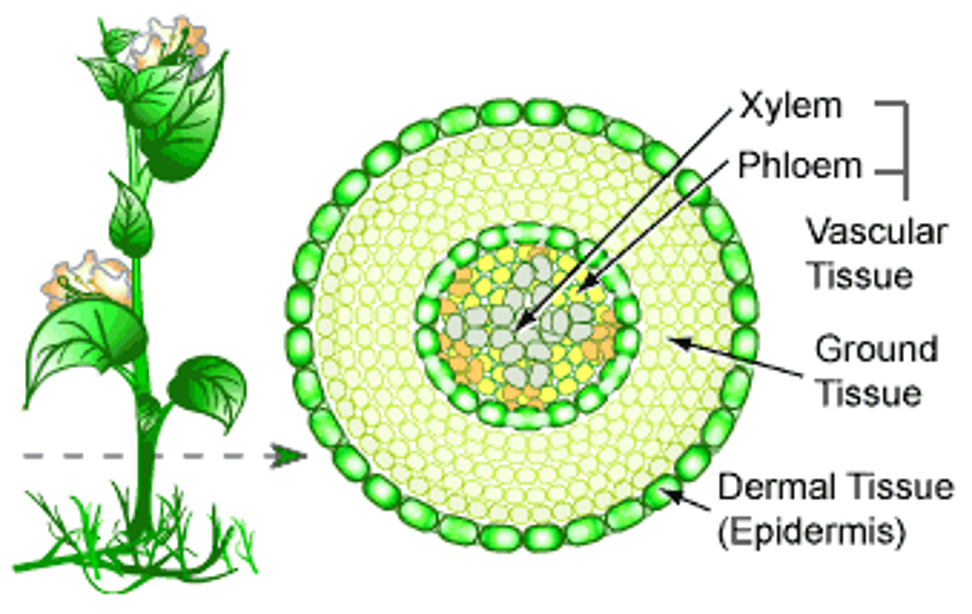
Dermal Tissue (epi)
Protection, Gas exchange, support
Ground Tissue
A. Parenchyma (mesophyll)
metabolic functions (photosynthesis, wound repair)
Pith
storage center of the plant (apart of ground tissue)

Cortex
middle outer water storage (apart of ground tissue)

Vascular tissue
Vascular bundle/cylinder Xylem : water & mineral transport (wxyz) Phloem: sugar transport (pqrs)
Apical meristem
Length & height (primary growth): continuous cell division/ cell mitosis at the bottom of roots and tips of stems (3 major tissue types)

Lateral meristem
Width and diameter: cell division is outward (secondary growth)
Produces wood (secondary xylem) and bark (secondary phloem)
Fibrous (grass)
Monocot root parallel leaf veins

Taproots (sweet gum seeding)
Dicot: webbed

Roots
made up protoderm, grown meristem, pro cambium, root apical meristem, root cap


Stems
Outside: Node, internode, leaf, petiole
Inside: Pith, xylem +phloem, cortex

Leaves
Petiole(part that connects leaf to stem) → Veins
Palisade Parenchyma on top
Spongy Palisade on bottom

Stoma
opening on leaf that allows gas exchange and prevents water loss
has guard cells with chloroplasts that control when to open and close


Rhodospirillum rubrum (bacteria)

Oscillatoria (cyanobacteria)

Gloeocapsa (cyanobacteria)

Anabaena (cyanobacteria)

Halobacterium salinarum (Archaea)

anabaena on Azolla

Chlamydomonas (can have two flagella)
Lineage Archaeplastida
Phylum Chlorophyta (green algae)
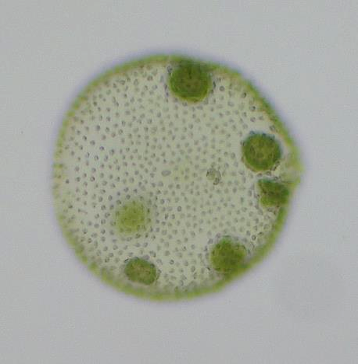
Volvox
Lineage Archaplasitida
Phylum Chlorophyta (green algae)

Spirogyra (can be dark green or light green)
Lineage Archaeplastida
Phylum Chlorophyta (Green Algae)

Ulva (sea lettuce)
Lineage Archaeplastida
Phylum Chlorophyta
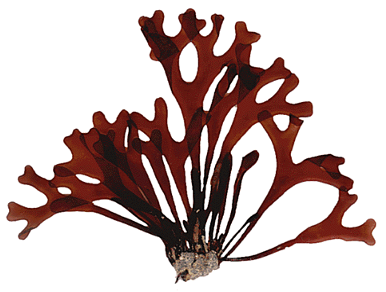
Chondrus (Irish Moss)
Lineage Archaeplastida
Phylum Rhodophyta (red algae)

Fucus (Rock weed)
Lineage Stramenopila
Phylum Orchophyta (brown algae)

Nereocystis (bull kelp)
Lineage Stramenopila
Phylum Orchophyta (Brown algae)

Diatoms
Lineage Stramenopila
Phylum Orchophyta
Silia cell walls - Diverse shapes

Euglena
Lineage Excavata
Phylum Euglenozoa (Euglenoids)

Paramecium caudatum
Lineage Alveolata
Phylum Ciliophora (ciliate) (grayish flat)

Paramecium bursaria
Lineage Alveolata
Phylum Ciliophora (ciliate) (green and purple bigger)

Chaos
Lineage Amoebozoa
Phylum Amoebozoa