(15) Proton Pump Inhibitors
 Call Kai
 Learn
Learn Practice Test
 Spaced Repetition
 Match
Match Flashcards
 Knowt Play
1/18

There's no tags or description
Looks like no tags are added yet.
Name | Mastery | Learn | Test | Matching | Spaced | Call with Kai | Chat |
|---|
No analytics yet
Send a link to your students to track their progress
19 Terms
Antacid vs. PPI
Antacid
→ neutralizes acid already present
PPI
→ blocks proton pump
→ prevents more H⁺ entering stomach
Proton Pump
Proton pump
H⁺/K⁺-ATPase
Located in parietal cells
Pumps H⁺ into stomach lumen
↑ H⁺ → ↓ pH → ↑ acidity
Name the amino-acid residues on the gastric proton pump (aka Important Cysteines)
CYS813 and CYS822
CYS813 vs CYS822
CYS813
closer to entrance
reactive/unstable PPI hits it first
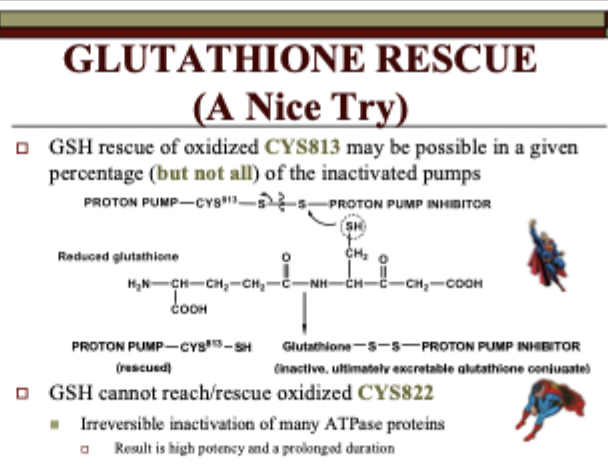
GSH can reach it
attacks the disulfide linkage
removes the PPI from the pump
CYS813 gets its free SH back
proton pump becomes active again
An inactive/excretable GSH–PPI conjugate is formed.
GSH can rescue pump
→ shorter duration
CYS822
deeper
more stable PPI can reach it
GSH cannot reach it
no rescue
→ longer duration
Glutathione Rescue - draw
How PPI Inhibits the Pump
Activated/reactive PPI
cysteine SH → forms disulfide bond
This makes the PPI:
covalently attached to the proton pump
Result: pump inhibited → cannot pump H⁺ into stomach lume
How PPI Inhibits the Pump - draw it

Potency + Duration Trend
PPIs that reach 822 generally have:
higher potency
longer duration
But professor said this is a general trend, not an absolute rule.
Fast vs slow PPIs
Fast / more reactive → reacts at 813
Slower / more stable → can reach 822
PPI structure
All PPIs have the same general core:
pyridylmethyl – sulfinyl – benzimidazole
Different R groups → change how quickly the PPI reacts.
PPI structure - draw

PPI activation idea
PPIs are like prodrugs, but not technically prodrugs.
Why?
Prodrug → needs metabolism
PPI → picks up H⁺ and chemically activates itself → no CYP activation needed
Henderson–Hasselbalch
For the basic PPI nitrogens:
pH − pKa = log [B]/[H:B]
For a base:
B = unionized
H:B = ionized/protonated
Important relationship:
pH < pKa → protonated/cationic form favored
pH > pKa → unionized form favored
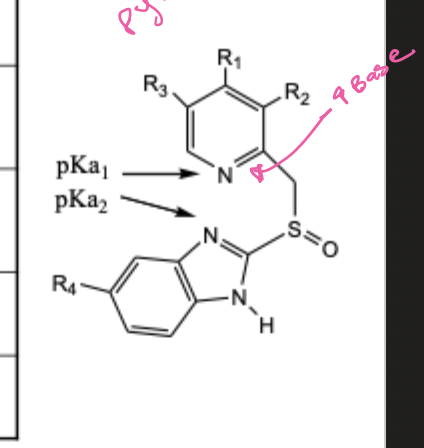
Two Important PPI Nitrogens
Pyridine N1
higher pKa
stronger base
picks up H⁺ first
Benzimidazole N3
lower pKa
weaker base
Two Important PPI Nitrogens - draw
At pH 1.5, what is the ionization state of the 2 important PPI nitrogens?
Pyridine N1 → cationic (+)
pH < pKa1
Benzimidazole N3 → un-ionized
pH > pKa2
PPI at pH 7.4
fully unionized conjugate predominates
The professor also initially says: both deprotonated
The important lecture idea is that once the drug has left the gastric pump environment, professor says its behavior there is no longer the main concern.
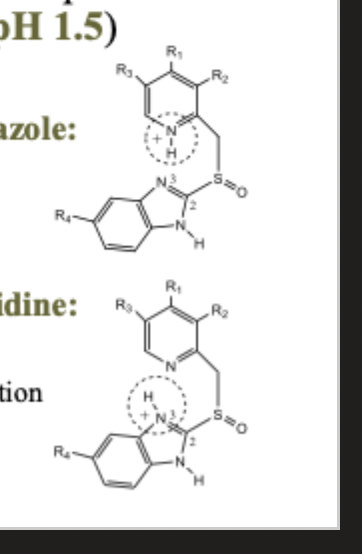
Two Monocationic Forms
Bz–PyrH⁺
proton is on pyridine
predominates at pH 1.5
BzH⁺–Pyr
proton is on benzimidazole
does NOT predominate
required for PPI activation
🔴 MEMORIZE THIS PAIR
Bz–PyrH⁺ = predominant
BzH⁺–Pyr = activation
Two Monocationic Forms - draw