biology 2 pt2
 Call Kai
 Learn
 Practice Test
 Spaced Repetition
 Match
 Flashcards
 Knowt Play
1/94

Earn XP
Description and Tags
Evolution, macroevolution, diseases ,pop ,micro evolution, species, prokaryotic, eukaryotic
95 Terms
Evolution
Descent with modification
Co-evolution
Two organisms that have evolved together
Descent
generation to generation
Modification
Change
Descent with modification
Genetic change in a population or species over generations
Evolution (1.)
Genetic change in population
Natural Selection
Those w/ better traits—> leads to MORE EVOLUTION GROWTH, accumulation of traits
What does natural selection lead to?
Continuous natural selection will EQUAL TO evolution
How is evolution seen as?
Seen as adaptation w/ accumulation of traits in a growing pop
Artificial breeding (or selective breeding)
Breeding of domesticated crops/animals, by choosing mates w/ desirable traits
Anti-biotics
Drugs that kill/inhibit BACTERIA, but can become useless if bacteria resists
What resists anti-biotiics?
MRSA, MALARIA(cannot be gone) mosquitos can evolve faster than pesticides,
Fossil record
Ordered sequence of fossils found in layers of rock, w/ older fossils/new
Where are older fossils buried?
At the very bottom
Where are new fossils buried?
Near the surface
Radiometric dating
Finding out age of fossils BREAKING DOWN RADIOACTIVE ISOTOPES, evidence for evolution
MACROevolution
MAJOR CHANGES e.g new species, mass extinction
Speciation
ancestral species evolving into 2 different species
What are the two ways branches split (speciation)?
Non branching and branching
Non-branching (speciation)
Ancient pop CHANGING OVER TIME EVOLVING to a DISTINCT NEW SPECIES
Branching
Population splits into TWO or more populations evolving into new species different from each other
What do fossil records demonstrate?
That structures evolve to at first serve one purpose and then change to serve another
e.g humans being upright led to having two legs
Flowers evolving from non-flowers
What does lineage of species show?
Shows evolution of new structures (fossils), so how they’ve adapted to there environment
Mass extinction is an example of…
Macroevolution
Systematics
Classifications of organisms to show evolutionary relationships (reflects evolutionary history)
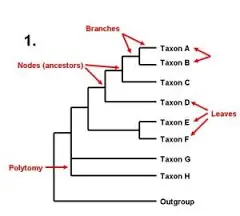
Phylogenetic trees
A hypothesis diagram about evolutionary history of related species (demonstrate, fossil records/DNA)

Cladistics
The history of ancestral species that are then placed on a phylogenetic tree, study of clades

Clades
The group of ancestral species themselves

Out group
Species diverged before common ancestor (e.g frog)

In group
Characteristics that separate it from a outgroup (e.g snakes, lizards, birds)

What is an example of a outgroup and ingroup?
Baboon- out group and ingroup Orangutan, Gorilla, Chimp, Human in
Infectious diseases
Diseases caused by pathogen that invades tissue
Genetic disease
Not caused by a pathogen but a defect in genes
Pathogen (in this case its a bacteria/parasite pathogen not a virus)
Bacteria and virus or other micro organism e.g gastro enteritis
Vector-born diseases
Diseases transmitted from person to person through an insect (e.g mosquitoes)
What do pathogens do?
Needs the host to develop
Bacterial Infection can be cured with…
Anti biotics
Useful Bacteria examples are…
Sewage treatment and bioremediation
Sewage treatment
sewages has to be treated w/ bacteria that treats it & turns it less harmful
Bioremediation
An environmental clean up using living organisms(bacteria, fungi, plants) to degrade hazardous pollution
What is an important fertilizer?
Nitrogen
What can speciation lead to?
Can lead to a population no longer being able to meet/mate because a species evolve into 2 different species w/ their own path

Graduated model
A model for a evokution of new species (NOT always LINEAR)
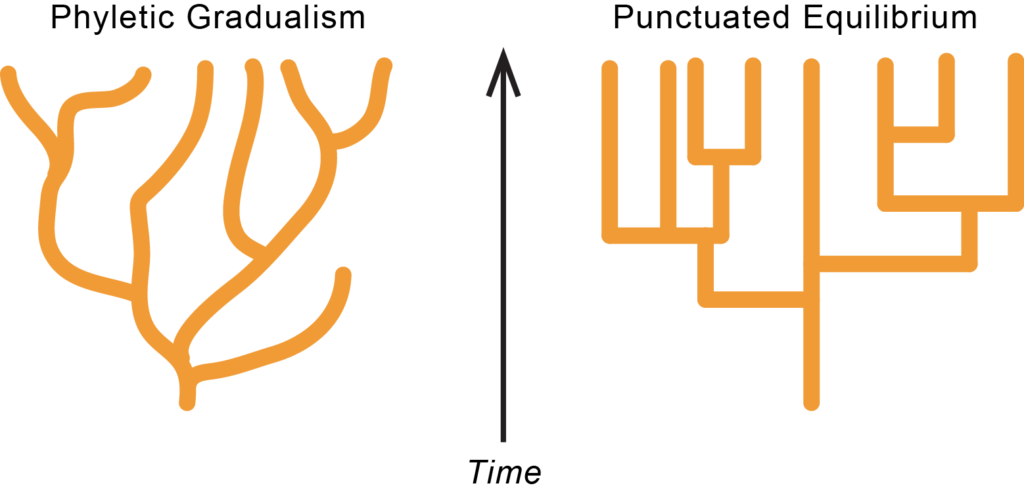
Punctuated equilibirum
Periods of NO CHANGE, INTERRUPTED by a BURST of SPECIATION
Example of punctuated equilibrium
Mammals NOT CHANGING UNTIL SPECIATION following extinction of dinosaurs

Allopatric speciation
Populations separated physically geographically into 2

Sympatric speciation
The emergence of a new species, in the midst of parent population WITHOUT ISOLATION
Example of sympatric speciation
In plants accidents during cell division can result in organisms w/ multi sets of chromosomes, producing new stuff
What did sympatric speciation eventually took part in?
Took part in the creation of food crops (apples, coffee, wheat) errors caused self fertilization producing modern bread
What does unequal reproduction lead to?
Unequal reproductive success leads to natural selection
What has evolution done?
Evolution has shaped life on earth through natural selection
Do individuals evolve?
That is FALSE
Changes of population refers to…
Evoution
Population
group of individiuals living at the same time/place
Population is the..
The smallest unit that can evolve
gene pools
The forms of all genes in a population at any one time
How does genetic variations occur?
Mutations
Mutations
random changes to DNA
How is natural selection involved w/ gene pools?
Natural selection the more it occurs the more gene pools mix and that gets passed down INCREASING frequency
MICROevolution
Small scale of evolution, changes to generations
Genetic Variation
Changes to genetic makeup of a population
What can mutations cause or do?
create different version of genes, in multi varieties, can BREAK down into 2 and can harm or change survival rates
What are 2 things to know about genetic variations?
Sexual recombination and mutations
Sexual recombination
Produces new arrangements of existing genes during formates of gametes, chromosomes exchanges pieces w/ one another
Independent assortment
Basically how eye color genes occur, the process of sorting genes to get passed down, that don’t affect someone, (genes for different traits are sorted separately from one another during the formation of reproductive cells (gametes)
Darwinian fitness
Contribution that a individual makes to gene pool of next generation compared to others (producing offspring with good traits contributing to population)
What are mechanisms of evolution?
Genetic drift, bottleneck, founder effect, gene flow, sexual selection
Genetic Drift ( important)
a CHANGE in GENE POOL due to CHANCE
Example of genetic DRIFT
In LARGE POP death due to migration has SMALL IMPACT
In SMALL POP random changes AFFECT gene pool
Bottleneck
Change in gene pool due to REDUCTION in POP size
Founder effect
Change in gene pool due to a SMALL POP (so not reduction of pop size)
Example of bottleneck occuring
Due to cheetahs having a reduction in pop size it led to the low variation in gene pool, which is why they look the same today
Gene FLOW (important)
the TRANSFER OF GENES from ONE POPULATION to ANOTHER (due to migration)
What is an example of gene flow?
Humans
Sexual selection
Individuals are more likely to attract mates that have more offspring (e.g males having characteristics that attract females, leading to these genes to contribute to gene pool)
Species
A population that can produce healthy offspring
Can similar appearance mean two animals are the same species?
E.g No birds can be both be birds but are not the same species because THEY CANNOT BREED
Who does the USUAL definition of species not apply to?
Fossils and those who reproduce Asexually
Reproductive Barriers
Separation of species due to diff interbreeding process/biologically
Examples of reproductive barriers
Behavioral isolation, habitat isolation, hybrid weakness, mating time difference, mechanical incompatibility, gametic incompatibility
Behavioral Isolation
Species developing different methods to get mates so leads to different ways to mate w/ each other (separating species)
e.g birds singing to attract mates but frogs won’t react to that
Mating time differences
Species reproducing at different times
Habitat Isolation
Living in different habitats so species never meet, separated
Mechanical Incompatibility
Anatomy incompatible different species, so bees and dogs can’t mate
Gametic Incompatibility
Diff egg/sperm that can’t fertilize,
Hybrid Weakness
The offspring of 2 diff species that could be infertile/sterile
From where did eukaryotic cells evolve?
Eukaryotic cells evolved from prokaryotic cells
Old eukaryotic cells are ancestors of..
Bacteria, fungi, plants, animals
What is one prominent feature of eukaryotic cells?
They all include Endomembrane

What does the Endomembrane system include?
Endoplasmic reticulum, nuclear envelope, golgi apparatus, vesicles, plasma membrane
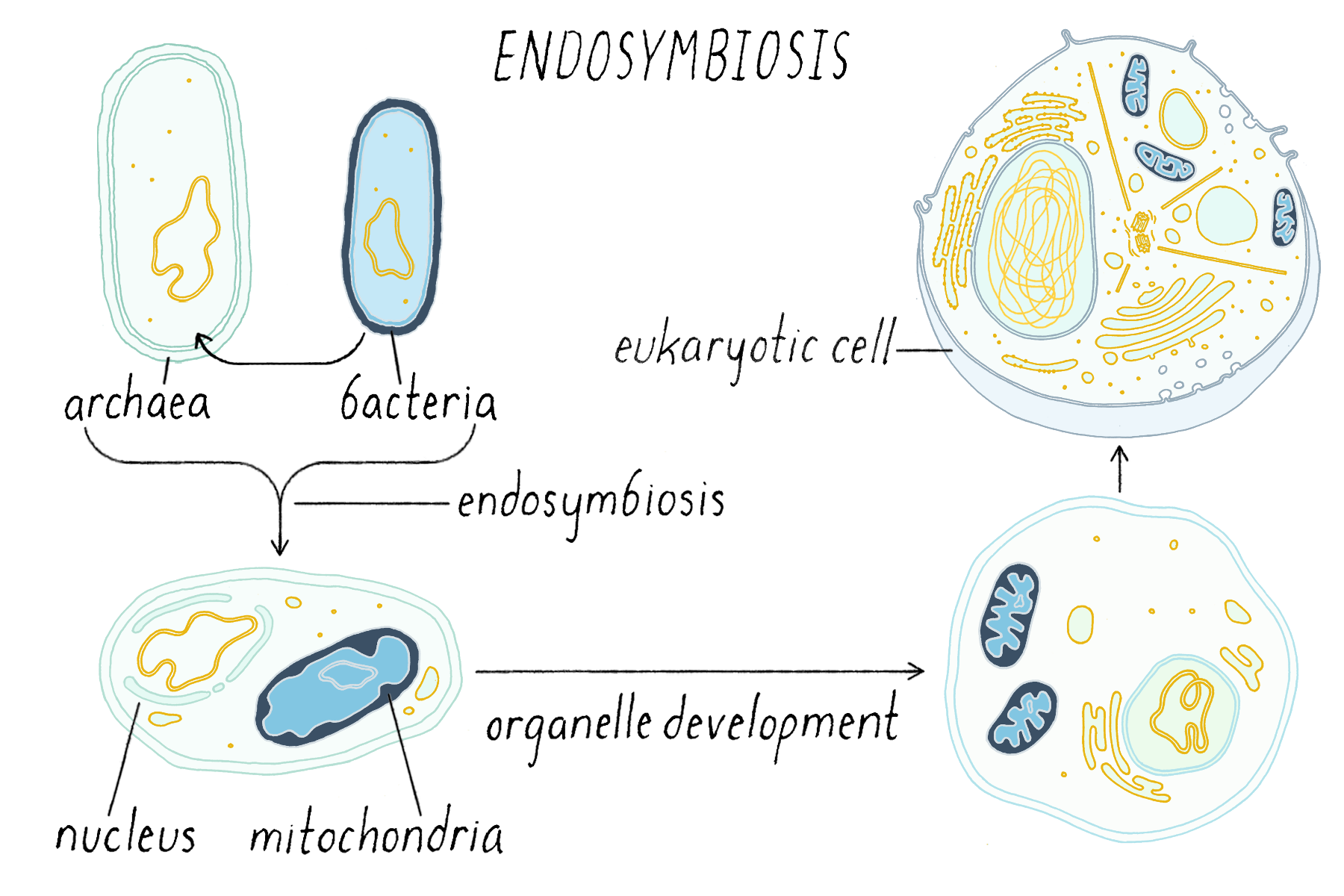
Endosymbiosis
When 1 species lives inside another host species
What are the 2 eukaryotic organelles that evolved from small free living prokaryotes?
Mitochondria and chloroplasts
What has endosymbiosis led to?
HAS benefitted all organisms, offering evolutionary advantadge, leading to interdependence