Formative quiz 2
 Call Kai
 Learn
Learn Practice Test
 Spaced Repetition
 Match
Match Flashcards
 Knowt Play
1/47

There's no tags or description
Looks like no tags are added yet.
Name | Mastery | Learn | Test | Matching | Spaced | Call with Kai | Chat |
|---|
No analytics yet
Send a link to your students to track their progress
48 Terms

Whhich muscle is this?
Levator labii superioris
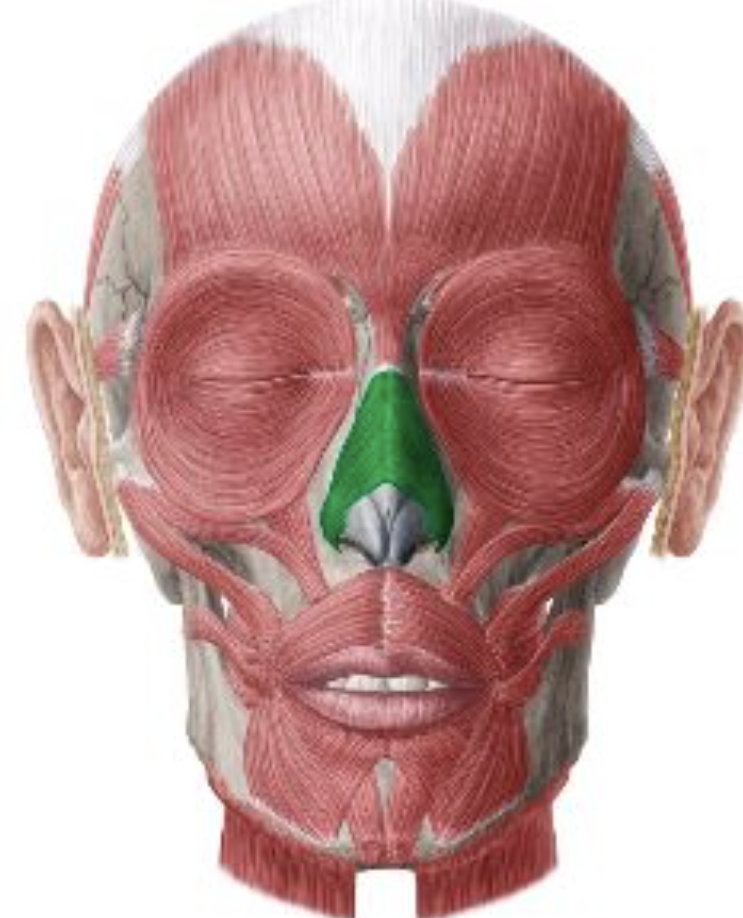
Which muscle is this?
Nasalis
Which of the following facial muscles extends from the lower border of the mandible to the angle of the mouth?
Depressor anguli oris
Which muscle helps in protruding the lower lip?
Mentalis
Which muscle pulls the corner of the mouth laterally and downwards and tightens the skin of the neck?
Platysma
Which muscle consists of two parts and can both compress and widen the nares?
Nasalis
Which muscle encircles the mouth?
Orbicularis oris
An 11-year-old boy comes to his pediatrician complaining about not being able to smile properly or close his left eye since this morning. All laboratory and imaging diagnostic tests are clear. By exclusion, the doctor establishes a diagnosis of left-sided Bell palsy, a paralysis of the facial nerve of unknown cause. Which muscle pulls the corners of the mouth sideways, and thereby assists in smiling?
risorius
A 52-year-old woman decides to get a Botox treatment for the wrinkles on her forehead. Which muscle draws the eyebrows downward and medially and produces the vertical wrinkles of the forehead?
Corrugator suppercilli
A 63-year-old patient suffers from chronic progressive external ophthalmoplegia. It is a disorder characterized by progressive weakness of the muscles of the eyes and eyebrows. He complains about not being able to close his eyes tightly, which results in irritation, burning, and dryness of the eyes. Which of the following muscles is weak in this patient?
Orbicularis oculi
If a patient is unable to depress the eyebrows and wrinkle the forehead, which facial muscle is affected?
Corrugator suppercilii
Which muscle forms the muscular basis of the cheeks?
Buccinator
Treacher-Collins syndrome is a rare congenital disorder characterized by deformities of the eyes, cheekbones, jaw, and ears. The severity varies from mild, unnoticeable defects to significant facial deformities with life-threatening complications. It is caused by genetic mutations that lead to an abnormal development of the first and second pharyngeal arch. All facial muscles derived from the second pharyngeal arch are supplied by which nerve?
facial
When testing the jaw jerk reflex to assess a patient's trigeminal nerve function. The mouth is held slightly open; the examiner places the index finger on the patient's chin and taps the finger with the reflex hammer. In healthy people, the stretch to which of the following muscles provokes an upward movement of the mandible?
masseter
Which masticatory muscle protrudes the mandible and moves it laterally?
Lateral pterygoid
The masseter muscle (musculus masseter) causes elevation and protrusion of which structure?
Mandible
Which muscles of the jaw are located on the inner surface of the mandible?
medial pterygoid
Which masticatory muscle elevates and retrudes the mandible, while also assisting the lateral pterygoid muscle to move it laterally?
temporalis
Misalignments of the teeth and jaws, trauma, and prolonged immobilization (e.g., after a mandibular fracture) leading to pain in the temple area are typically caused by the tension of which muscle?
temporalis
A 35-year-old man is brought to the emergency department after a penetrating injury to the skull. The patient also suffered an injury to the nerve supplying most facial muscles. This nerve arises from which of the following pharyngeal arches during gestation?
second
Which nerve innervates all the muscles of mastication?
Mandibular
Which part of the mandible provides insertion for the temporal muscle?
Coronoid process
Which of th efollowing muscle functions in the closing the eye when blinking?
Orbicularis oculi
Which of the following muscle does not attach to the modiolus?
zygomaticus minor
Which of the following muscles produce the side to side grinding movements of the mandible?
Medial and lateral pterygoid

Which muscle moves up the tongue but is not innervated by the hypoglossal nerve?
C, Palatoglossus muscle

Which muscle retracts the tongue?
A, Styloglossus muscle

Which muscle protrudes the tongue?
D, Genioglossus muscle

Which muscle doesn’t move the tongue?
E, Geniohyoid muscles

Which muscle depresses the tongue?
B, Hyoglossus muscle

Muscle making the floor of the mouth and elevate the tongue?
A, Mylohyoid muscle

Infrahyoid muscle that connecthyoid with the shoulder
E, Inferior belly of the omohyoid muscle

Sternohyoid muscle
F, Sternohyoid muscle

Suprahyoid muscle that has two bellies
B, Anterior belly of the digastric muscle

Infrahyoid muscle that does not move the hyoid
D, Sternothyroid muscle

Infrahyoid muscle that nove the thyroid cartilage up and hyoid bone down
C, Thyrohyoid muscle

Unilateral muscle contraction, flex ipsilateral, and move face looking to opposite site
G, Sternocleidomastoid

Muscle found in the surface of the ramus of the mandible
D, Angle of the mandible

Muscle that elevates and retracts the mandible
A, Temporalis muscle

Main muscle for protrusion of the mandible
B, Superior head of the lateral pterygoid muscle

Muscle deep to the ramus of the mandible that elevates the mandible
C, Deep head of the medial pterygoid muscle

Muscle that elevates the upper lip
Levator labii superioris

Muscle that closes the eye
A, Orbicularis oculi

Muscle that close the lips and mouth
D, Orbicularis oris

Muscle attaches to the modiolus and elevates the upper lip
Levator anguli oris

Muscle for smiling and attach to the modiolus
C, Zygomaticus major

Muscle that tenses the lower face and neck
G, Platysma

Muscle that pulls down the corner of the mouth and attach to the modiolus
F, Depressor anguli oris