Science Consolidated
 Call Kai
 Learn
 Practice Test
 Spaced Repetition
 Match
 Flashcards
 Knowt Play
1/111

There's no tags or description
Looks like no tags are added yet.
112 Terms
Health, Disease & Disorder
Health: A state of mental, physical, and social well-being
Disease: A condition that interferes with the normal bodily function of an organism
Disorder: An abnormality in the function of the body or mind
Pathogen
A biological agent that causes disease or illness in a host organism
Micro-organism
A microscopic organism which may exist in its single-celled form or a colony of cells
Infection
The invasion and multiplication of harmful organisms in or on the body’s tissues
Virulence
A pathogen’s ability to cause damage to a host
Endemic, Epidemic, Pandemic & Outbreak
Endemic: A disease outbreak that is consistently present but limited to a particular region
Epidemic: A sudden increase in the occurrence of a disease among the population in a given area
Pandemic: When an epidemic occurs across multiple countries or continents
Outbreak: A sudden, unexpected increase in the prevalence of a particular disease above the base level for that population
Antibodies & Antigens
Antibody: Produced by plasma B cells and released into the blood and lymph in order to neutralize foreign invaders
Antigens: Unique molecules or parts of molecules that can often elicit an immune response
Vaccinations
Vaccination: The artificial introduction of antigens of pathogenic organisms to the body
Vaccine: A preparation containing antigens that stimulates the immune system to produce antibodies and memory cells, providing protection against a particular disease
Zoonotic Disease
An infectious disease that naturally spreads from animals to humans Eg: Avian influenza, which originated from birds, but has mutated to be able to infect humans
Vectors
Organisms that transmit pathogens from an infected host to a susceptible host
Immunity
Immunity: The body’s ability to recognise foreign substances and stimulate cells to destroy or remove them
Immunological Memory: The ability of the adaptive immune system to recognise a pathogen it has encountered before and launch a faster, stronger response
Immunization: Programming the immune system so that the body can respond rapidly to infecting microorganisms
Transmission
The way a pathogen spreads disease from one host to another
Bacteria
0.2-10 μm (micrometres)
DNA - large circular chromosome, smaller circular fragments (plasmids)
Prokaryotic
Unicellular
Peptidoglycan cell wall covered in cilia and flagellum to assist movement
Types of Bacteria
Spherical - coccus
Rod shaped - bacillus
Spiral - spirillum
Comma shaped - vibrio
Viruses
20-300 μm
Protein coat encloses infectious genetic material (DNA or RNA)
Neither prokaryotic or eukaryotic
Non-cellular
Fungi
Around 50 μm
DNA within a nucleus
Eukaryotic
Can be unicellular (yeasts) or multicellular (moulds)
Cell wall composed of chitin
Protists (Protozoa)
1-300 μm
DNA
Eukaryotic
Can be unicellular, multicellular, or colonial
Membrane-bound nucleus + organelles, but no cell wall
What are Protist pathogens?
Unicellular eukaryotes that are not classified as plants, animals, or fungi, but may have some plant, animal or fungi features
Infectious disease caused by Bacteria
Tetanus - caused by clostridium tetani - enters the human body through contact with open wounds
Disease caused by a Protist
Malaria - caused by plasmodium parasite - transmitted through mosquito bites, specifically female anopheles mosquitos
Disease caused by a Fungus
Ringworm - skin infection - red circular rashes
Prokaryotic vs Eukaryotic
Prokaryotic cells lack a nucleus and membrane bound organelles whereas eukaryotic cells possess both
DNA viruses vs RNA viruses
DNA - usually double-stranded & can encode up to hundreds of viral proteins
RNA (retroviruses) - usually single-stranded & have smaller genomes that encode only a few proteins
Both can be linear or circular
Infectious vs Contagious vs Non-Infectious Diseases
Infectious diseases have a causative agent (pathogen)
Contagious diseases can spread between individuals
Non-infectious diseases are caused by genetics, environmental influences, or cellular malfunction
All contagious diseases are infectious, but not all infectious diseases are contagious
Three ways infectious diseases are spread
Direct or close contact - transmission within 1-2 m such as Ebola and COVID-19
Indirect contact - transmission outside of 1-2 m such as measles or on a fomite surface
Vectors
Three ways infectious diseases can be controlled
Physical preventative methods eg: wearing gloves, masks, hand washing
Medication - antibiotics/antivirals
Vaccination
Types of Vaccines
Live attenuated - microorganisms of reduced virulence, good for long lasting immunity, but bad for individuals with weaker immune systems
Eg: Measles, mumps and rubella (MMR) vaccine
Inactivated - dead microorganisms, safe for people with compromised immune systems but immunity tends to be weaker
Eg: Inactivated Polio vaccine (IPV)
Toxoid - toxins that are produced by bacteria, safer to take but immunity decreases over time
Eg: Tetanus vaccine
Sub-unit - fragment of the microorganism, reduced risk of side-effects, but may require multiple doses
Eg: HPV vaccine
Antibiotics
Bactericidal - kill bacteria by disrupting the cell wall, cell membrane, or essential enzymes
Bacteriostatic - prevent bacteria from reproducing
Broad spectrum & narrow spectrum
Antivirals
A type of medication targeted towards viruses and specifically affects virus-infected cells
Can prevent virus from entering the cell, exiting the cell, and replicating within the cell
Skin
First line of defence
Provides an impervious mechanical barrier to prevent pathogens from entering the body
Low pH, constant shedding of dead skin cells, chemical secretions → inhibit the growth of pathogens
Mucous Membranes
First line of defence
Viscous, slimy secretions that protect internal structures
Contains lysosomes that destroys bacterial cell walls
Cilia
First line of defence
Slender, hairlike structures that protrude from the surface of most mammalian cells
Acids
1st line of defence
Stomach juices are highly acidic to kill ingested bacteria and swallowed pathogens
Sweat is slightly acidic & contains lysosomes
Phagocytosis
2nd line
The process by which phagocytes change shape and completely enclose a foreign particle, releasing enzymes to destroy it
Phagocytes include: neutrophils, macrophages, dendretic cells, natural killer cells
Inflammation
2nd line
A chemical response that helps wounds repair and leads to pathogen destruction
Five cardinal signs of inflammation: pain, heat, redness, swelling, loss of function
Fever
2nd line
Caused by pyrogens released by macrophages
Occurs when cytokines alter the body’s set temperature
Slows the replication of bacteria and viruses by shifting the temperature away from their optimal range
Four protective reflexes
Coughing - irritation occurs in lower respiratory tract and causes expulsion of air from lungs
Sneezing - occurs when the walls of the nasal cavity are irritated
Vomiting - can be induced by psychological stimuli, excessive stretching of stomach, or bacterial toxins
Diarrhoea - Results due to irritation of small/large intestines by bacteria/viruses/protozoa, irritation causes increased contractions of muscles leading to rapid removal of irritant
Blood Components
Plasma: liquid component, carries nutrients, hormones, waste products, helps to regulate body temp.
Platelets: Small cell fragments, help with blood clotting
Red Blood cells (erythrocytes): contains haemoglobin which allows them to transport oxygen from the lungs to the rest of the body & remove carbon dioxide
White blood cells (leukocytes): part of the immune system, help fight infections by attacking foreign invaders
Macrophages
Monocytes differentiate into macrophages
Responsible for detecting, targeting and eliminating foreign substances that are in the body
Act as Antigen Presenting Cells, meaning they present antigens on the cell surface by protein molecules
Lymphocytes
Adaptive immunity cells which produce antibodies to target specific antigens
Types of Immunity
Active Immunity - involves the production of antibodies by the body itself and the subsequent development of memory cells
Passive Immunity - results from the acquisition of antibodies from another source and hence memory cells are not developed
Main parts of the Immune System
Innate - consists of chemical & cellular defences against pathogens - its purpose is to immediately prevent the spread of pathogens - it is present from birth - first & second line of defense
Adaptive - response that is specific to the pathogen presented, takes longer to initiate - usually the third line of defense
3 lines of defense
First line of defense - the surface barriers that prevent the entry of pathogens into the body, innate & non-specific
Second line of defense - the non-specific phagocytes and other internal mechanisms that comprise innate immunity
Third line of defense - the specific lymphocytes that produce antibodies as part of the adaptive immune response
Humoral Immunity
Humoral immunity is effective against pathogens that are outside the body cells and involves antibodies produced by B lymphocytes
Plasma B cells are responsible for antibody production
Memory B cells remain in lymphoid tissue and are responsible for immunity
Cell Mediated Immunity
Cell-mediated immunity is effective against pathogens within cells and involves the action of T lymphocytes
Cytotoxic T cells clone themselves, move to the cite of infection, and release cytokines to destroy it and the pathogen, usually by causing apoptosis (programmed cell death)
Suppressor T cells slow down/turn off the immune system to prevent damage to good cells
Memory T cells are produced after helper and cytotoxic T cells
Helper T cells activate both cell mediated & humoral responses
Active vs Passive Immunity
Active natural - producing antibodies in response to a pathogenic infection
Active artificial - producing antibodies in response to a vaccine
Passive natural - receiving antibodies from another organism eg: through breastmilk
Passive artificial - receiving manufactured antibodies via external delivery
How do antibodies work
The antibody binds directly to the antigen, neutralizing it
The antibody acts as a tag on the antigen, making it easier for immune cells to recognize it
Antibodies can clump multiple antigens together (Agglutination) or pull soluble antigens out of a solution (precipitation)
How can a virus change over time due to mutations
Viral errors predominantly arises during replication
Synthesis error - when polymerase adds incorrect nucleotides to the DNA/RNA sequence
Proofreading - when DNA/RNA mismatches are not corrected by proofreading and/or post-replicative repair
RNA viruses mutate faster than DNA viruses
How do viruses replicate
Once the virus infiltrates the cell, it multiplies by incorporating its own RNA/DNA into the host’ genetic material and replicating during the cell’s normal DNA replication process
Life Cycle of a Virus
Attachment to host cell
Entry into host cell
Biosynthesis
Maturation
Release
Attachment to host cell
A portion of the molecule on the viral surface resembles the chemical shape of the body’s molecule and this is how the virus binds to host cell receptors
Entry into the host cell
Enveloped viruses can enter through envelope fusion, where the viral envelope fuses with the host cell membrane
Or through endocytosis, where the host cell membrane encapsulates the viral particle
Naked viruses can enter through passing their nucleic acid from the viral capsid into the host cell membrane
Or also through endocytosis
Biosynthesis
Following entry into the host cell, the viral genome enters the cell’s nucleus where it is replicated, and transcribed into RNA in the ribosomes, if required
Maturation
The capsid is assembled around the viral genome
Release
Naked viruses are predominantly released by host cell lysis (when the cell membrane ruptures leading to cell death)
Enveloped viruses are released through budding, where the virus obtains its membrane from the host cell membrane, or through exocytosis, where the virus obtains its envelope and is released via transport vesicles
Atomic Mass
Total number of protons and neutrons
Atomic Number
Total number of protons
Nucleons
Either a proton or neutron within the nucleus of an atom
Strong nuclear force
One of the four fundamental forces in nature, responsible for binding protons and neutrons together inside the nucleus of an atom
Electromagnetic force
A physical interaction that occurs between electrically charged particles, opposite charges attract each other, while identical charges repel each other
Radioactive decay
The spontaneous process by which an unstable atomic nucleus loses energy by emitting ionizing radiation (alpha, beta, gamma) in order to become stable
How does strong nuclear force + electromagnetic force relate to the stability of a nucleus
The stability of a nucleus depends on the constant competition between the strong nuclear force holding the nucleus together, and the electromagnetic force attempting to split it apart
The strong nuclear force only effects nucleons that are close to each other and balanced and the electromagnetic force causes the positive protons within the nucleus to naturally repel each other
Large nuclei eventually become unstable because when a nucleus has too many protons, the electromagnetic force eventually causes it to split apart
Different isotopes have different levels of stability
Because of the balance between protons and neutrons inside the nucleus, and the competing strong nuclear force and electromagnetic force acting on them
Binding Energy
The energy that needs to be supplied to split a nucleus into its constituent nucleons
Binding energy is absorbed when an atom or nucleus is broken apart, and released when an atom or nucleus is formed
Binding energy of products > binding energy of reactant = exothermic (energy released)
Binding energy of products < binding energy of reactant = endothermic (energy absorbed)
How does Binding Energy relate to the stability of a nucleus and nuclei becoming unstable?
A higher binding energy per nucleon means a nucleus is more tightly bound and more stable
A low binding energy per nucleon indicates instability and a tendency to undergo radioactive decay
Mass Defect
The mass lost when separate nucleons bind to form a nucleus
mass of nucleons - mass of nucleus
The total mass of a stable nucleus is always less than the masses of the constituent nucleons, this difference in mass is known as the mass defect
This lost mass is converted directly into released energy through E=mc2
Mass Defect & Binding Energy
Binding Energy = mass defect x speed of light2 (E=mc2)
Energy = Mass x Speed of Light (3 × 10⁸)2
To split a nucleus into nucleons, the binding energy must be supplied to their nucleus, to replace the mass defect
Alpha Radiation (α)
2 protons + 2 neutrons (a helium nucleus)
Mass: 4 u (atomic mass units)
Charge: +2
Speed: 5-10% the speed of light
Ionizing ability: Strongly ionizing, double positive charge & large mass allows them to strongly attract + strip electrons away from neutral atoms they pass
Penetrating power: Weakly penetrating, travels 1-5cm in air, can be stopped by paper or the outer layer of human skin
Beta Radiation (β)
High energy, high speed electron
Mass: 1/1860 the mass of a proton
Charge: -1
Speed: aprox. 30-90% the speed of light
Ionizing ability: Moderately to weakly ionizing, stronger than gamma rays but weaker than alpha particles
Penetrating power: Moderately penetrating, travels a few metres in air, can be stopped by 5mm of aluminium
Gamma Radiation (γ)
High frequency electromagnetic waves
Mass: 0
Charge: 0
Speed: The speed of light
Ionizing ability: Weakly ionizing, they do not frequently interact with matter due to their lack of mass and electric charge
Penetrating power: Highly penetrating, travels for an infinite range through air, can be stopped by 10cm of lead or several metres of concrete
Alpha Decay
Where an unstable atomic nucleus changes into a new element by shooting out an alpha particle
Atomic mass reduces by 4 and atomic number reduces by 2 in daughter nucleus

Beta Decay
When an atom’s nucleus decays and releases a beta particle, a neutron turns into a proton which stays in the nucleus, and a high energy electron is emitted
Atomic mass remains the same, but atomic number increases by 1 in daughter nucleus

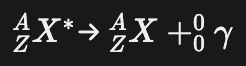
Gamma Decay
Where an unstable atomic nucleus drops from a high-energy excited state to a lower energy state by releasing gamma rays
Half Life
The time it takes for half of the nuclei in a radioactive sample to decay (t½)
The more unstable an isotope is, the faster it decays, resulting in a shorter half-life
Nuclear Fusion
A nuclear reaction in which 2 or more light atomic nuclei combine to form one or more different, heavier atomic nuclei and subatomic particles
The difference in mass between reactants & products manifests as the release of energy
This results from the difference in nuclear binding energy
Nuclear Fission
A nuclear reaction the occurs when an atomic nucleus splits into 2 or more pieces, which can happen spontaneously but is often triggered by the absorption of a neutron
The total mass of fission products is slightly less than original reactants, with the loss of mass converting into energy
Why does nuclear fusion release more energy than nuclear fission?
Fusion reactions have a larger mass defect than fission reactions, therefore, more mass is converted into more energy to be released
Main components of nuclear power stations
Reactor vessels - encase and prevent radiation from escaping
Control rods - absorb neutrons to control nuclear reactions
Fuel rods - contain pellets of enriched uranium & generate heat through controlled nuclear fission
Steam generator - a heat exchanger that uses heat from the reactor core to power a turbine and generate energy
Moderator - slows down fast neutrons produced during fission so they can effectively cause nuclear fission
How do nuclear power stations work to generate electricity?
A nuclear reactor is a device in which nuclear reactions are generated
The chain reaction is controlled to release large amounts of steady heat
This heat is used to create steam, which powers a turbine and generates electricity
Controlled vs Uncontrolled nuclear reactions
Uncontrolled reactions occur when neutrons escape too quickly resulting in the rapid release of nuclear energy, causing an explosion
Controlled reactions occur when the neutrons produced from nuclear fission are slowed and absorbed to maintain a steady chain reaction
Advantages of using nuclear energy
Longer operational lifetime than traditional coal power plants
Reliable and fuel efficient
Disadvantages of using nuclear energy
Lengthy development times, mean they are unable to satisfy immediate electricity demands
Dangerous radioactive waste is produced, which must be safely dealt with and disposed of securely underground
What is Energy?
The capacity to do work or cause change
What is Energy Consumption?
Energy consumption refers to all the energy used to perform an action, manufacture something, or simply inhabit a building
Direct vs Indirect energy use
Direct energy use refers to the energy that is immediately consumed in the moment
Eg: Turning on a light
Indirect energy use refers to the energy that is consumed in the creation or transport of goods and services - the user does not directly use the energy, but causes the energy use elsewhere
Eg: Energy used to manufacture a lightbulb
What are Fossil Fuels?
Non-renewable resources made from the remains of plants and animals that died millions of years ago and have been subjected to immense heat and pressure causing them to turn into a carbon-rich fuel
Three types: coal, oil, natural gas
What happens to the concentration of CO2 in the atmosphere when we burn fossil fuels?
Burning fossil fuels releases large amounts of CO2 into the atmosphere at a faster rate than it can be removed - this causes the overall CO2 concentration to increase
Describe the Greenhouse Effect
Earth’s surface absorbs visible light from the sun & increases in temperature
Earth’s surface emits infrared radiation, most of which passes through the atmosphere
Some infrared radiation is absorbed by molecules of greenhouse gas
These molecules of greenhouse gas increase in vibrational energy
Increased vibrations causes more collisions with other molecules of gas
Kinetic energy of gases in the atmosphere increases causing the temperature of the atmosphere to increase

Effects of the Greenhouse Effect
Global:
Greenhouse effect aintains relatively warm average global temperature, whereas enhanced greenhouse effect causes average surface temperature to increase, causing extreme weather
Greenhouse effect keeps water moving through the water cycle, but enhanced greenhouse effect causes sea levels to rise & flood coastal regions due to melting ice sheets
Local:
Greenhouse effect creates stable biomes with predictable weather, but enhanced greenhouse effect causes water scarcity and wildfire risks as the temperature continues to increase
Common Greenhouse Gases
Carbon Dioxide - CO2
Methane - CH4
Nitrous Oxide - N2O
Chlorofluorocarbons (CFCs)
Hydrofluorocarbons (HFCs)
What is Organic Chemistry?
The study of compounds based on carbon atoms and their structures, properties, and reactions
Process of Fractional Distillation
Crude oil is heated until most of it evaporates and turns into a gas, where it is pumped into the fractionating column
Column is hot at bottom, cool at top, vaporized oil rises
When a substance reaches a height in the column where the temperature is equal to its boiling point, it condenses to form a liquid
Crude oil is then separated into different fractions at different heights, each fraction contains hydrocarbons with similar boiling points
Heavy fractions with longer molecular chains condense near the bottom, lighter fractions with shorter molecular chains condense near the top
Boiling Point
The temperature at which a substance changes from a liquid into a gas (or gas to liquid)
Viscosity
How difficult it is for a liquid to flow
Volatility
How easy it is for a substance to change into a gas
Flammability
How easy it is for a molecule to catch fire and burn in the air
Longer chain hydrocarbons
High boiling point
High viscosity
Low volatility
Low flammability
Shorter chain hydrocarbons
Low boiling point
Low viscosity
High volatility
High flammability
Fractions within a fractionating column (must be in order)
Refinery gas
Petrol
Naptha
Kerosene
Diesel
Fuel oil
Lubricating oil
Residue/Bitumen
Alkanes
Homologous series of hydrocarbons that contain only carbon-carbon single bonds
Are saturated
General formula: CnH2n+2