Exam 3 Review: Learning, Cognition, Intelligence, Emotion, and Motivation
 Call Kai
 Learn
 Practice Test
 Spaced Repetition
 Match
 Flashcards
 Knowt Play
1/81

Earn XP
Description and Tags
Comprehensive vocabulary flashcards covering classical and operant conditioning, cognitive decision-making heuristics and biases, theories of intelligence, physiological and cognitive models of emotion, and core motivational concepts for Exam 3 review.
82 Terms
Classical Conditioning (Pavlovian Conditioning)
Learning by making an association between two stimuli
where a previously neutral stimulus becomes associated with a stimulus that naturally causes a response.
Conditioned Stimulus (CS)
A stimulus that originally does not cause the specific response but eventually does after being paired with an unconditioned stimulus.
Example: A bell that becomes associated with food.
Conditioned Response (CR)
A learned reaction produced by a conditioned stimulus after association has taken place (such as a dog salivating upon hearing a bell).
Unconditioned Stimulus (US or UCS)
Something that naturally causes a response without learning.
Example: Food naturally causes a dog to salivate.
Unconditioned Response (UR or UCR)
A natural, automatic response to an unconditioned stimulus.
Example: A dog naturally salivating when food is presented.
Acquisition of CR (Classical Conditioning)
The process of learning the association between the conditioned stimulus and unconditioned stimulus.
The conditioned response gradually becomes stronger
Extinction of CR (Classical Conditioning)
When the conditioned stimulus is repeatedly presented without the unconditioned stimulus.
The learned response gradually becomes weaker.
Example: A bell is repeatedly rung without food, so the dog eventually stops salivating.
Little Albert Experiment
An experiment by John B. Watson and Rosalie Rayner.
A young child was conditioned to fear a white rat by pairing it with a frightening noise.
Demonstrated how a fear response could be learned through classical conditioning.
Taste Aversion Learning
A form of classical conditioning in which an animal or human learns to avoid a specific food after becoming sick from eating it; can occur after a single trial, despite long delays between eating and illness, and can last a lifetime.
Law of Effect
Behaviors followed by satisfying outcomes are more likely to happen again.
Behaviors followed by unpleasant outcomes are less likely to happen again.
Developed by Edward Thorndike.
Operant (Instrumental) Conditioning
Learning an association between a behavior and its outcome.
Behaviors increase or decrease depending on their consequences.
Reinforcement increases behavior, while punishment decreases behavior
Thorndikes puzzle box experiment
Thorndike placed hungry cats inside a puzzle box with food outside.
The cats learned how to escape by performing a specific action.
trial/error learning
Drilled in repetition in learning
Over time, they escaped faster because they learned which behavior produced a reward.
Operant conditioning
Shaping
Teaching a behavior through small steps called successive approximations.
Rewarding behaviors that gradually get closer to the desired behavior.
Example: Rewarding a pigeon for gradually getting closer to turning in a circle until it learns the full action.
Skinner Box
A controlled environment designed by B.F. Skinner to study animal behavior.
Animals learn to perform behaviors, such as pressing a lever, to receive rewards.
Used to study reinforcement and punishment.
Partial Reinforcement
An operant conditioning
Reinforcing a behavior only some of the time instead of every time.
Learning happens more slowly, but the behavior becomes more resistant to extinction.
Ratio Schedule
Reinforcement depends on the number of responses |
Variable Schedule
The number of responses or the amount of time changes.
Fixed Schedule
The number of responses or amount of time stays the same.
Interval Schedule
A reinforcement depends on how much time has passed
Positive Punishment
Adding something unpleasant to decrease behavior.
The addition of an unpleasant stimulus following a behavior to decrease the likelihood of that behavior occurring in the future.
Negative Punishment
Taking away something enjoyable to decrease behavior.
The removal or confiscation of a pleasant or rewarding stimulus following a behavior to decrease the likelihood of that behavior recurring.
Instinctive Drift
When an animal's instincts interfere with learned behavior/ trained operant behaviors.
Breland and Breland discovered that animals sometimes return to natural, instinctive behaviors even after being trained.
Not every behavior can easily be associated with every reward.
Token Economy
A behavior modification system frequently used in institutional settings where individuals earn tokens or points for exhibiting desirable behaviors, which can later be traded for tangible rewards.
Learned Helplessness
Occurs when someone learns that their actions do not affect what happens to them.
After repeated experiences where their actions have no effect, they may stop trying to change the situation.
Can look similar to depression.
Cognitive Concepts
Mental representations that group and categorize objects, events, or experiences based on shared properties and features.
System 1 Thinking
Daniel Kahneman's concept of fast, automatic, intuitive, and emotional thinking that operates with little to no deliberate cognitive effort.
System 2 Thinking
Daniel Kahneman's concept of slow, effortful, deliberate, and logical thinking that requires focused conscious attention to analyze problems and reach rational decisions.
System 1 errors (6)
Availability bias: making decisions based on examples that easily come to mind rather than looking at all facts (e.g think plane crashes bc saw a recent one on the news)
Representativeness Heuristic: judging someone or smth based on how they match steryotype/typical example (e.g think someone is doc bc of their clothes)
Conjunction fallacy: believing that 2 events happening together are more likely than one happening alone (e.g., believing someone to be a bank teller AND a feminist, then solely a bank teller)
Framing effects: making different decisions depending on how info is presented, even when info is the same (e.g. choosing a product w/ 90% success instead of one w/ 10% failure)
Optimism bias: believing bad things are less likely to happen to you than to other ppl
End-of-history illusion: believing you have changed a lot in the past but will not change much in the future. (e.g thinking current interests+beliefs will stay the same for the rest of life)
Prototype Theory
We categorize things by comparing them to the best or most typical example of a category.
Example: When thinking of a bird, you might picture a robin because it is a typical bird.
Exemplar Theory
We categorize things by comparing them to specific examples we have experienced before.
Example: Recognizing a dog because it reminds you of a dog you have seen before
Rational Choice Theory
People make decisions by weighing an outcome's value against how likely it is to happen.
Decisions are supposed to be based on the expected benefits and risks.
However, people do not always make completely rational decisions.
Heuristics
Mental shortcuts or simple rules of thumb that help people make decisions quickly.
They save time but can sometimes lead to mistakes or incorrect judgments.
Algorithms
Step-by-step procedures used to solve problems.
Unlike heuristics, can guarantee a correct solution when followed properly.
Availability Bias
A cognitive heuristic
Judging how likely something is based on how easily examples come to mind.
Events that are more memorable or frightening seem more common than they actually are.
Example: After hearing about a plane crash, someone may believe flying is extremely dangerous.
Representativeness Heuristic
A mental shortcut
Making judgments based on how much someone or something matches a typical example or stereotype.
People may ignore actual statistics or probabilities.
Example: Assuming someone is an engineer because they enjoy math and puzzles, even without considering how many engineers and lawyers are in the group.
Conjunction Fallacy
Believing that two events happening together are more likely than one event happening by itself.
Example: Believing someone is more likely to be a bank teller AND a feminist than simply a bank teller.
** Adding more details does NOT make something more likely to happen
Framing Effects
People make different decisions depending on how information is presented or worded.
Example: A treatment described as having a 70% success rate sounds more positive than one described as having a 30% failure rate, even though they mean the same thing.
Optimism Bias
The belief that we are more likely to experience positive events and less likely to experience negative events compared with other people.
Example: Believing you are less likely than others to get into an accident.
Confirmation Bias
The tendency to look for information that supports what we already believe instead of looking for evidence that disagrees with us.
Example: Only reading articles that support your opinion.
Functional Fixedness (fixation)
Having difficulty seeing a problem in a new or different way.
Believing an object can only be used for its usual purpose.
Example: Not realizing a box could be used as a stand because you only think of it as something used for storage.
and candle mounting problem: not realizing you can use an actual candle BOX to attach a candle to a wall

9-Dot Problem
A problem-solving activity where you must connect nine dots using four straight lines without lifting your pencil.
Demonstrates fixation because people often assume they must stay within the boundaries of the dots.
The solution requires thinking outside the box.
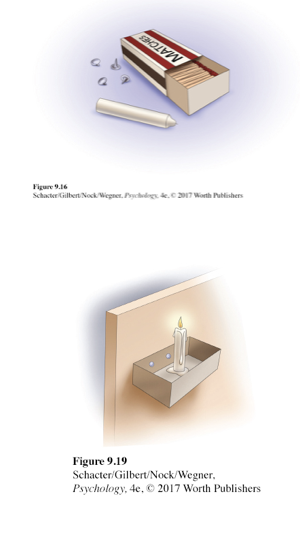
Candle-Mounting Problem
A problem-solving activity where you must attach a candle to a wall using a box of tacks.
Demonstrates functional fixedness because people usually see the box only as a container instead of realizing it can be used as a candle holder.
Intelligence
The ability to use your mind to solve new problems, learn from experience, and adapt to new environments.
a concept, not something physical that can be directly observed.
Intelligence Quotient (IQ)
A score used to measure a person's performance on intelligence tests compared with others of the same age.
An IQ of 100 represents average performance.
IQ tests measure abilities such as reasoning, memory, and problem-solving.

Binet Test
Developed by Alfred Binet and Theodore Simon.
Originally designed to identify children who needed additional educational help.
Measured aptitude (ability to learn), rather than just what someone had already learned.
Wechsler Adult Intelligence Scale (WAIS) and the 4 main areas
A modern intelligence test used to measure adult intelligence.
Includes four main areas:
Verbal comprehension: Understanding words and information.
Perceptual reasoning: Solving visual problems and recognizing patterns.
Working memory: Holding and using information in your mind.
Processing speed: Completing simple tasks quickly and accurately.
Two-Factor Theory of Intelligence
Charles Spearman's theory
General intelligence (g): Overall mental ability that affects performance across different tasks.
Specific intelligence (s): Abilities related to particular tasks or areas.
People can have strong general intelligence but different specific abilities.
Thurstone's 7 Primary Mental Abilities
Louis Thurstone's model asserting intelligence comprises seven independent abilities:
Word fluency – Ability to quickly find words, rhymes, or solve anagrams.
Verbal comprehension – Ability to understand words and sentences.
Numerical ability – Ability to perform calculations.
Spatial visualization – Ability to mentally picture and rotate objects.
Associative memory – Ability to remember information and word pairs.
Perceptual speed – Ability to quickly notice visual details.
Reasoning – Ability to identify patterns and develop general rules.
Sternberg's Triarchic Theory of Intelligence (3 intelligences)
Robert Sternberg believed intelligence includes three types:
Analytical intelligence: Academic problem-solving and analyzing information.
Creative intelligence: Coming up with new ideas and adapting to unfamiliar situations.
Practical intelligence: Handling everyday situations and real-life problems.
Emotional Intelligence
]The ability to understand emotions and use them to improve thinking and decision-making.
Includes:
Recognizing your own emotions.
Managing your emotions.
Recognizing emotions in other people.
Using emotions to make better decisions.
Having better social skills.
Family, Adoption, Twin, and Adoption-Twin Studies
These studies help researchers understand how genetics and the environment influence intelligence.
Family studies: Compare intelligence among family members.
Adoption studies: Compare adopted children with their biological and adoptive families.
Twin studies: Compare identical twins (share 100% of their genes) with fraternal twins (share about 50%).
Adoption-twin studies: Examine twins who were raised in different environments to help separate genetic and environmental influences.
Important: If identical twins have similar IQ scores even when raised apart, this provides evidence that genetics plays a role.
Heritability of Intelligence
The proportion of differences in a trait within a population that can be explained by genetic differences.
The slides give an estimated heritability of IQ between 0.5 and 0.7.
This does NOT mean that 50–70% of one person's intelligence comes from genetics.
Both genes and the environment influence intelligence.
Flynn Effect
The worldwide historical trend of rising average raw intelligence test scores across successive generations, predominantly attributed to environmental enhancements in education, health, and nutrition.
Emotion
A positive or negative experience associated with a particular pattern of physiological activity.
Emotions are automatic responses to events or situations.
They help motivate us to respond to opportunities and threats.
Valence and Arousal
Valence: Whether an emotion is positive or negative.
Arousal: How strongly or intensely your body is activated.
Example: Happiness has positive valence, while fear has negative valence. Both can involve high arousal.
James-Lange Theory of Emotion
The body reacts first, then emotion.
We experience an emotion after noticing our body's physical response to a stimulus.
The body reacts first, and then we interpret that reaction as an emotion.
Example: You see a threat, your heart starts racing, and you interpret the physical reaction as fear.
Cannon-Bard Theory of Emotion
Body reaction and emotion happen simultaneously (at same time)
A stimulus causes the physical response and emotional experience to happen at the same time.
Example: You see a threat and simultaneously feel afraid and experience a racing heart.
Two-Factor Theory of Emotion
Physical arousal + interpretation of the situation = emotion.
Schachter and Singer's theory
Emotions are created by combining physical arousal with how we interpret the situation.
Example: Your heart is racing, and because you are in a scary situation, you interpret that feeling as fear.
Amygdala
brain structure involved in processing emotions, especially fear.
Helps recognize and evaluate possible threats.
Damage can reduce fear and affect how someone recognizes danger.
Fast Emotional Pathway
Thalamus → Amygdala.
Quickly evaluates possible threats.
Allows the brain to respond before fully analyzing the situation.
Slow Emotional Pathway
Thalamus → Cortex → Amygdala.
Allows the brain to analyze information more carefully.
Helps determine whether something is actually dangerous.
Universality Hypothesis
suggests that emotional expressions are similar across all human cultures.
For example, people across different cultures may smile when happy.
people who are congenitally blind smile when happy, supporting the idea that some expressions are not simply learned by watching others
Emotional Display Rules (4)
Describe how people change their emotional expressions depending on the situation.
Intensification: Exaggerating an emotion.
De-intensification: Making an emotion appear less intense.
Masking: Hiding your true emotions by showing a different emotion.
Neutralizing: Hiding emotions completely and showing no expression (poker face).
M.I.N.D
Motivation
The psychological cause of an action.
It is what causes people to take action and work toward goals.
Hedonic Principle
People are motivated to seek pleasure and avoid pain.
Emotions help guide our goals and decisions.
Homeostasis
The body's regulatory tendency to actively maintain a balanced, stable internal equilibrium despite external shifts (such as triggering thirst to restore internal hydration).

Maslow's Hierarchy of Needs
A motivational framework arranging human needs in five sequential tiers from bottom to top
Physiological needs: Food, water, sleep, and other basic survival needs.
Safety needs: Protection, security, and stability.
Love and belonging: Friendships, relationships, and feeling accepted.
Esteem needs: Respect, confidence, and feeling accomplished.
Self-actualization: Reaching your potential and becoming the best version of yourself.
Ghrelin
Ghrelin is a hormone produced in the stomach.
It sends signals to the brain that increase hunger.
Orexigenic = increases hunger.
ASSOCIATED WITH Lateral hypothalamus (LH)
Ventromedial hypothalamus (VMH) - receives anorexigenic
signals, lesion (damage/destruction) of VMH “turns on” hunger
Leptin
hormone produced by fat cells.
It sends signals to the brain that decrease hunger.
Anorexigenic = decreases hunger.
ASSOICATED WITH ventromedial hypothalamus (VMH)
Lateral hypothalamus (LH) – receives
orexigenic signals; lesion (damage or destruction) of LH “turns off” hunger
Anorexia Nervosa
An eating disorder marked by an intense, irrational fear of gaining weight, severe voluntary food restriction, significantly reduced body weight, and a distorted self-perception of body shape.
Bulimia Nervosa
An eating disorder characterized by recurrent cycles of binge eating followed by inappropriate compensatory actions, such as self-induced vomiting or excessive purging.
GLP-1 Medications
activate receptors.
They promote insulin secretion after meals, which helps lower blood sugar.
They can also reduce food intake.
The slides mention additional potential benefits, including improvements in cardiovascular health, kidney disease, diabetes, and sleep apnea.
Intrinsic Motivation
doing something because it is personally rewarding.
Motivation to undertake an action or activity purely for internal fulfillment, personal enjoyment, and inherent challenge rather than external reinforcement.
Extrinsic Motivation
doing something for an outside reward.
Motivation to engage in an action or task specifically to acquire an external incentive, reward, praise, or to prevent a punishing consequence.
The Four C's of Motivation
Scott Geller's model
competence, consequences, choice, and community.
morphemes
Smallest meaningful unit in a language
NOT just words
Example: The, kid, s, hit, the, ball, s
s changes to plural (more than one)
phonemes
smallest unit of sound
smallest unit of speech sound in a language that distinguishes one word from another (constants, vowels, allophones)
Ex: th, e, k, i, d, s, h, i, t, th, e, b, o, l, s
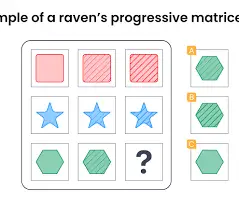
Fluid intelligence
Ability to see abstract relationships and draw logical inferences
Raven’s Progressive Matrices: a test to find missing piece of pattern
Crystallized intelligence
Ability to retain and use knowledge that was acquired through experience
Sternberg – 5 components of creativity
-expertise – “chance favors prepared mind”
– imaginative thinking – see things in novel way
– venturesome personality – persistence, risk taking
– intrinsic motivation – driven by internal factors
– creative environment – network with peers; supportive environment
Theories of Intelligence: data driven
Spearman: 2-factor: general (g) and specific (s)
intelligences
• Thurstone: 7 intelligences
• synthesis: 3-level hierarchy
Theories of Intelligence: Theory-Driven
Sternberg’s 3 intelligence (analytic, creative, practical)
• Gardner’s multiple intelligences:
Linguistic: Skill with spoken and written language, storytelling, and word meanings.
Logical-mathematical: Ability to analyze problems logically, work with numbers, and spot patterns.
Spatial (visual-spatial): Capacity to visualize and manipulate mental images, maps, and physical space.
Bodily-kinesthetic: Skill in using body movements and handling objects with precision.
Musical: Sensitivity to rhythm, pitch, tone, and sound patterns.
Interpersonal: Ability to understand and respond effectively to other people's moods, motives, and feelings.
Intrapersonal: Capacity for self-awareness and understanding one's own emotions, values, and goals.
Naturalistic: Skill in recognizing and categorizing plants, animals, and features of the natural world. [1, 2, 3, 4]