Period 3 Oxides
 Call Kai
 Learn
 Practice Test
 Spaced Repetition
 Match
 Flashcards
 Knowt Play
1/90

There's no tags or description
Looks like no tags are added yet.
91 Terms
what are transition metals
elements that contain an incomplete d-subshell
how many stable ions with an incomplete d-subshell can transition metals form?
at least one
how many e- can a d-subshell contain?
up to 10 e-
why are Scandium (Sc) and Zinc (Zn) not transition metals?
Sc will only form the ion Sc3+ which has the configuration [Ar].
Zinc will only form the ion Zn2+ which has the configuration [Ar] 3d10.
what is the Aufbau principle?
e- tend to occupy the lowest energy subshells first
why do e- fill orbitals singly before they double up?
bc e- naturally repel each other
why does the 4s subshell usually fill up before the 3d subshell?
has a lower energy level
what are the 2 exceptions to the 4s usually filling up before the 3d subshell? Why?
Chromium (Cr) - Chromium is more stable with one electron in the 4s subshell and one electron in each of the 3d orbitals.
Copper (Cu) - Copper prefers to have a complete 3d subshell and one electron in the 4s subshell.
transition metals will lose e- to form what type of ions?
positive
tranisition metals have similar physical properties like…what?
high density
high mp and bp
transition metals have varying chemical properties like… what?
variable oxidation states
good catalysts
form coloured ions
some can form complex ions
why do transition metals have variable oxidation states?
their e- reside in 4s and 3d subshells which are very close in energy level

colours

what is a complex ion?
a metal ion surrounded by coordinately bonded ligands.
when does a complex ion form?
when transition metals interact with ligands.
what is a ligand
an atom, molecule or ion that has at least one lone pair of electrons.
how is a coordinate bond formed?
an atom, molecule or ion that has at least one lone pair of electrons.
This lone pair is donated to the central metal ion, forming a coordinate bond (also called a dative covalent bond).
This is where both electrons in the bond come from the ligand.
what is a monodentate ligand?
can form only one coordinate bond to the central metal ion

explain how Ammonia (NH3) forms a monodentate ligand
Ammonia only has a single lone pair of electrons to donate to form a coordinate bond.
explain how Chloride (Cl-) ions form a monodentate ligand
Chloride ions only have a single lone pair of electrons to donate to form coordinate bonds.
explain how water (H2O) forms a monodentate ligand
Water has two lone pairs of electrons.
However, these lone pairs are very close together so water can only form one coordinate bond at a time.
what are bidentate ligands?
can form two co-ordinate bonds to the central metal ion.
why can bidentate ligands form 2 co-ordinate bonds to the central metal ion?
bc each ligand contains 2 groups with lone pairs of e-
what are multidentate ligands
can form many co-ordinate bonds to the central metal ion.
EDTA4- is a hexadentate ligand that can form six co-ordinate bonds to the central metal ion.
Ethylenediaminetetraacetic acid (EDTA4-) is a multidentate ligand capable of forming six coordinate bonds.
Transition metal complexes can have different shapes. What is the number of coordinate bonds that can be formed with a metal ion called?
coordination number
fill in the gaps.
Complex ions that form 6 coordinate bonds have an ___1___ shape
Many of these octahedral complexes are formed with __2__.
These are called __3__ complexes.
Other octahedral complexes form with __4__.
The bonds in an octahedral complex are __5__.
Complexes ions that form four coordinate bonds usually have a ___6___ shape.
Tetrahedral complexes often form with ___7___ ions - for example [CuCl4]2-.
The bonds in a tetrahedral complex are ___8___.
octahedral
water
hexaaqua
ammonia
90°
tetrahedral
chloride
109.5°
fill in the gaps.
Some complexes can form four coordinate bonds to create a ___1___ shape.
The most common ligand that does this is a ___2___ ion (CN-).
Cisplatin (PtCl2(NH3)2) is an example of a compound that has a square planar shape.
The bonds in an square planar complex are ___3___.
A few ions can form two coordinate bonds to create a __4__ shape.
This is most common with ___5___ (Ag+) ions.
Silver diamine [Ag(NH3)2]+ is a linear complex.
The bonds in a linear complex are ___6___.
square planar
cyanide
90°
linear
silver
180°
cisplatin is a sqaure planar complex used in…?
chemotherapy

Silver diamine [Ag(NH3)2]+ is a linear complex found in…?
Tollens’ reagent
transition metal complexes can exhibit steroisomerism. What is stereoisomerism?
where molecules with the same formula have different spatial arrangements of atoms.
what is a common type of stereoisomerism seen in transition element complexes
cis-trans isomerism.
when does cis-trans isomerism occure and when it is ofen seen?
Cis-trans isomerism occurs when two identical ligands in a complex are either adjacent to each other (cis) or opposite each other (trans).
This type of isomerism is often seen in square planar or octahedral complexes.
what is an example of a transition metal complex that exhibits cis-trans isomerism. What is it used for?
Cisplatin is used as a chemotherapy drug to treat certain types of cancers.
The effectiveness of cisplatin relies on its specific structure.
how does cisplatin work?
In cisplatin, the chloride ions and ammonia molecules are adjacent to each other.
This specific arrangement enables cisplatin to bind to DNA in cancer cells, blocking replication and causing cell death.


why is transplatin not used as a drug?
In transplatin, the chloride ions are opposite each other. This alters its biological activity.
Transplatin does not effectively interact with DNA and is not used as a drug.
fill in the gaps.
Cis-trans isomerism can also occur in ____1____ complexes.
The spatial arrangement of ligands around the central metal ion can ____2____.
This is the case even though the overall formula ____3_____
e.g.
Consider the complex [Co(NH3)4Cl2]+:
In the cis isomer, the two chloride ligands are positioned next to each other on the same side of the octahedron.
In the trans isomer, the chloride ligands are positioned opposite each other on opposite sides of the octahedron.
octahedral
differ
remains the same
e.g.
Consider the complex [Co(NH3)4Cl2]+:
In the cis isomer, the two chloride ligands are positioned next to each other on the same side of the octahedron.
In the trans isomer, the chloride ligands are positioned opposite each other on opposite sides of the octahedron.

Most transition metal complexes have a colour. What is the colour often used to identify
the specific metal ion present.
when a transition element ion is not bound to any ligand, it is said to be…?
isolated
When a transition element ion is not bound to any ligand, it is said to be isolated. What does this mean?
When the ion is in its isolated form, all of its 3d orbitals have the same energy.
what is an energy gap (ΔE)?
When ligands are attached to the central metal ion, 3d orbitals are split into different energy levels.
The difference in energy levels of these orbitals is referred to as the energy gap (ΔE).
fill in the gaps.
When light hits a transition metal ion, some frequencies of light are —-1——.
When this happens, electrons jump to a ___2___ orbital.
The frequencies absorbed depends on the ___3___ of the energy gap (ΔE) between orbitals .
Other frequencies of light are ___4____.
Reflected frequencies will combine to create a colour ___5____ - the colour that is seen.
If the 3d subshell is full, ___6____ electrons are able to jump between orbitals.
This means that the compound will either appear ___7___ or ___8___.
absorbed
higher
size
reflected
complement
no
white
colourless

what can ΔE be affected by?
The oxidation state of the metal ion.
The coordination number.
The nature of the ligand present.
what is Planck’s constant (h)?
gives the relationship between the energy of a photon of light and its frequency
how can Planck’s constant (h) be used to work out the energy absorbed by an electron?

flip for img

fill in the gaps
Copper hexaaqua ions [Cu(H2O)6]2+ will absorb ___1___ light.
The remaining reflected frequencies will combine to form the colour complement, in this case a ____2___ colour in solution.
yellow
blue
what are the factors that can affect the colour of a complex ion?
changes in oxidation state
changes in coordination number
changes in ligands
explain why changes in oxidation state can affect the colour of a complex ion?
The oxidation state of the metal ion affects the splitting of the 3d orbitals and the energy required to promote an electron.
A higher oxidation state typically increases the splitting energy (ΔE).
explain why changes in coordination number can affect the colour of a complex ion?
The coordination number can change the geometry of the complex.
This in turn alters the splitting of the 3d orbitals and ΔE.
explain why changes in ligands can affect the colour of a complex ion?
Different ligands cause different degrees of splitting in the 3d orbitals due to their varying field strengths.
This changes the ΔE and the colour of the complex.

example of how changes in oxidation state can affect the colour of a complex ion

example of how changes in coordination number can affect the colour of a complex ion
example of how changes in ligands can affect the colour of a complex ion

what is spectroscopy the study of?
how light interacts with matter
what can spectroscopy be used for?
to analyse the properties of a substance
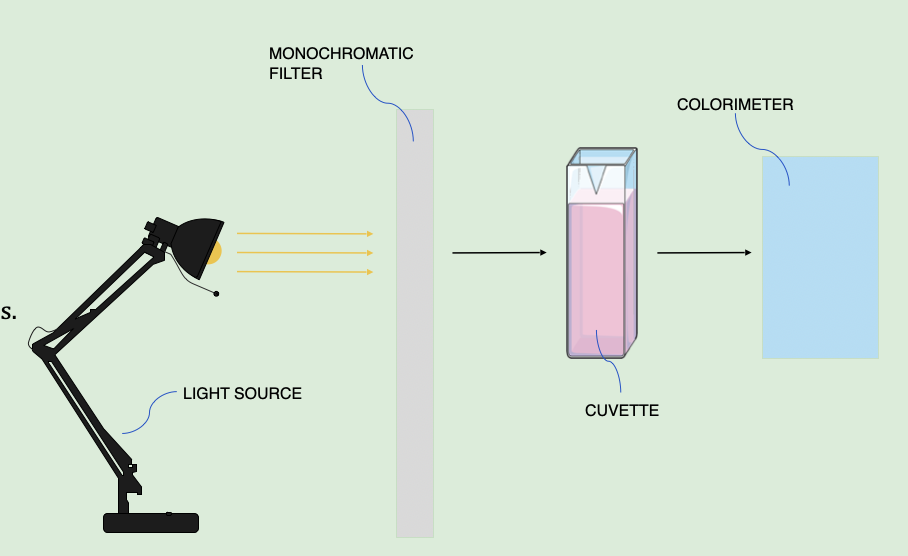
what does a colorimeter measure?
the absorbance of light by a solution to determine its concentration
what is the filter used in a colorimeter selected to match?
the complementary colour of the sol - this is the colour of the light that the sol absorbs most strongly
fill in the gaps.
The amount of light absorbed is directly related to the ___1___ of the solution.
By comparing the intensity of light before and after passing through the solution, the colorimeter calculates the ___2___.
This can be used to determine the ___3___ of the solution.
conc
absorbance
conc
fill in the gaps:
Some transition metals exhibit ___1___ oxidation states.
Transition metals can exist in multiple oxidation states depending on the ___2___ environment.
This arises from the small energy ____3____ between their 3d and 4s orbitals.
This allows them to lose varying numbers of ____4____ and form different ions.
Vanadium (V) can exist in several oxidation states:
variable
chemical
differences
electrons

Vanadium can be reduced to lower oxidation states using zinc (Zn):
Vanadium can be reduced from +5 to +2.
This is done in acidic solutions.
Explain the steps
Vanadium (V) ions are first reduced to vanadium (IV) ions.
Initially VO2+ is reduced to zinc to form VO2+.
Reaction: 2VO2+(aq) + Zn(s) + 4H+(aq) → 2VO2+(aq) + Zn2+(aq) + 2H2O(l).
The solution changes colour from yellow to blue
Vanadium (IV) ions are further reduced to vanadium (III) ions.
VO2+ is reduced to V3+.
Reaction: 2VO2+(aq) + Zn(s) + 4H+(aq) → 2V3+(aq) + Zn2+(aq) + 2H2O(l).
This process produces a green solution.
Finally, vanadium (III) is reduced to vanadium (II).
V3+ is reduced to V2+.
Reaction: 2V3+(aq) + Zn(s) → 2V2+(aq) + Zn2+(aq).
Vanadium (II) is typically observed as a violet solution.

what do redox potentials measure?
measures the tendency of a chemical species to be reduced.
what does a higher redox potential mean
A higher redox potential means a greater tendency for the species to gain electrons (reduction).
what does a lower redox potential mean
A lower redox potential indicates a greater tendency for the species to lose electrons (oxidation).
what is redox potential similar to?
the electrode potential (E°) of a cell.

what can redox potentials be influenced by?
The pH of the solution.
The presence of ligands.

img
what is Tollen’s reagent used for?
to distinguish between aldehydes and ketones
what is Tollen’s reagent?
Tollens’ reagent is an aqueous solution of silver nitrate (AgNO3) mixed with ammonia (NH3).
This forms the complex ion [Ag(NH3)2]+ - a mild oxidising agent.
explain what happens when Tollen’s reagent is added to an aldehyde
When it reacts with Tollens’ reagent, the aldehyde is oxidised to a carboxylic acid.
During this process, the silver ion (Ag+) is reduced to metallic silver.
Reaction: RCHO(aq) + 2[Ag(NH3)2]+(aq) + 3OH-(aq) → RCOO- + 2Ag(s) + 4NH3 (aq) + 2H2O(l).
why can’t ketones be oxidised by Tollen’s reagent?
Ketones do not have a hydrogen atom attached to the carbonyl carbon.
This makes them resistant to oxidation by Tollens' reagent.
When Tollens' reagent is added to a ketone, no reaction occurs and no silver mirror is formed.
what is a redox titration?
sn oxidising agent can be titrated against a reducing agent
what happens to the electrons during redox titrations?
electrons are transferred from the reducing agent to the oxidising agent.
why are redox titrations described as “self-indicating”?
because transition metal ions often undergo a colour change as their oxidation states change.
e.g.
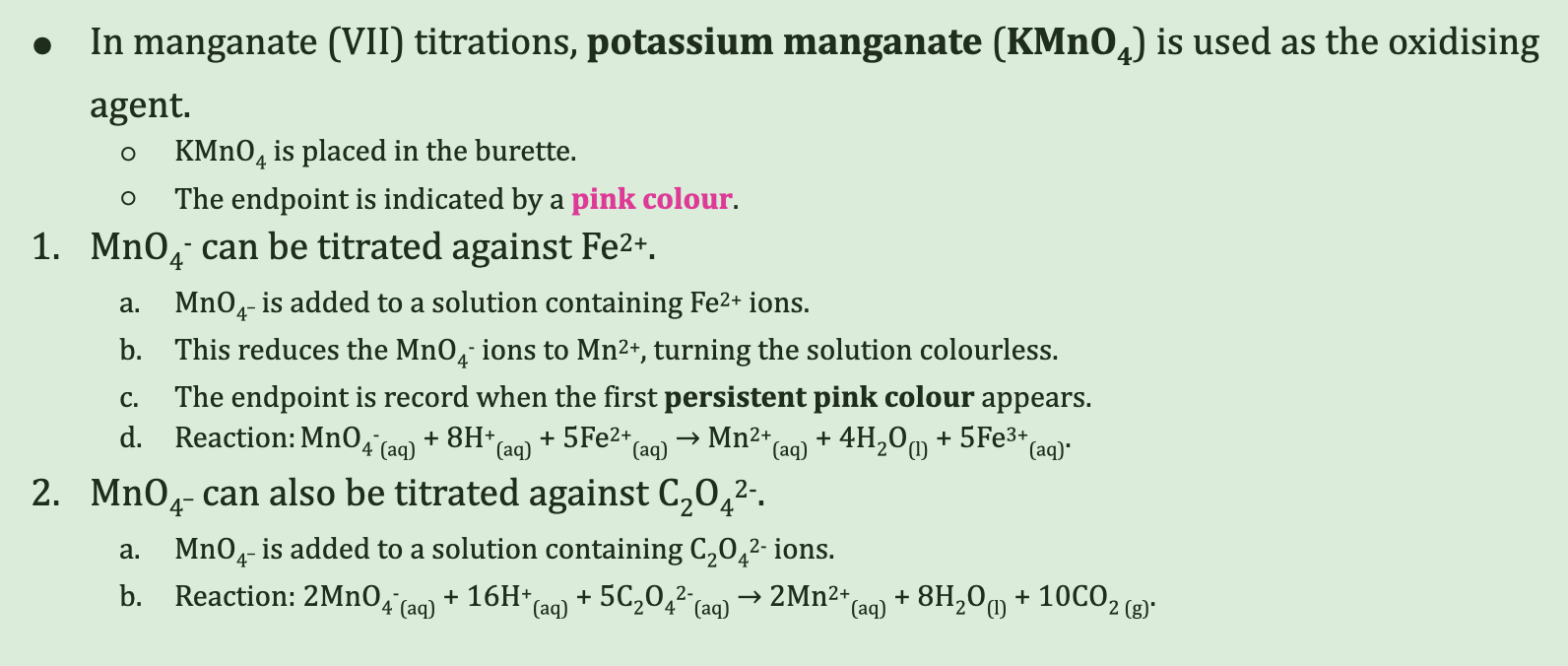
Manganate (VII) ions (MnO4-) change colour when reduced to Mn2+ ions.
MnO4- ions have a deep purple colour.
In acidic solutions it is reduced to the almost colourless Mn2+ ion:
MnO4-(aq) + 8H+(aq) + 5e- → Mn2+(aq) + 4H2O(l)
e.g.
Titration of KMnO4 with FeSO4
In this titration, MnO4- ions are added to a solution containing Fe2+ ions.
The endpoint is marked by a pink colour.
Example Titration Question
A health supplement tablet containing iron (II) sulphate was analysed by titration. A tablet weighing 2.00 g was dissolved in dilute sulphuric acid and titrated against 0.080 mol/dm3 KMnO4. The titration required 22.00 cm3 for a complete reaction.
Calculate the percentage by mass of iron in the tablet.
1. Write the balanced equation for the reaction:
MnO4-(aq) + 8H+(aq) + 5Fe2+(aq) → Mn2+(aq) + 4H2O(l) + 5Fe3+(aq)
2. Determine the amount of MnO4- used in the titration:
0.220 dm3 × 0.080 mol/dm3 = 0.00176 mol
3. Determine the amount of Fe2+ ions in the reaction.
From the balanced equation, the ratio of MnO4- to Fe2+ = 1:5
Moles of Fe2+ = 0.00176 × 5 = 0.00880 moles
4. Convert the moles of Fe2+ into mass:
Mass of iron = 0.00880 moles × 55.85 = 0.4915 g
5. Find the percentage of iron in the tablet:
0.4915 ÷ 2.00 × 100 = 24.58%
catalysts play an important role in industry. What is a catalyst and how do they work?
A catalyst is a substance that increases the rate of a chemical reaction without being consumed or permanently altered in the process.
Catalysts work by providing an alternative reaction pathway with a lower activation energy (Ea).
explain why transition metals are particularly effective as catalysts?
Transition metals can exist in/switch between multiple oxidation states.
this allows them to interact with a variety of reactants
This allows them to easily gain and lose electrons, enabling them to participate in redox reactions.
Transition metals can form stable intermediate compounds during a reaction.
These intermediates often lower the activation energy needed for the reaction to proceed.
What is the contact process? Vanadium in the Contact Process.
The Contact Process is the industrial method to produce sulphuric acid (H2SO4).
In the presence of the vanadium (V) oxide (V2O5) catalyst, SO2 is oxidised to SO3:
SO2 (g) + ½O2 (g) → SO3 (g)
V2O5 is reduced to vanadium (IV) oxide (V2O4):
V2O5 + SO2 → V2O4 + SO3
The V2O4 is then reoxidised back to V2O5, making the catalyst ready to facilitate another cycle:
V2O4 + ½O2 → V2O5
Heterogeneous catalysts exist in a different phase to the reactants.
Heterogeneous catalysts are usually solid.
The reactants are typically liquids or gases.
Heterogeneous catalysts provide a surface where reactions can take place.
Heterogeneous catalysts provide a surface where the reactants can adsorb and react.
They then desorb as products.
The Haber process is an example of a process that uses a heterogeneous catalyst.
The Haber process synthesises ammonia from hydrogen and nitrogen gas.
Reaction: N2 (g) + 3H2 (g) → 2NH3 (g).
The Haber process uses an iron catalyst.
Finely divided iron (Fe) is used as the catalyst in the Haber process.
The iron catalyst is solid, while the reactants (N2 and H2), are gases.
To enhance the effectiveness and efficiency of heterogeneous catalysts, support mediums are often used.
What is a support medium?
A support medium is an inert substance that the catalyst is dispersed on or within.
The support medium allows the catalyst to be finely dispersed.
This increases the available surface area where the reactants can adsorb and react.
This improves the efficiency of the catalyst, allowing more active sites to be available for the reaction.
In the Haber process, finely ground iron is used as the catalyst.
The support medium provides structural stability to the catalyst.
This prevents the catalyst from clumping together at high temperatures.
Platinum or rhodium catalysts in catalytic converters are supported on a ceramic or metal matrix.
This ensures that the metal catalyst maintains its structure and activity over the lifespan of the converter.
Reaction: 2CO(g) + 2NO(g) → 2CO2 (g) + N2 (g).
fill in the gaps
In cars, ___1___ ___2___ use a ceramic lattice (as a support medium) coated in rhodium to convert harmful gases like carbon monoxide and nitrogen oxides into less harmful substances.
catalytic converters
Heterogeneous catalysts can be poisoned when impurities bind to their active sites.
What does this mean?
Catalyst poisoning blocks the areas where reactions can take place.
As a result, the reaction rate decreases, leading to lower efficiency.
This reduced efficiency often means that more catalyst is required to achieve the desired output.
This increases the operational costs.
Catalytic converters can be poisoned by lead. What does this mean?
In catalytic converters, lead from fuel additives can poison platinum catalysts.
This can drastically reduce their ability to convert harmful gases.
Iron catalysts can be poisoned by sulphur. What does this mean?
In the Haber process, sulphur impurities can poison the iron catalyst.
This can lower ammonia production efficiency.
It may also require costly catalyst regeneration or replacement.
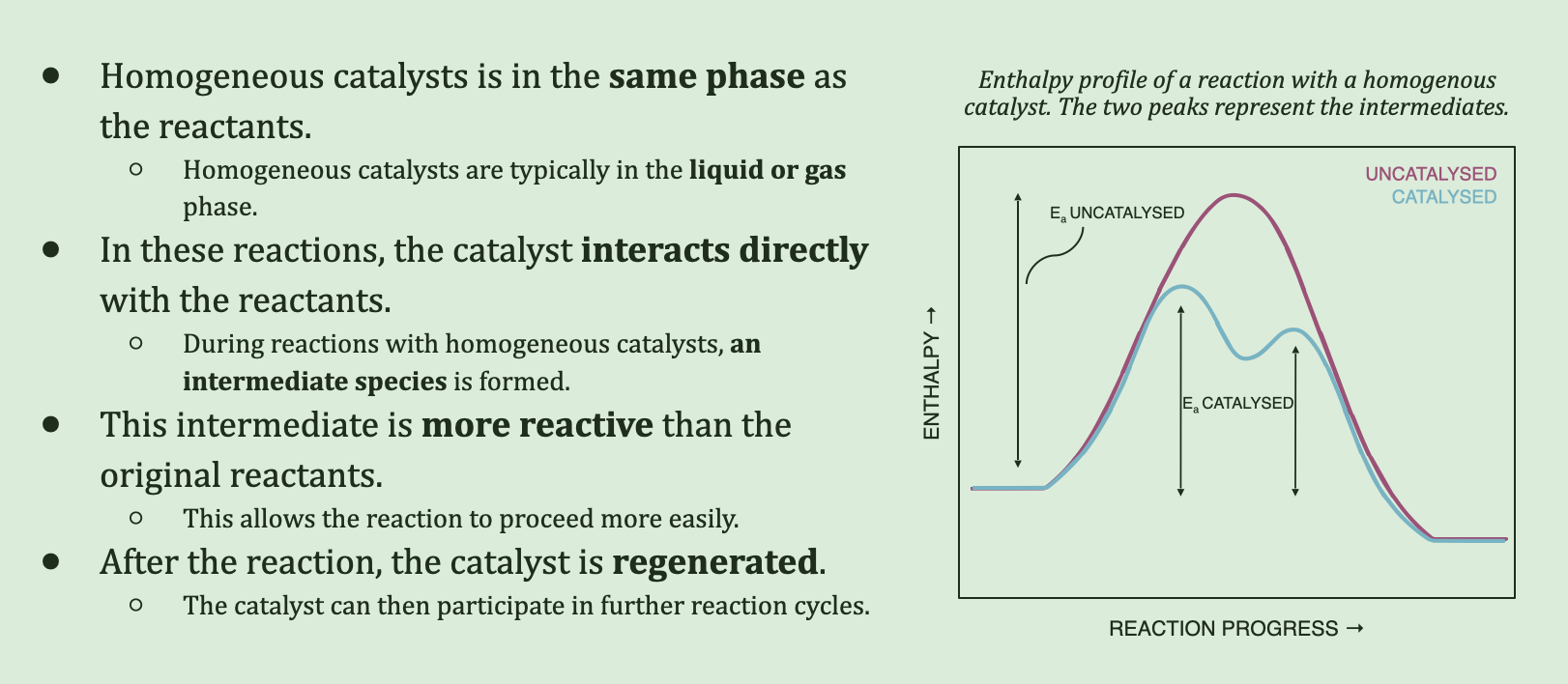
img - homogenous catalysts
The reaction between iodide (I-) ions and peroxodisulphate (S2O82-) ions is slow.
explain why
This is because both reactants are negatively charged.
This causes repulsion that makes it difficult for them to collide and react.
Reaction: S2O82-(aq) + 2I-(aq) → I2 (aq) + 2SO42-(aq).
The reaction between iodide (I-) ions and peroxodisulphate (S2O82-) ions is slow.
This is because both reactants are negatively charged.
This causes repulsion that makes it difficult for them to collide and react.
Reaction: S2O82-(aq) + 2I-(aq) → I2 (aq) + 2SO42-(aq).
Fe2+ ions act as homogeneous catalysts to speed up the reaction. How?
Fe2+ is oxidised by S2O82-
In the first step, the S2O82- ions oxidise Fe2+ to Fe3+, forming sulphate (SO42-) ions.
Reaction: S2O82-(aq) + 2Fe2+(aq) → 2Fe3+(aq) + 2SO42-(aq).
Fe3+ is then reduced by I-.
In the second step, the Fe3+ ions are reduced back to Fe2+ by I- ions, producing iodine (I2).
Reaction 2Fe3+(aq) + 2I-(aq) → 2Fe2+(aq) + I2 (aq).
The I2 formed in the reaction can be detected using the starch test.
When iodine interacts with starch, a blue-black colour is formed.
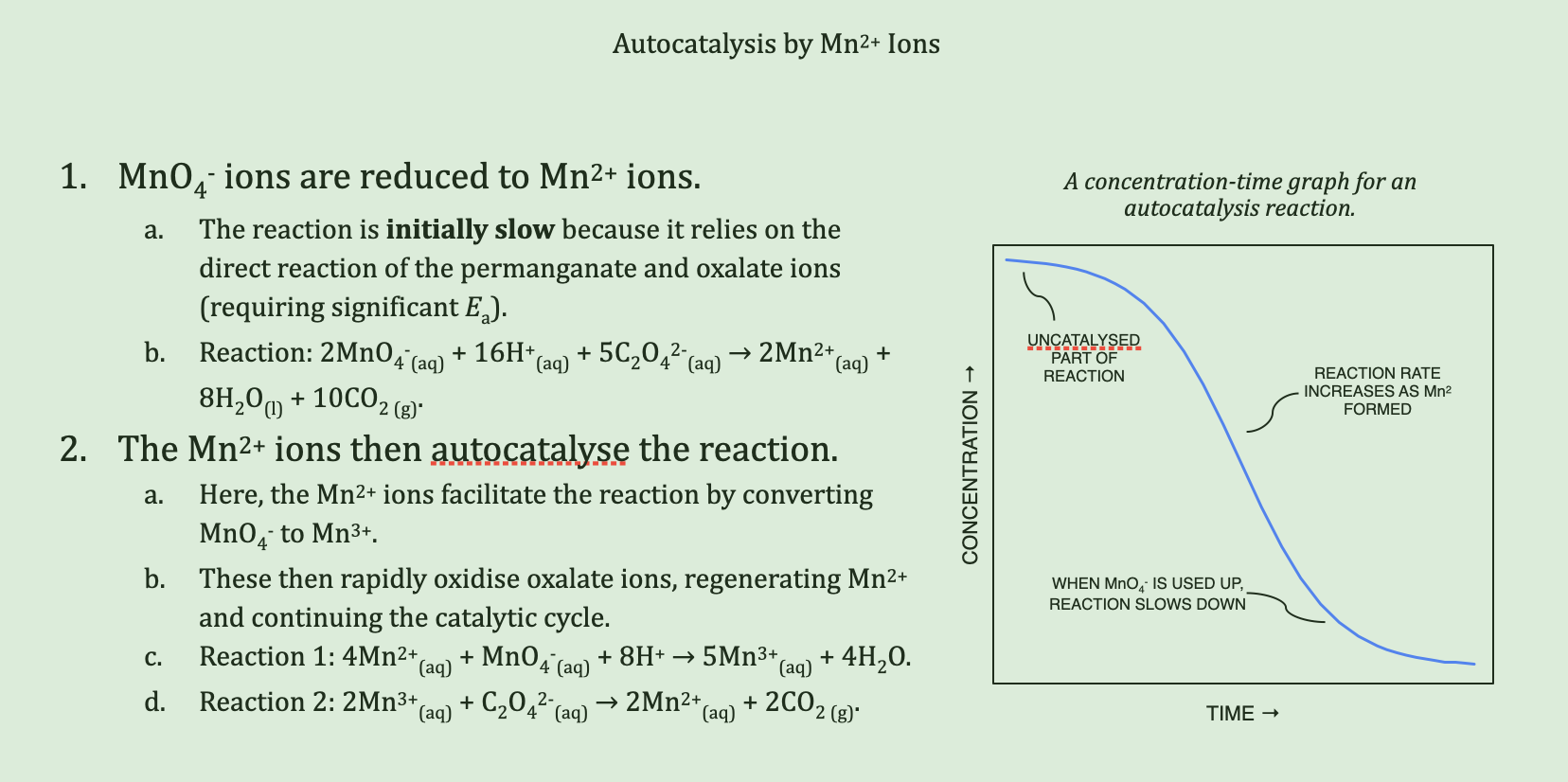
what is autocatalysis and what does it do?
Autocatalysis is a type of reaction where one of the products acts as a catalyst for the reaction itself.
This speeds up the process as the reaction progresses.
e.g.
Oxalate (C2O42-) ions and permanganate (MnO4-) ions will react together.
This reaction is initially slow.
As the reaction proceeds, Mn2+ ions are produced.
The Mn2+ ions then accelerate the reaction.
The Mn2+ ions thus act as autocatalysts.
The overall reaction is as follows:
2MnO4-(aq) + 16H+(aq) + 5C2O42-(aq) → 2Mn2+(aq) + 8H2O(l) + 10CO2 (g)
img - Autocatalysis by Mn2+ Ions