1.1 Biopsychology: The nervous system and the endocrine system
 Call Kai
 Learn
 Practice Test
 Spaced Repetition
 Match
 Flashcards
 Knowt Play
1/44

Earn XP
Description and Tags
- the nervous system, - neurons and synaptic transmission, - endocrine system, - flight or fight response
45 Terms
What is the nervous system?
Nervous system= the network of nerve cells and fibres which transmit nerve impulses between parts of the body
What are the two sub-systems that the nervous system is divided in?
Two sub-systems that the nervous system is divided in=
Central nervous system (CNS)
Peripheral nervous system (PNS)
What is the CNS?
CNS= the primary command centre for the body
What makes up the CNS?
CNS is made up of the brain and the spinal cord
What does the brain do? (CNS)
Brain= coordinating centre of sensation and intellectual and nervous activity (command)
What does the spinal cord do? (CNS)
Spinal cord= a bundle of nerve fibres that connect the brain to the rest of the body (communication and reflex action)
What does the peripheral nervous system? (PNS)
PNS= a network of nerves that connects the CNS to the rest of the body
What are the two sub-systems that the PNS is divided in?
Two sub-systems that the PNS is divided in=
Autonomic nervous system (ANS)
somatic nervous system (SNS)
What does the autonomic nervous system (ANS) do? (part of the PNS)
Autonomic nervous system (ANS)= control of the body’s involuntary movements and the organ’s functions
unconscious
→ splits into sympathetic and parasympathetic nervous system
What does the somatic nervous system (SNS) do? (part of the PNS)
Somatic nervous system (SNS)= control the body’s voluntary movements and transmits signals to+from the senses and muscles
conscious
What does the sympathetic nervous system do?
Sympathetic nervous system= responsible for preparing the body for the fight-flight response (“up”)
What does the parasympathetic nervous system do?
Parasympathetic nervous system do= responsible for restoring the body’s resting levels (“down”)
What is the chart for the nervous system?

What is a neuron?
neuron= a nerve cell that transmits electrochemical information
What is the diagram for the motor, relay and sensory neuron?

What is the function of the motor neuron? classic
Function of the motor neuron= collected in the CNS and stretching to the PNS. They carry messages from the CNS to effectors, such as muscles and glands (CNS→ PNS)
What is the length of fibres of the motor neuron?
Length of the fibres in motor neurons= short dendrites and long axons
What is the function of the relay neuron? symmetrical
Function of the relay neuron= collected in the CNS. They transfer messages from sensory neurons to other connected neurons or to motor neurons. (communication)
What is the length of the fibres of the relay neuron?
Length of fibres in relay neurons= short dendrite and short/long axons
What is the function of the sensory neuron? T-junction
Function of the sensory neuron= collected outside of the CNS. They carry messages from the PNS to the spinal cord and brain (PNS→ CNS)
What is the length of fibres in the sensory neuron?
Length of fibres of the sensory neuron= long dendrites and short axons
What do dendrites do?
Dendrites= inputs into the cell
What do axons do?
Axons= outputs from the cell
What is the diagram for the process of synpatic transmission?
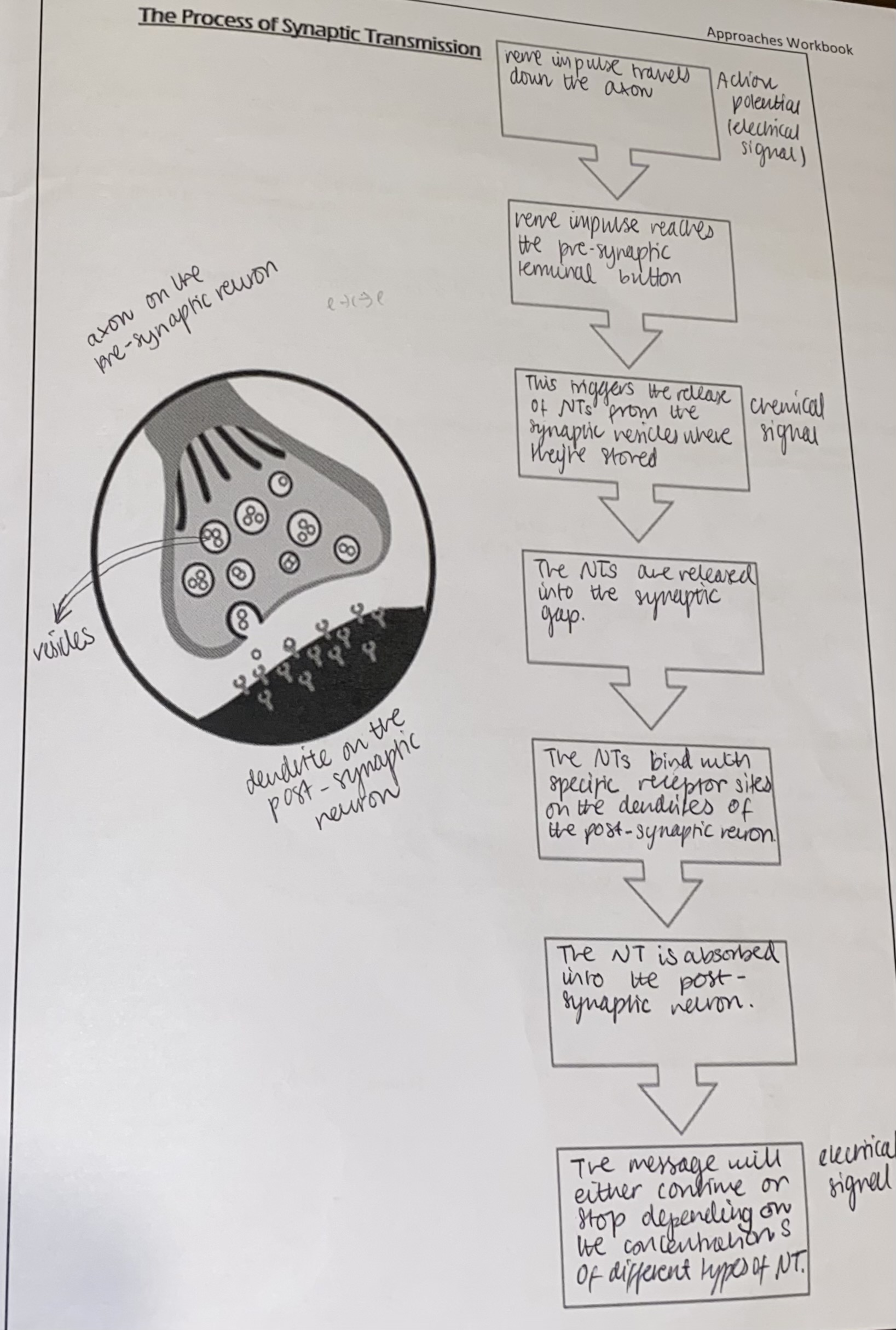
old ver- (What are the stages of synaptic transmission?)
Stages of synaptic transmission=
Nerve impulse travels down the axon (action potential- electrical signal)
Nerve impulse reaches the pre-synaptic terminal button
This triggers the release of NTs from the synaptic vesicles where they’re stored (chemical signal)
The NTs are released into the synaptic gap
The NTs bind with specific receptor sites on the dendrites of the post-synaptic neuron
The NT is absorbed into the post-synaptic neuron
The message will either continue or stop, depending on the concentrations of different types of NTs (electrical signal)
What is the action potential in synaptic transmission?
Action potential= the impulse that sets the process of synaptic transmission off and is when the cell moves from being negatively to positively charged
What is the lock and key arrangement in synaptic transmission?
Lock and key arrangement in synaptic transmission= specific NTs can only be received by specific receptor sites
What are excitatory and inhibitory NTs?
Excitatory NTs= make the next cell more likely to fire: depolarisation→ cell moves from being negatively to positively charged/ less negatively charged, due to increased action potential
Inhibitory NTs= makes the next cell less likely to fire: hyperpolarisation→ more negatively charged, due to a reduced action potential
Both types are always present- it is the relative concentrations that push it one way or the other (summation)
Why can neurons only transmit information in one direction at a synapse?
Neurons can only transmit information in one direction at a synapse=
signal always moves from the axon of the pre-synaptic neuron to the dendrite of the post-synaptic neuron as the vesicles that contain the NTs are only in the pre-synaptic neuron and receptor sites are only on the membrane of the post-synaptic neuron
Biological rule- always, only
What is the endocrine system?
Endocrine system= a collection of organs that synthesise and secrete hormones into the bloodstream
What are endocrine glands?
Endocrine glands= the specialised organs that synthesise and secrete hormones into the bloodstream
What are hormones?
Hormones= biochemical substances that circulate in the bloodstream in order to target specific organs and processes
What is the diagram of the human body with the glands?
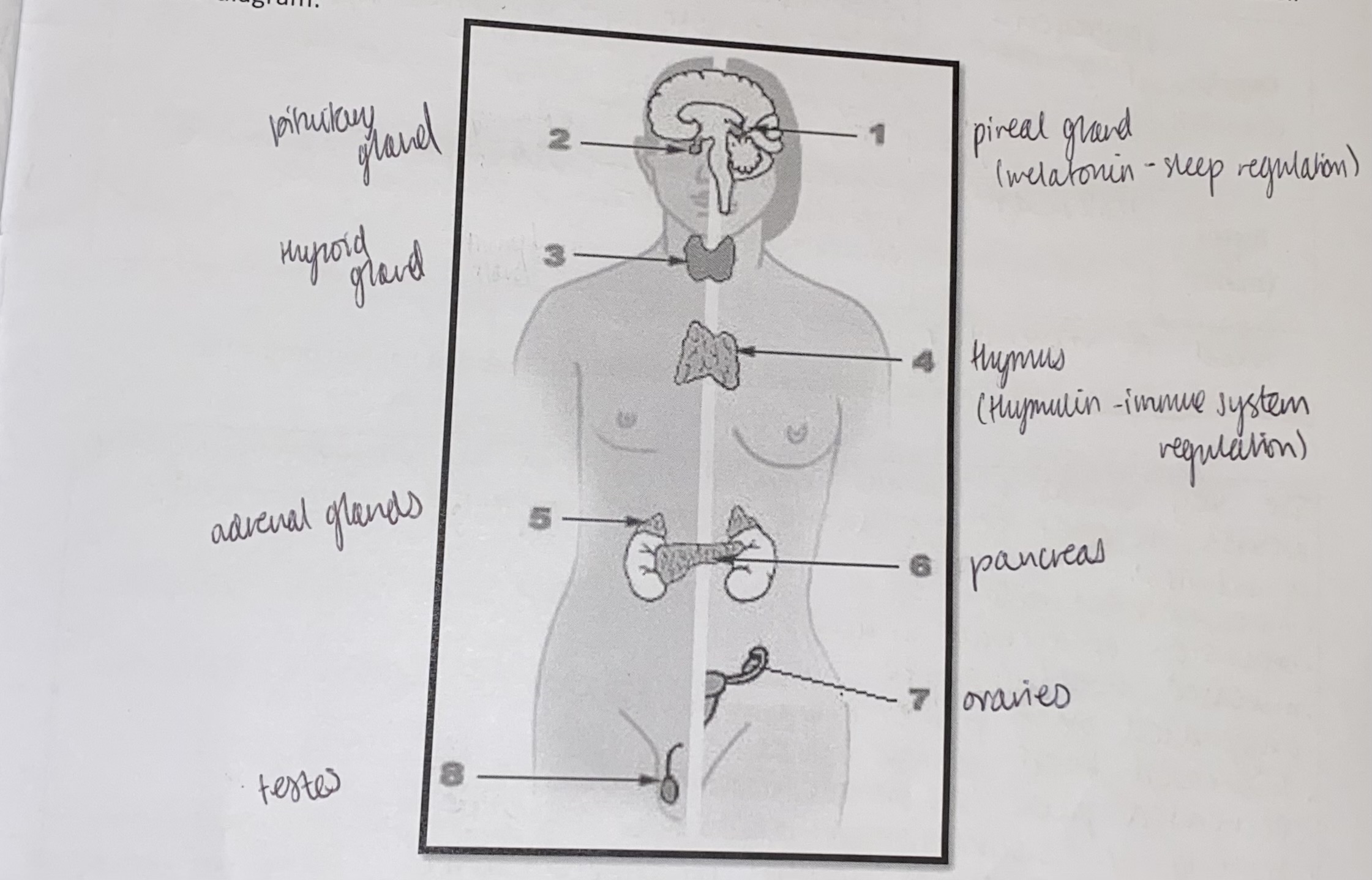
What hormones does the pituitary gland produce?
Pituitary gland produces=
oxytocin
TSH
Adrenocorticotrophic hormone (ACTH)
What does the pituitary gland do?
Pituitary gland is the ‘master gland’ that controls all the other glands
e.g.
TSH→ thyroid gland
ACTH→ adrenal gland
What hormone does the thyroid gland produce?
Thyroid gland produces thyroxine
What does the thyroid gland do?
Thyroid gland is involved in the regulation of metabolism, such as the conversion of food into energy
What hormone do the adrenal glands produce and what are they activated by?
Adrenal glands produce adrenaline
Adrenal glands are activated by=
noradrenaline (NT) and the sympathetic nervous system
What do the adrenal glands do?
Adrenal glands= responsible for reacting to threat stimuli: via fight-flight response
What hormone does the testes produce?
Testes produce the hormone testosterone
What does the testes do?
Testes= responsible for the development of male reproductive system and secondary sex characteristics
What is the flight-or-fight response?
Flight-or-fight response= the way animals and humans respond to stress by becoming physiologically aroused in order to combat or retreat from an aggressor
What are examples of the physiological changes that happen during the flight-or-fight response?
Examples of the physiological changes that happen during the flight-or-fight response=
increased heart rate
expansion of airways in lungs
increased breathing rate
oxygenated blood primes blood and muscels
increased blood glucose levels
decreased pain sensitivity (cortisol)
halting of salivation and digestion
evacuation of excess weight in faeces and urine
Outline the role of adrenaline in the flight or fight response
Adrenaline is released from the adrenal medulla in response to the release of ACTH by the pituitary gland
Adrenaline causes increased heart rate and breathing rate, causing increased blood flow and pressure
This increases the supply of oxygenated blood to the brain and skeletal muscles for rapid response planning and physical action
The endocrine and sympathetic nervous system cause the arousal and the parasympathetic nervous system returns the body to a resting state
What are the stages of synaptic transmission?
Stages of synaptic transmission=
The first neuron moves from its resting state of being negatively charged to being positively charged; creating an action potential
Once at the end of the neuron, this electrical impulse triggers the release of NTS from tiny sacs called synaptic vesicles within the pre-synaptic terminal button
The NT chemical then diffuses across the gap to be received by receptor sites on the post- synaptic terminal buttonthat are specific to that NT (ie lock and key)
The NTS may have an excitatory or inhibitory effect. Inhibitory chemicals increase the negative charge and make the next neuron less likely to fire. Excitatory chemicals increase the positive charge and make the next neuron more likely to fire. Both chemicals are always present, so if the balance of effects is more excitatory, the next neuron will fire (summation).
Any excess NT is either reabsorbed back into the pre-synaptic neuron (reuptake) or broken down by an enzyme and its components released into the bloodstream. The quicker this happens, the shorter the effect and vice versa.