Skin & Bone Models
 Call Kai
 Learn
 Practice Test
 Spaced Repetition
 Match
 Flashcards
 Knowt Play
1/15

There's no tags or description
Looks like no tags are added yet.
16 Terms

Point to epidermis, dermis, and hypodermis
What are their jobs? (Include position & composition)
Epidermis = barrier, superficial, composed of dead keratinocyte layers for protection
Dermis = deep to epidermis, composed of loose & dense irregular connective tissue for support & resistant to pulling in all directions. Holds blood vessels, glands, sensors
Hypodermis = deep to dermis, composed of adipose connective tissue for energy storage, cushioning, insulation
Point to stratum basale, stratum spinosum, stratum granulosum, stratum lucidum, stratum corneum.
What are functions of each epidermis layer?
How do keratinocytes develop/maintain?
Basale = dividing layer for keratinocytes
Granulosum = packed full of keratin cells
Lucidum = extra barrier against friction, pressure, only in thick skin
Corneum = stratified dead keratinized cells, barrier, hold moisture in, keep bacteria out

Point to papillary & reticular layers
Structure & Function of these layers?
Papillary = connects to the epidermis’ stratum basale through papillae projections, loose connective tissue, flexible & holds capillaries, touch sensors
Reticular = irregular, dense connective tissue, resistant to tearing & can stretch, packed fibers/collagen

Locate hair follicle, bulb, shaft, matrix, papilla, medulla, cortex, and cuticle.
Locate sebaceous gland
Locate sweat glands
Build the temperature-control feedback loop. (Too hot, too cold)
How does environment affect cooling down, even if there is sweat secreted?

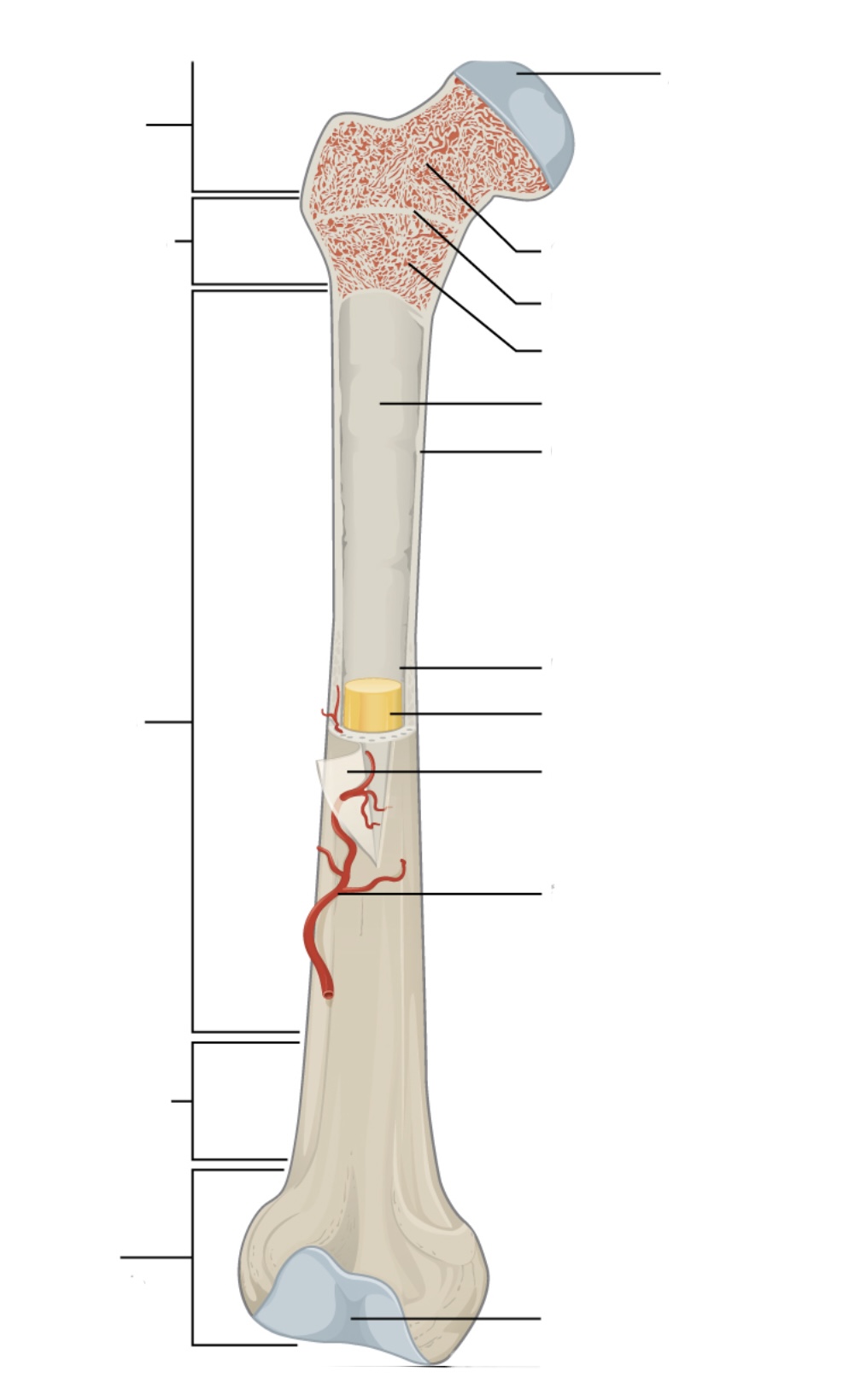
Locate Compact bone, spongy bone, marrow space
Locate on the long bone: periosteum, endosteum, medullary cavity, epiphysis, diaphysis, metaphysis
How does compact bone, spongy bone, and marrow space relate?

Locate an osteon, lamellae, central canal, lacuna, osteocyte, canaliculi

How does structure of osteon relate to its function?
Matrix rings, canal…
What contributes to stiffness vs toughness?
Stiffness = resistant to deformation (mineral)
Toughness = resistant to cracking (collagen)

Name the locations

Name the locations

Name the locations

Name the locations

Name the locations
Name the locations