macro midterm two
 Call Kai
 Learn
 Practice Test
 Spaced Repetition
 Match
 Flashcards
 Knowt Play
1/83

There's no tags or description
Looks like no tags are added yet.
84 Terms
natural rate of unemployment
unemployment that the economy normally experiences
cyclical unemployment
year-to-year fluctuations in unemployment around the natural rate, often associated with short-run fluctuations in economic activity
employed
workers paid as employees, work in their own businesses, workers without pay in family businesses, including full and part time workers
unemployed
those who are not employed, are available for work, and had tried to find employment recently (within the last four weeks)
not in the labor force
students, homemakers, retirees
unemployment rate
percentage of labor force that is unemployed

labor-force participation rate
the percentage of the adult population that is in the labor force

troubles with measuring the unemployment rate?
difficult to distinguish between unemployed and those who are not in the labor force
frequent movements in and out of the labor force
new entrants: young workers looking for employment
discouraged workers
people working under the table to avoid taxation
discouraged workers
individuals who would like to work but have given up looking for a job and don’t show up in employment statistics
why does unemployment exist?
unemployment never falls to zero, but instead fluctuates around the natural rate of unemployment
frictional unemployment
structural unemployment
frictional unemployment
unemployment that results because it takes time for workers to search for the jobs that best suit their tastes and skills
arises from the process of the job search
inevitable — labor marker in constant state of churn
shorter-term
what are some factors of churn or change that can impact frictional unemployment?
changes in consumer preference
regional booms
sectoral shifts = changes in the composition of demand among industries/ regions
changing patterns of international change
what can policy do to impact the process of the job search?
government-run employment agencies that provide information about job vacancies
public training programs
ease workers transition away from declining to growing industries
help disadvantaged groups escape poverty
advocates:
keeps labor force more fully employed and reduces the inequities inherent in a constantly changing market economy
critics:
better to let the private market match workers and jobs
government involvement is likely worse at disseminating the right information to the right workers and deciding what kinds of worker training would be most valuable
unemployment insurance
a government program that partially protects the incomes of workers who become unemployed
— increases frictional unemployment = workers have less incentive to search or take jobs while they are eligible to receive unemployment benefits
what are the benefits of unemployment insurance?
reduces income uncertainty
unemployed have more time to search
unemployed can look for jobs that better suit their tastes and skills
improves the ability of the economy to match each worker with the most appropriate job
structural unemployment
unemployment that results because of the number of jobs available in some labor markets is insufficient to provide a job for everyone who wants one
due to wages stuck above the equilibrium level
longer-term
three reasons for structural employment:
minimum-wage laws
unions and collective bargaining
efficiency wages
what happens at equilibrium wage?
the quantity of labor supplied and the quantity of labor demanded are both equal to LE
minimum-wage laws unemployment
if the wage is forced to remain above the equilibrium level (possibly due to a minimum-wage law), the quantity of labor supplied rises to LS and the quantity of labor demanded falls to LD
LS — LD = surplus of labor

what are the effects of binding minimum-wage?
matters most for those with low levels of skill and experience (like teenagers)
causes structural unemployment
quantity of labor supplied exceeds the quantity of labor demanded
worker are unemployed because they are waiting for jobs to open up
union
a worker association that bargains with employers over wages, benefits, and working conditions
exert their market power to negotiate higher wages for workers
less than 11% of US workers today belong to unions
what happens when unions raise the wage above equilibrium level?
higher quantity of labor supplied
smaller quantity of labor demanded
unemployment
better off: employed workers (insiders)
worse off: unemployed (outsiders)
efficiency wages
above-equilibrium wages paid by firms to increase worker productivity, allowing the firm to operate more efficiently
could be more profitable for firms to keep wages high despite having a surplus of labor
efficiency wage theory benefits:
worker health
more nutritious diet — healthier and more productive workers
especially prevalent in less developed countries
worker turnover
hiring and training new workers is costly — try to reduce turnover
worker quality
higher wages attract better job applicants and increase the quality of the firm’s workforce
worker effort
workers have discretion over how hard to work, and some may choose to work as little as possible
worker morale
high wages improve worker morale; content workers are more productive
workers aer less productive if they think they’re being treated unfairly
what causes structural unemployment?
structural unemployment, when the quantity of labor demanded is smaller than the quantity of labor supplied, is caused by minimum-wage laws, the market power of unions, and efficiency wages.
barter
the exchange of one good or service for another
relies on a double coincidence of wants, which is an unlikely occurrence that two people’s wants align exactly for an exchange
money
the set of assets in an economy that people regularly use to buy good and services
not the same as the common understanding of money, which is conflated with wealth
includes only the few types of wealth that sellers regularly accept in exchange for goods and services
what are the functions of money?
the functions of money distinguish it from other assets:
medium of exchange
unit of account
store of value
what does it mean for money to be a medium of exchange?
it’s an item that buyers give to sellers when they want to purchase goods and services
transfer of money that allows the transactions to take place
relates to liquidity
liquidity
the ease with which an asset can be converted into the economy’s medium of exchange
money is the most liquid asset available because it is the economy’s medium of exchange
what does it mean for money to be a unit of account?
money is the yardstick that people use to post prices and record debts, being a measure and record of economic value
what does it mean to call money a store of value?
it’s an item that people can use to transfer purchasing power from the present to the future
wealth refers to the total of all stores of value, both monetary/ nonmonetary
what are the kinds of money?
commodity money = money that takes the form of a commodity with intrinsic value (item would have value even if it weren’t used as money, like gold)
fiat money = money without intrinsic value that is used as money by government decree (paper dollars)
money stock
the quantity of money circulating in the economy
currency
paper bills and coins in the hands of the public
demand deposits
balances in bank accounts; depositors can access on demand by writing a check
M1
measure of a country’s money supply including:
currency
demand deposits
liquid deposits (balances in savings accounts)
M2
measure of a country’s money supply including:
everything in M1
small-time deposits
money market funds
the Fed
the central bank of the United States, institution designed to oversee the banking system and regulate the quantity of money in the economy
monetary policy
the setting of the money supply by policymakers in the central bank made by the Federal Open Market Committee (FOMC), which discusses the condition of the economy and considers changes in monetary policy
what are the Fed’s functions?
regulate banks and ensure the health of the banking system by monitoring each bank’s financial condition and facilitating bank transactions
act as a bank’s bank — makes loans to banks when the banks themselves need funds
act as a lender of last resort to maintain stability in the overall banking system
control the money supply
money supply
the amount of money available in the economy
Federal Open Market Committee (FOMC)
discuss conditions of the economy
consider changes in monetary policy
perform open-market operations to increase or decrease the money supply
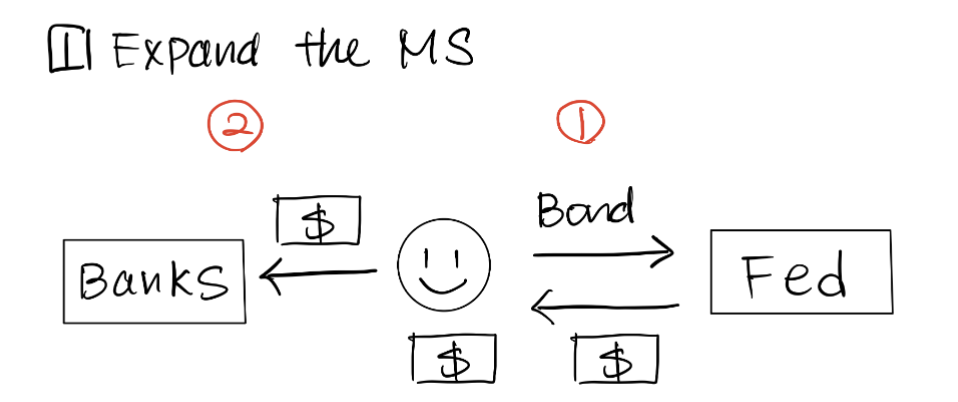
what action should the FOMC take to INCREASE the money supply?
buy government bonds, paying for new bonds with the newly created dollars means that the number of dollars in the economy increases
some of these new dollars are held as currency and some are deposited in banks
what action should the FOMC take to REDUCE the money supply?
sell government bonds in the nation’s market, where the public pays for these bonds with its holdings of currency and bank deposits
people withdraw from banks
smaller quantity of bank reserves
banks reduce their amount of lending
reduce the money supply
since people withdraw from banks to buy these bonds, banks have a smaller quantity of reserves

reserves
deposits that banks have received but have not loaned out
100-Percent-Reserve Banking
if banks hold all deposits in reserve, banks do NOT influence the supply of money
fractional-reserve banking
a banking system in which banks hold only a fraction of deposits as reserves, where that fraction is the reserve ratio
reserve ratio
fraction of deposits that banks holds as reserves, as determined by government regulation and bank policy
doesn’t impact the amount in liabilities because making loans doesn’t alter (from 100-percent-reserve system) the bank’s obligation to its depositors, but now has two different types of assets
reserves
loans
reserve requirement
minimum amount of reserves that banks must hold; set by the Fed
reducing reserve requirements would LOWER the reserve ratio and INCREASE the money multiplier
less effective in recent years as many banks hold excess reserves
excess reserves
reserves that banks hold in excess of the reserve requirement
what happens because of fractional-reserve banking?
when banks hold only a fraction of deposits in reserve, the banking system creates money.
money multiplier
the amount of money that results from each dollar of reserves
reciprocal of the reserve ratio = 1/R
the higher the reserve ratio
the less of each deposit banks loan out
the smaller the money multiplier
Fed lending to bank
the Fed’s lending to banks can INCREASE the money supply
banks pay an interest rate called the discount rate
if the Fed LOWERS the discount rate, it encourages banks to borrow more, increasing the quantity of reserves and the money supply
discount rate
interest rate on the loans that the Fed makes to banks
higher discount rate = less bank borrowing
decreased quantity of reserves
decreased money supply
lower discount rate = more bank borrowing
increased quantity of reserves
increased money supply
interest on reserves
the interest rate paid to banks on the reserves held in the deposit at the Fed
an INCREASE in the interest rate on reserves
increases the reserve ratio
lowers the money multiplier
lowers MS
a DECREASE in the interest rate on reserves
decreases the reserve ratio
increases money multiplier
decreases MS
federal funds rate
interest rate at which banks make overnight loans to one another
if a bank finds itself short of reserves, it can borrow reserves from another bank
decision by the FOMC to change the target for the federal funds rate are also decisions to change the money supply
a decrease in the target for federal funds rate means an expansion in the money supply
differs from the discount rate
affects other interest rates
is determined by the supply and demand in the market for loans among banks
inflation
rise in the price level
inflation drives the price level up and the value of money down
each dollar buys a smaller quantity of goods and services
economy-wide problem
concerns the value of the economy’s medium of exchange
inflation rate
the percentage change in the price index from the preceding period
deflation
decrease in the overall level of prices
hyperinflation
extraordinarily high rate of inflation
price level (P)
the number of dollars needed to buy a basket of goods and services
when the price level rises, people have to pay more for the goods and services they buy
value of money (1/P)
the quantity of goods and services that can be bought with $1 (reciprocal of P)
a rise in the price level: lower value of money because each dollar in your wallet now buys a smaller quantity of goods and services
money demand
how much wealth people want to hold in liquid form (money/ monetary form)
depends on the price level: an increase in P reduces the value of money, so more money is required to buy goods and services
quantity of money demanded:
is positively related to the price level, other things equal
is negatively related to the value of money
what happens in the long run to money supply and money demand?
the money supply curve is vertical as fixed by the Fed
in the long run, money supply and money demand are brought into equilibrium by the overall level of prices

equilibrium price level
a model of money supply and money demand at equilibrium, where MS = MD so that the value of money (1/P) and the price level (P) are determined at the equilibrium where MS = MD
classical theory of money/ quantity theory of money
the theory asserting that the quantity of money available (MS) determines the price level and that the growth rate in the quantity of money available determines the inflation rate
velocity of money (V)
rate at which money changes hands
V = (P x Y) / M
quantity equation
M x V = P x Y
relates the quantity of money to the nominal value of output (P x Y)
shows that an increase in the quantity of money in an economy must be reflected in one of the other three variables
the price level must rice OR
the quantity of output must rise OR
the velocity of money must fall
implications of quantity equation
V is relatively stable over time
a change in M causes nominal GDP to change by the same percentage
a change in M does not affect Y
therefore, P changes by the same percentage as (P x Y) and M
rapid money supply growth causes rapid inflation
the classical dichotomy
the theoretical separation of nominal and real variables in the long run
nominal variables: measured in monetary units ($ prices)
real variables: measured in physical units (amounts of goods and services)
monetary developments affect nominal variables but not real variables
what happens if the central bank doubles the money supply?
then all nominal variables, including prices, will double
BUT, all real variables, including relative prices, will remain unchanged
monetary neutrality
proposition that changes in the money supply do not affect real variables
most economists believe that the classical dichotomy and neutrality of money describe the economy in the long run, but not the short-run effects
Fisher Effect
one-for-one adjustment of nominal interest rate to inflation
when the Fed increases the rate of money growth, long-run result is:
higher inflation rate
higher nominal interest rate
inflation tax
revenue the government raises by creating (printing) money
like a tax on everyone who holds money
when the government prints money
the price level rises
the dollars in your wallet are less valuable
why do countries experience hyperinflation?
the governments of these countries are using money creation as a way to pay for their spending
inflation fallacy
“inflation robs people of the purchasing power of his hard-earned dollars”
when prices rise
buyers pay more
sellers get more
inflation does not in itself reduce people’s real purchasing power
shoeleather costs
avoiding the inflation tax by holding less money (and going to the bank more often)
resources wasted when inflation encourages people to reduce their money holdings
can be substantial in countries in hyperinflation
menu costs
costs of changing prices
inflation increases menu costs that firms must bear
deciding on new prices
printing new price lists and catalogs
sending the new price lists and catalogs to dealers and customers
advertising the new prices
dealing with customer annoyance over price changes
relative-price variability
firms don’t all raise prices at the same time, so relative prices can vary
the higher the inflation rate, the greater this swing in relative prices
inflation distorts relative prices
consumer decisions are distorted
markets are less able to allocate resources to their bet use
inflation-induced tax distortions
inflation-induced tax distortions:
inflation makes NOMINAL income grow faster than REAL income
taxes are based on nominal income, and som aren’t adjusted for inflation
inflation causes people to pay more taxes even when their real incomes don’t increase
confusion and inconvenience
inflation changes the yardstick we use to measure transactions
complicates long-range planning and the comparison of dollar amounts over time
difficult to judge the costs of the confusion and inconvenience that arise from inflation
arbitrary redistributions of wealth
unexpected inflation
redistributes wealth among the population
not by merit
not by need
inflation is more volatile/ uncertain, especially when the average rate of inflation is high
what’s worse: inflation or deflation?
deflation