populations in ecosystems
 Call Kai
 Learn
Learn Practice Test
 Spaced Repetition
 Match
Match Flashcards
 Knowt Play
1/113

There's no tags or description
Looks like no tags are added yet.
Name | Mastery | Learn | Test | Matching | Spaced | Call with Kai | Chat |
|---|
No analytics yet
Send a link to your students to track their progress
114 Terms
what we learn in this topic:
how living organisms form communities within ecosystems through which energy is transferred and elements are recycled
how populations of different species live in communities and how competition for survival arises both within and between these populations
how populations within a single community are affected by living and non living factors in an ecosystem
what is ecology?
the study of the inter-relationships between organisms and their environment - including both abiotic factors (temp, rainfall) and biotic factors (competition, predation)
ecosystems:
dynamic systems made up of a community and all the non living factors of its environment. they can range in size from small to large
what are the 2 major processes to consider in an ecosystem?
the flow of energy through the system
the cycling of elements within the system
example of an ecosystem: freshwater pond/lake:
has its own community of plants to collect the necessary sunlight energy to supply the organisms within it
nutrients like nitrate ions and phosphate ions are recycled within the pond/ lake
there is little/ no loss or gain between it and other ecosystems
what are there within each ecosystem?
a number of species, made up of a group of individuals that make up a population
what is a population?
a group of individuals of one species that occupy the same habitat at the same time and are potentially able to interbreed
carrying capacity:
an ecosystem supporting a certain size of population of a species
what can the size of a population vary as a result of?
the effect of abiotic factors
interactions between organisms, eg. intraspecific and interspecific competition and predation
populations in an oak woodland:
populations of nettles, worms, green woodpeckers, beetales
the boundaries of a population are often difficult to define
eg. all the mature green woodpeckers can breed with one another and so form a single population
populations of different species form a community

community:
all the populations of different species living and interacting in a particular place a the same time
community: in an oak woodland:
a community may include a large range of organisms like oak trees, hazel shrubs, bluebells, nettles, sparrow hawks, blue tits, ladybirds, aphids, woodlice, earthworms, fungi and bacteria
habitat:
the place where an organism normally lives and is characterised by physical conditions and the other types of organisms present
habitat: oak woodland:
in an ecosystem there are many habitats
leaf canopy of trees for blue tits
decaying log for woodlice
stream flowing for aquatic plants and water beetles
banks for a water vole
microhabitat:
smaller units in each habitat with their own microclimate eg. the mud at the bottom of the stream for a bloodworm
niche:
how an organism fits into the environment. where an organism lives and what it does there, including all the biotic and abiotic conditions to which an organism is adapted in order to survive, reproduce and maintain a viable population
how to understand/ explain a niche:
some species may appear very similar, but their nesting habits or other aspects of their behaviour will be different, or they may show different levels of tolerance to environmental factors (eg. pollutant or a shortage of oxygen/ nitrates)
competitive exclusion principle:
no 2 species occupy the same niche
population size:
the number of individuals in a population
what are populations like?
dynamic in that they vary in size and composition over time
what possible where a population grows in size slowly over a period of time?
its possible to plot a graph of number in a population against time (harder where a population grows rapidly)

eg. growth of microorganisms:
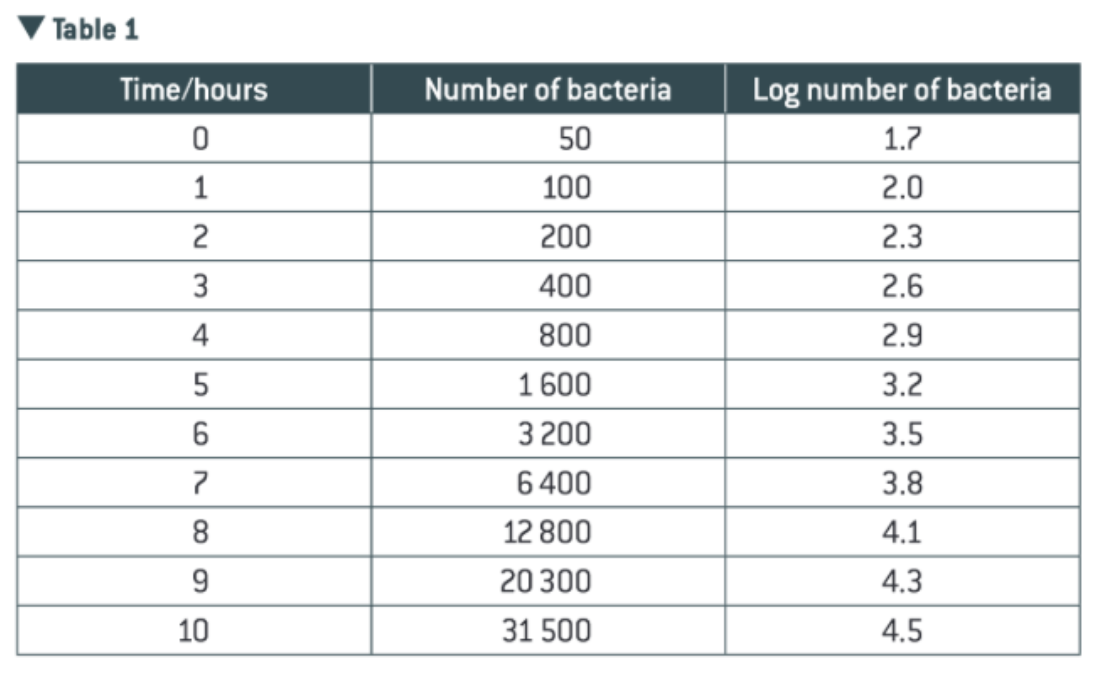
table 1 shows increase in population size of bacterium that initially doubles its numbers each hour
if we try to plot a graph of numbers against time using a time scale that allows us to differentiate each point, the curve runs off the graph after the point plotted at 4 hours
in these cases it is necessary to use a logarithmic scale to represent the number of bacteria
the logarithms of bacterial numbers are shown
when the graph of log bacterial numbers is plotted against time all points can be represented on the graph and we can see that rhetorical rate of growth starts to slow after 8 hours
SITUATION:
situation where a single photosynthetic bacterial cell, capable of asexual reproduction, is placed in a newly created pond
its summer and so there is plenty of light and the temp of the water is 12 degrees - mineral nutrients have been added to the water
in these circumstances the bacterial cell divides rapidly because all the factors needed for the growth of the population are present
no limiting factors
in situation, what things may change over time?
mineral ions are consumed as the population becomes larger
the population becomes so large that the bacteria at the surface prevent light reaching those at deeper levels
other species are introduced into the pond, carried by animals or the wind, and some of these species may use the bacteria as food or compete for light or minerals
winter brings much lower temperatures and lower light intensity of shorter duration
the growth of population slows (possibly ceases), and the population size may diminish
over winter the population is likely to reach a constant size - abiotic and biotic factors affect this
changes in the factors will influence the population size
what is the carrying capacity?
each population has a certain size that can be sustained over a relatively long period and this is determined by these factors
abiotic factors that influence the size of a population:
temperature
light
pH
water and humidity
temperature:
each species has a different optimum temperature at which it is best able to survive. the further away from this optimum, the fewer individuals in a population are able to survive and the smaller the population that can be supported
in plants and cold blooded animals…
enzymes work slower so metabolic rate is reduced
populations have a smaller carrying capacity
at temps above optimum, the enzymes work less efficiently as they gradually undergo denaturation - populations carrying capacity is reduced
in birds, mammals, and the warm blooded animals…
can maintain a relatively constant body temp regardless of external temp
you may think the carrying capacity would be unaffected by temp, but the further the temp of the external environment gets from their optimum temp, the more energy these organisms expend in trying to maintain their normal body temp
leaves less energy for individual growth and so they mature slower and reproductive rate slows
carrying capacity of population is reduced
light:
ultimate source of energy for most ecosystmes
basic necessity of life
rate of photosynthesis increases as light intensity increases
more photosynthesis = plants grow faster and more spores and seeds produced
carrying capacity therefore greater
carrying capacity of animals that feed on plants therefore greater
pH:
affects action of enzymes
each enzyme has an optimum pH where it operates most effecitvely
population of organisms is larger where the appropriate pH exists and smaller, or non existent, where pH is different from the optimum
water and humidity:
where water is scarce, populations are small and consist only of species that are well adapted to living in dry conditions
humidity affects the transpiration rates in plants and the evaporation of water from the bodies of animals
in dry air conditions, the populations of species adapted to tolerate low humidity will be larger than those with no adaptations
what happens when any abiotic factor is below the optimum for a population?
fewer individuals are able to survive as their adaptations aren’t suited to the conditions. if no individuals have adaptations that allow survival, the population becomes extinct
extra info: the influence of abiotic factors on plant populations:


extra info: the growth and size of human populations:

when does competition happen?
where 2+ individuals share any resource (eg. light, food, space, oxygen) that is insufficient to satisfy all their requirements full
intraspecific competition:
where such competition arises between members of the same species
interspecific competition:
where competition arises between members of different species
what determines the size of a population?
the availability of such resources like food, water, breeding sites, etc
the greater the availability…
… the larger the population
what does availability of resources also affect?
the degree of competition between individuals which results in a smaller population
examples of intraspecifc competition:
limpets competing for algae, which is their main food. the more algae available, the larger the limpet population becomes
oak trees competing for resources. in a large population of small oak trees some willl grow larger and restrict the availability of light, water, and minerals to the rest, which then die. in time the population will be reduced to relatively few large dominant oaks
robins competing for breeding territory. female birds are normally only attracted to males who have established territories. each territory provides adequate food for one family of birds. when food is scarce, territories become larger to provide enough food. there are therefore fewer territories in a given area and fewer breeding pairs, leading to a smaller population size
what happens when populations of 2 species are in competition?
one will normally have competitive advantage over the other
therefore what will happen to the species?
one will gradually increase in size and the other will diminish
what happens if conditions remain the same?
it will lead to the complete removal of one species - the competitive exclusion principle
competitive exclusion principle:
where 2 species are competing for limited resources, the one that uses these resources most effectively will ultimately eliminate the other - no 2 species can occupy the same niche indefinitely when resources are limiting
example:
2 species of sea birds (shags and cormorants) appear to occupy the same niche, living and nesting on the same type of cliff face and eating fish from the sea. analysis of their food, however, shows that shags feed largely on sand eels and herring, whereas cormorants eat mostly flat fish, gobies and shrimps. they therefore occupy different niches
what’s it necessary to do to show how a factor influences the size of a population?
link it to the birth rate and death rate of individuals in a population
example:
an increase in food supply doesn’t necessarily mean there will be more individuals - it could just result in bigger individuals
what is it therefore important to show?
how a factor, like a change in food supply, affects number of individuals in a population
example:
a decrease in food supply could lead to individuals dying of starvation and directly reduce the size of a population
what does an increase in food supply mean?
more individuals are likely to survive and so there is an increases probability that they will produce offspring and the population will increase. this effect therefore takes longer to influence population size

extra info: the effects of interspecific competition on population size:


extra info: competing to the death:

extra info: effects of abiotic and biotic factors on population size:

what is a predator?
an organism that feeds on another organism, know as their prey
what has happened as predators have evolved?
they’ve become better adapted for capturing their prey with faster movement, better camouflage and better means of detecting prey
how have prey also become more adept for avoiding predators?
better camouflage, more protective features like spines, and better concealment behaviour
what would have happened if prey or predators hadn’t matched the adaptations of each other?
both would’ve probably have become extinct
when does predation occur?
when one organism is consumed by another
what would happen if prey and predators are brought together in a laboratory?
the prey would be exterminated by the predator as the range and variety of the habitat is limited in a lab
why is extermination less likely in a habitat?
the area over which the population can travel is much greater and the environment is much more diverse - eg. more potential refuges
how can prey therefore escape predation in these circumstances?
they are harder to find and catch, so although the prey population falls to a low level it rarely becomes extinct
why isn’t lab condition findings very reliable?
they don’t necessarily reflect what happens in the wild
why’s it hard to obtain reliable data on natural populations?
its not possible to count all the individuals in a natural population - its size can only be estimated from sampling and surveys, which doesn’t guarantee accuracy
relationship between predators and prey and its effect on population size:
predators eat their prey, reducing the prey population
with fewer prey available the predators are in competition with each other for the prey that are left
the predator population reduces as some individuals are unable to obtain enough prey for survival or to reproduce
with fewer predators left, fewer prey are eaten so more survive and can reproduce
the prey population increases
more prey available so the predator population increases
what is the case in natural ecosystems?
organisms eat a range of foods and so fluctuations in population size are often less severe
diagram to show relationships between prey and predator populations:

what else leads to changes in organism populations?
disease and climatic factors
selection pressure:
those individuals who are able to escape predators, or withstand disease or adverse climate are more likely to survive and reproduce. the population therefore evolves to be better adapted to the prevailing conditions

extra info; the Canadian lynx and the snowshoe hare:

abundance:
the number of individuals of a species in a given space
why are only small samples of a habitat usually studied in detail?
its impossible to identify and count every organism. to do so would be time consuming and cause damage to the habitat being studied
as long as the samples are representative of the habitat as a whole…
…any conclusion drawn from the findings will be reliable
sampling techniques used for the study of habitats:
random sampling using frame quadrats or point quadrats
systematic sampling along a belt transect
point quadrat:
horizontal bar supported by 2 legs
at set intervals along the horizontal bar are 10 holes, through each of which a long pin may be dropped
each species that the pin touches is then recorded

frame quadrat:
a square frame divided by string or wire into equally sized subdivisions
often designed so that it can be folded to make more compact for storage
the quadrat is placed in different locations within the area being studied
the abundance of each species within the quadrat is then recorded

factors to consider when using quadrats:
size of quadrat to use
number of sample quadrats to record in the study area
the position of each quadrat within the study area
size of quadrat to use:
will depend on the size of the plants or animals being counted and how they are distributed within the area
larger species require larger quadrats
where a population of species isn’t evenly distributed throughout the area, a large number of small quadrats will give more representative results than a small number of large ones
number of sample quadrats to record within the study area:
the larger the number of sample quadrats the more reliable the results will be
as the recording of species within a quadrat is a time consuming task a balance needs to be struck between the reliability of the results and the time available
the greater the number of different species present in the area being studied, the greater the number of quadrats required to produce reliable results for a valid conclusion
the position of each quadrat within the study area:
to produce statistically significant results a technique called random sampling must be used
why is random sampling important?
to avoid any bias in collecting data, ensuring reliable data
example: investigating the effect of grazing animals on the species of plants growing in a field:
choose 2 fields as close together as possible in order to minimise soil, climatic, and other abiotic difference
one field is regularly grazed by animals like sheep, whereas the other hasn’t been grazed for many years
then take many samples at many random sites in each field by placing the quadrat on the ground and recording the names and numbers of every species found within the area of the quadrat
brief method of sampling:
lay out 2 long tape measures at right angles, along 2 sides of the study area
obtain a series of coordinates by using random numbers taken from a table or generated by a computer
place a quadrat at the intersection of each pair of coordinates and record the species within it
how is it sometimes more informative to measure?
the abundance and distribution of species in a systematic way rather than a random manner
when is this important?
when some form of gradual change (transition) in the communities of plants and animals takes place
example:
the distribution of organisms along a line of succession, such as, through sand dunes by the edge of the sea and inland up into woodland
how can a belt transect be made?
by stretching a string or tape across the ground in a straight line. a frame quadrat is then laid down alongside the line and the species within it recorded. it is then moved its own length along the line and the process repeated - gives a record of species in a continuous belt
what does random sampling and transects obtain?
measures of abundance
abundance:
the number of individuals of a species within a given area
how can abundance be measured? (for species that don’t move)
frequency
percentage cover
frequency:
the likelihood of a particular species occurring in a quadrat
eg. a species occurs in 15/30 quadrats, the frequency is 50%
this method is useful where a species, like grass, is hard to count
gives a quick idea of the species present and their general distribution within an area
it doesn’t provide information on the density and detailed distribution of a species
percentage cover:
an estimate of the area within a quadrat that a particular plant species covers
useful where a species is particularly abundant or is difficult to count
the advantages in these situations are that data can be collected rapidly and individual plants don’t need to be counted
its less useful where organisms occur in several overlapping layers (more probably plants)
what’s necessary to obtain reliable results:
ensure that the sample size is large, that is, many quadrats are used and the mean of all the samples is obtained. the larger the number of samples, the more representative of the community as a whole will be the results
why are these above measures not possible with motile animals?
motile animals move away when approached. they are often hidden and different to find and identify
what is the mark release recapture technique?
a known number of animals are caught, marked and then released by into the community. some time later, a given number of individuals are collected randomly and the number of marked individuals is recorded
estimated population size:
(total number of individuals in the first sample x total number of individuals in the second sample) / number of marked individuals recaptured
what assumptions does this technique rely on?
the proportion of marked to unmarked individuals in the second sample is the same as the proportion of marked to unmarked individuals in the population as a whole
the marked individuals released from the first sample distribute themselves evenly amongst the remainder of the population and have sufficient time to do so
the population has a definite boundary so that there is no immigration into or emigration out of the population
there are few, if any, deaths and births within the population
the method of marking isn’t toxic to the individual nor does it make the individual more conspicuous and therefore more liable to predation
the mark or label isn’t lost or rubbed off during the investigation
ecosystem:
made up of all the interacting biotic and abiotic factors in a particular area within which there are a number of communities of organisms
are ecosystems the same forever?
no, they are dynamic