BIOL 107 Unit 4
 Call Kai
 Learn
 Practice Test
 Spaced Repetition
 Match
 Flashcards
 Knowt Play
1/47

Earn XP
Description and Tags
Organisms and Energy!
48 Terms
What is plasmolysis?
The cell membrane pulls away from the cell wall in hypertonic environments. Occurs in plant and prokaryote (bacterial) cells.
Can prokaryotes produce while plasmolysed?
No.
Facultative Anaerobes
Bacteria that can respire using O2 and anaerobically.
Which of the following statements are true? 1. Both prokaryotes and eukaryotes have ribosomes. 2. Both prokaryotes and eukaryotes have DNA housed in a nucleus. 3. Prokaryotes and some eukaryotes both have cell walls. 4. Some prokaryotes and some eukaryotes have flagella. 5. Photosynthetic prokaryotes and eukaryotes both use chloroplasts to perform photosynthesis.
True 2. False 3. True 4. True 5. False
(T/F) Archaea are more closely related to bacteria than eukaryotes.
F
Prokaryotes have:
A cell wall, a capsule (slime layer), circular DNA.
Fungal roles in the environment include:
Decomposers, mutualists/symbiotes (mycorrizhae), parasites, predators.
Deep sea hydrothermal vents are able to sustain ecological communities with no energy input from the sun. How?
Chemoautotrophic bacteria generate energy and gain carbon from inorganic materials.
A type of bacteria colonizes on the surface of a leaf, where it obtains nutrition from the leaf's nonliving, waxy covering without harming the plant, and inhibits the growth of other microbes that are plant pathogens. If this bacteria gains access to the inside of a leaf, however, it causes a fatal disease in the plant. Once the plant dies, the bacterium and its offspring decompose the plant. What is the correct sequence of ecological roles played by the bacterium in the situation described here?
Mutualist, pathogen, decomposer.
Broad-spectrum antibiotics inhibit the growth of most intestinal bacteria. Consequently, assuming that nothing is done to counter the reduction of intestinal bacteria, a hospital patient who is receiving broad-spectrum antibiotics is most likely to exhibit which of the following characteristics?
Deficiency in certain vitamins and nutrients (those that the patient cannot synthesize themselves).
Which plant part absorbs most of the water and minerals taken up from the soil?
Root Hairs
Describe an anatomical difference between roots and leaves.
A waxy cuticle covers leaves but is absent from roots
What cell type retains the ability to undergo cell division?
A meristem cell near the root tip
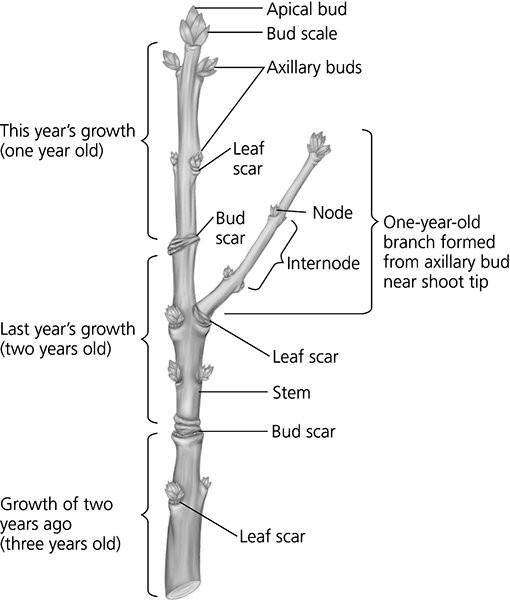
If you examined the cut surface at the base of this twig, how many growth rings should be present?
three
Shoot elongation in a growing bud is due primarily to what?
cell elongation localized in each internode
Describe the driving force that pushes the root tip through the soil.
elongation of cells behind the root apical meristem.
The value for Ψ in root tissue was found to be -0.15 MPa If the root tissue were placed in a 0.1 M solution of sucrose (Ψ = -0.23 MPa) the net water flow will be in which direction?
Into the sucrose solution from the root tissue; from high to low.
What best predicts the movement of water across biological membranes?
Water potential (Ψ)
What is another term for solute potential in a cell?
Osmotic potential
When an animal cell is placed in a hypotonic solution and water enters the cell via osmosis, the volume of the cell increases until it bursts. Why doesn’t this happen to plant cells?
they have cell walls, which provide pressure to counteract the pressure of the incoming water
If you place a flaccid plant cell in pure water, what occurs?
Water enters the cell because the flaccid cell has solutes and low water potential.
What primarily enters the water via the roots?
Water, nitrogen, and potassium.
What primarily enters the water through the leaves?
Carbon Dioxide.
Several tomato plants are growing in a small garden plot. If soil water potential were to drop significantly on a hot, summer afternoon, which of the following would most likely occur?
Size of stomatal openings would decrease.
What is the driving force behind transpiration?
The difference in water potential between the soil and the atmosphere.
Why do plants primarily use root hairs to uptake water and nutrients from the soil?
They significantly increase surface area and can access pockets of water and air between soil particles that the larger root structures cannot.
How do plants uptake nutrients from the soil?
Cation exchange; the secrete H+ ions to displace positively charged ions attached to negatively-charged soil particles, and then uptake them.
How are plants able to uptake water from the soil?
They utilize solute potential to force the water to flow from high potential (soil) to low potential (root interiors).
Arbuscular Mycorrhizae vs Ectomycorrhizae?
Inside root cells; outside root cells but within intracellular space.
Why is phosphorus essential to plant nutrition?
It is a primary component of ATP and other organic molecules.
What elements can plants intake from the atmosphere? What elements must it uptake from the soil?
C, H O (atmospheric); N, P (soil)
Given that early land plants most likely share a common ancestor with green algae, the earliest land plants most likely belonged to what category?
nonvascular plants that grew leafless, photosynthetic shoots
What ion plays the primary role in basic transport processes in plant cells?
H+
Describe the transmembrane route for transport within plant tissue.
water and solutes move out of one cell, through the cell wall, and into the neighboring cell
Long-distance transport in phloem requires which of the following processes?
I) | a positive water potential |
II) | active transport through parenchyma cells |
III) | cohesion between water molecules |
IV) | evaporation of water molecules |
I, II, and III.
Give two examples of sources and sinks based on season.
What is the driving force of water up the xylem and in the phloem?
Water pressure potential; xylem → psi (p) is much more negative in the atmosphere than the soil. phloem → solute potential (psi (s)) drives water into the phloem from the xylem, then the increased psi (p) drives solution into parts of the plant that have more negative psi (p).
What tissue would have a complex plasma membrane with many folds and transporters?
epithelial tissue
In what tissue would you find cells with lots of mitochondria?
muscular tissue
In what tissue would you find cells with a lot of transmembrane receptor proteins?
nervous tissue
What is a typical characteristic of connective tissues?
relatively few cells and a large amount of extracellular matrix
What is the name of the epithelial cell surface that faces the outside of an organ?
basal
Which organ system is responsible for protection against injury, infection, and dehydration?
integumentary system
Animals cannot produce enzymes to digest cellulose, yet many termite species consume cellulose from plant material as a main part of their diet. How do termites access the nutrients contained in cellulose?
Mutualistic bacteria in the hindgut of the termite digest the cellulose into sugars.
Food being digested in the stomach is in a highly acidic environment. The pH of the small intestine is higher than that of the stomach. Explain.
Secretin increases the flow of bicarbonate ions from the pancreas into the small intestine to neutralize the stomach acid.
What are essential nutrients?
The 8 essential amino aids, fatty acids, vitamins and minerals. Anything an organism cannot synthesize itself.
Is the environment inside the small intestine acidic? Why or why not?
No, because bicarbonate (secreted from the pancreas) neutralizes the chyme (stomach acid) that enters the intestinal tract.
What increases surface area in the small intestine?
Villi or microvilli