Openstax Chemistry 2e - Atoms First - Chapter 3
 Call Kai
 Learn
 Practice Test
 Spaced Repetition
 Match
 Flashcards
 Knowt Play
1/80

There's no tags or description
Looks like no tags are added yet.
81 Terms
actinide
inner transition metal in the bottom of the bottom two rows of the periodic table

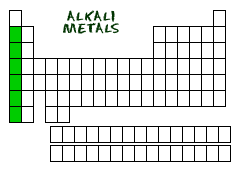
alkali metal
element in group 1 of the periodic table (lithium, sodium, potassium, rubidium, cesium, and francium)
alkaline earth metal
element in group 2: beryllium (Be), magnesium (Mg), calcium (Ca), strontium (Sr), barium (Ba), and radium (Ra)

amplitude
extent of the displacement caused by a wave

atomic orbital
mathematical function that describes the behavior of an electron in an atom (also called the wavefunction)

Aufbau principle
procedure in which the electron configuration of the elements is determined by "building" them in order of atomic numbers, adding one proton to the nucleus and one electron to the proper subshell at a time

blackbody
idealized perfect absorber of all incident electromagnetic radiation; such bodies emit electromagnetic radiation in characteristic continuous spectra called blackbody radiation
Bohr's model of the hydrogen atom
structural model in which an electron moves around the nucleus only in circular orbits, each with a specific allowed radius

chalcogen
element in group 16: oxygen (O), sulfur (S), selenium (Se), tellurium (Te), and the radioactive element polonium (Po)

continuous spectrum
electromagnetic radiation given off in an unbroken series of wavelengths (e.g., white light from the sun)

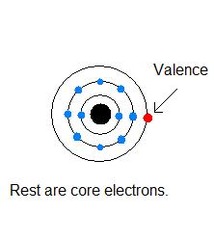
core electron
electron in an atom that occupies the orbitals of the inner shells

covalent bond
attractive force between the nuclei of a molecule's atoms and pairs of electrons between the atoms

covalent compound
(also, molecular compound) composed of molecules formed by atoms of two or more different elements

covalent radius
one-half the distance between the nuclei of two identical atoms when they are joined by a covalent bond

d orbital
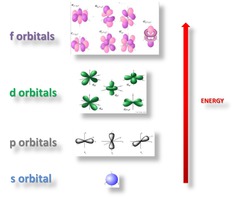
region of space with high electron density that is either four lobed or contains a dumbbell and torus shape;describes orbitals with l = 2
degenerate orbitals
orbitals that have the same energy

effective nuclear charge
charge that leads to the Coulomb force exerted by the nucleus on an electron, calculated as the nuclear charge minus shielding
electromagnetic radiation
energy transmitted by waves that have an electric-field component and a magnetic-field component
electromagnetic spectrum
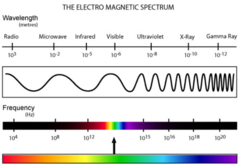
range of energies that electromagnetic radiation can comprise, including radio, microwaves, infrared, visible, ultraviolet, X-rays, and gamma rays
electron affinity
energy change associated with addition of an electron to a gaseous atom or ion

electron configuration
listing that identifies the electron occupancy of an atom's shells and subshells

electron density
a measure of the probability of locating an electron in a particular region of space, it is equal to the squared absolute value of the wave function ψ "Psi"
endothermic
processes that increase the energy of an atom and involve the absorption of light
excited state
state having an energy greater than the ground-state energy
exothermic
processes that decrease the energy of an atom and involve the emission of light
f orbital
multilobed region of space with high electron density, describes orbitals with l = 3

frequency (ν)
number of wave cycles (peaks or troughs) that pass a specified point in space per unit time

ground state
state in which the electrons in an atom, ion, or molecule have the lowest energy possible
group
vertical column of the periodic table

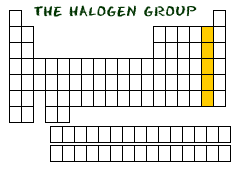
halogen
element in group 17: fluorine (F), chlorine (Cl), bromine (Br), iodine (I), and astatine (At)
Heisenberg uncertainty principle
rule stating that it is impossible to exactly determine both certain conjugate dynamical properties such as the momentum and the position of a particle at the same time. The uncertainty principle is a consequence of quantum particles exhibiting wave-particle duality
hertz (Hz)
the unit of frequency, which is the number of cycles per second, s^-1
Hund's rule
every orbital in a subshell is singly occupied with one electron before any one orbital is doubly occupied, and all electrons in singly occupied orbitals have the same spin
inert gas (also, noble gas)
element in group 18: helium (He), neon (Ne), argon (Ar), krypton (Kr), xenon (Xe), and the radioactive radon (Rn)

inner transition metal
element in the bottom two rows; if in the first row, also called lanthanide, or if in the second row, also called actinide
intensity
property of wave-propagated energy related to the amplitude of the wave, such as brightness of light or loudness of sound
interference pattern
pattern typically consisting of alternating bright and dark fringes; it results from constructive and destructive interference of waves
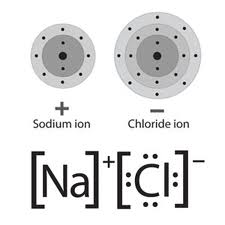
ionic bond
electrostatic forces of attraction between the oppositely charged ions of an ionic compound

ionic compound
compound composed of cations and anions combined in ratios, yielding an electrically neutral substance
ionization energy
energy required to remove an electron from a gaseous atom or ion
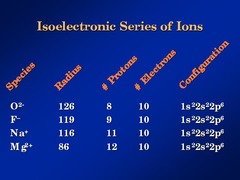
isoelectronic
group of ions or atoms that have identical electron configurations
lanthanide
inner transition metal in the top of the bottom two rows of the periodic table

line spectrum
electromagnetic radiation emitted at discrete wavelengths by a specific atom (or atoms) in an excited state

magnetic quantum number (ml)
quantum number signifying the orientation of an atomic orbital around the nucleus

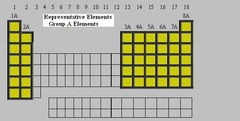
main-group element
(also, representative element) element in groups 1, 2, and 13-18
metal
element that is shiny, malleable, good conductor of heat and electricity

metalloid
element that conducts heat and electricity moderately well, and possesses some properties of metals and some properties of nonmetals

molecular compound
(also, covalent compound) composed of molecules formed by atoms of two or more different elements
monatomic ion
ion composed of a single atom

noble gas
(also, inert gas) element in group 18: helium (He), neon (Ne), argon (Ar), krypton (Kr), xenon (Xe), and the radioactive radon (Rn)
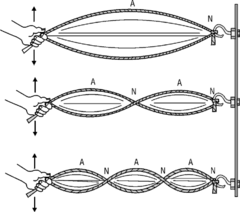
node
any point of a standing wave with zero amplitude
nonmetal
element that appears dull, poor conductor of heat and electricity

orbital diagram
pictorial representation of the electron configuration showing each orbital as a box and each electron as an arrow

oxyanion
polyatomic anion composed of a central atom bonded to oxygen atoms

p orbital
dumbbell-shaped region of space with high electron density, describes orbitals with l = 1

Pauli exclusion principle
specifies that no two electrons in an atom can have the same value for all four quantum numbers
period
(also, series) horizontal row of the periodic table
periodic law
properties of the elements are periodic function of their atomic numbers
periodic table
table of the elements that places elements with similar chemical properties close together

photon
smallest possible packet of electromagnetic radiation, a particle of light
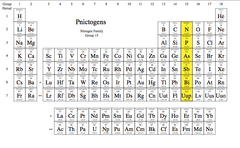
pnictogen
element in group 15: aka nitrogen family. It consists of the elements nitrogen (N), phosphorus (P), arsenic (As), antimony (Sb), bismuth (Bi) and perhaps the chemically uncharacterized synthetic element moscovium (Mc).
polyatomic ion
ion composed of more than one atom
principal quantum number (n)
quantum number specifying the shell an electron occupies in an atom
quantization
limitation of some property to specific discrete values, not continuous
quantum mechanics
field of study that includes quantization of energy, wave-particle duality, and the Heisenberg uncertainty principle to describe matter
quantum number
number having only specific allowed values and used to characterize the arrangement of electrons in an atom
representative element
(also, main-group element) element in columns 1, 2, and 12-18

s orbital
spherical region of space with high electron density, describes orbitals with l = 0

secondary (angular momentum) quantum number (l)
quantum number distinguishing the different shapes of orbitals; it is also a measure of the orbital angular momentum

series
(also, period) horizontal row of the period table
shell
atomic orbitals with the same principal quantum number, n
spin quantum number (ms)
number specifying the electron spin direction, either + 1/2 or - 1/2
standing wave
(also, stationary wave) localized wave phenomenon characterized by discrete wavelengths determined by the boundary conditions used to generate the waves; standing waves are inherently quantized
subshell
atomic orbitals with the same values of n and l
transition metal
element in groups 3-12 (more strictly defined, 3-11; see chapter on transition metals and coordination chemistry)

valence electrons
electrons in the outermost or valence shell (highest value of n) of a ground-state atom
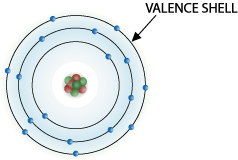
valence shell
outermost shell of electrons in a ground-state atom
wave
oscillation of a property over time or space; can transport energy from one point to another

wave-particle duality
observation that elementary particles can exhibit both wave-like and particle-like properties
wavefunction (ψ "Psi")
mathematical description of an atomic orbital that describes the shape of the orbital; it can be used to calculate the probability of finding the electron at any given location in the orbital, as well as dynamical variables such as the energy and the angular momentum
wavelength (λ "Lambda")
distance between two consecutive peaks or troughs in a wave
