Pharmacological Management of Parkinson's Disease
 Call Kai
 Learn
 Practice Test
 Spaced Repetition
 Match
 Flashcards
 Knowt Play
1/33

Earn XP
Description and Tags
A comprehensive vocabulary flashcard set covering the biochemical changes, cardinal symptoms, risk factors, and pharmacological classes used in the management of Parkinson's disease.
34 Terms
Parkinson's Disease (PD)
A complex, progressive neurodegenerative disorder pathologically characterized by the degeneration of dopaminergic neurons in the substantia nigra and clinically marked by motor symptoms including muscle rigidity, resting tremors, and bradykinesia.
Bradykinesia
A cardinal motor symptom of Parkinson's disease defined as slowness of movement and impaired execution of motor tasks, often presenting with reduced emotional facial expressions.
Dyskinesia
Involuntary, spontaneous, abnormal twitching movements of facial, arm, and leg muscles, which can appear as an early sign of disease or as a complication of long-term dopaminergic therapy.
Lewy Bodies
Pathological intracellular protein inclusions consisting of aggregated α-synuclein that accumulate inside degenerating neurons in Parkinson's disease.
Nigrostriatal Pathway Imbalance
The disruption in basal ganglia circuitry where loss of nigrostriatal dopaminergic inhibition on striatal GABAergic neurons results in excessive, unopposed excitatory cholinergic (acetylcholine) activity.
Levodopa (L-DOPA)
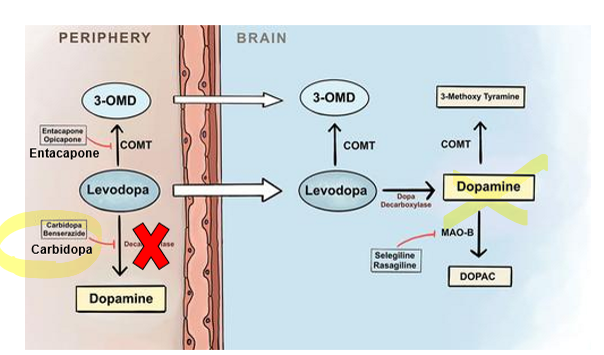
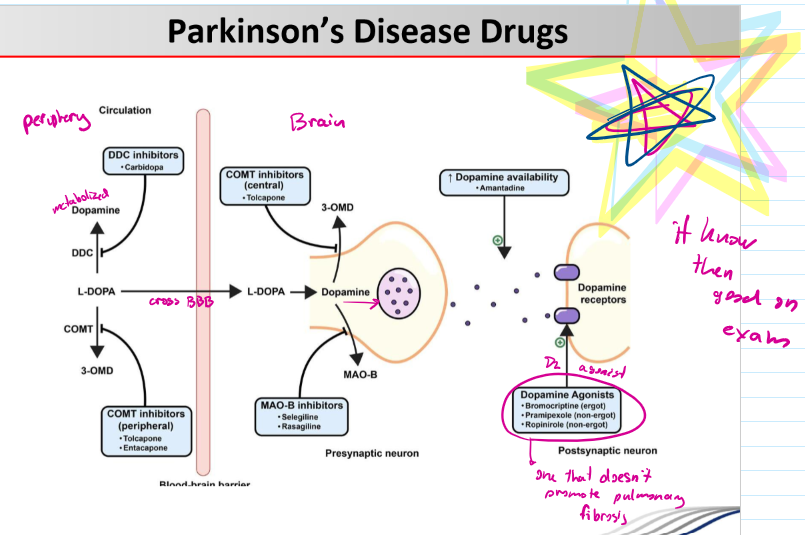
The metabolic immediate precursor of dopamine that crosses the blood-brain barrier via large neutral amino acid transporters to enhance striatal dopamine synthesis; recognized as the gold standard treatment for motor symptoms in Parkinson's disease.
Carbidopa
A peripheral dopa decarboxylase (DDC) inhibitor that does not cross the blood-brain barrier; co-administered with levodopa to prevent its premature peripheral breakdown into dopamine, lowering required levodopa doses and diminishing peripheral adverse effects like nausea and vomiting.

"On-Off" Phenomenon
Motor fluctuations characterized by rapid shifts between periods of good symptom control ("on") and severe parkinsonian disability ("off"), driven by the short plasma half-life (1–3hours) of levodopa and progressive loss of neuronal storage capacity.
Large Neutral Amino Acids (LNAAs) do what to levodopa
Dietary amino acids (such as leucine and isoleucine) that compete with levodopa for active transport across the intestinal mucosa and the blood-brain barrier, diminishing levodopa absorption after protein-rich meals.

Levodopa-Induced Dyskinesia (LID)
Dose-dependent involuntary choreic or dystonic muscle movements that typically emerge at peak drug concentrations during advanced stages of Parkinson's disease.
D2 Receptor Subtype
The key inhibitory dopamine receptor subtype located in the striatum and substantia nigra whose activation mediates the primary therapeutic motor benefits of antiparkinsonian pharmacotherapy.
Bromocriptine
An ergot alkaloid derivative from Claviceps purpurea that acts as a partial agonist at dopamine D2 receptors; rarely selected as first-line therapy today due to side effects including pulmonary fibrosis and compulsive gambling (compulsive behavior)
Pramipexole
A non-ergot dopamine agonist with high affinity for dopamine D3 receptors, effective both as monotherapy in early disease and adjunctively with levodopa.
Ropinirole
A non-ergot dopamine agonist with high affinity for dopamine D2 receptors; it is metabolized by hepatic CYP1A2, meaning co-administered inhibitors such as caffeine or ciprofloxacin can decrease its clearance.
Monoamine Oxidase Type B (MAO-B) Inhibitors
A drug class (including selegiline and rasagiline) that selectively inhibits the primary mitochondrial enzyme responsible for dopamine catabolism in the brain, thereby prolonging central dopamine action.
Selegiline
A selective, irreversible inhibitor of MAO-B with minimal efficacy when administered alone, primarily used as an adjunct to levodopa to reduce wearing-off fluctuations.
Rasagiline
A potent second-generation selective MAO-B inhibitor that is approved for monotherapy in early symptomatic Parkinson's disease as well as an adjunct to levodopa.
Catechol-O-Methyltransferase (COMT) Inhibitors
A therapeutic class (including entacapone and tolcapone) that blocks the enzyme converting levodopa to 3-O-methyldopa (3-OMD), preventing peripheral and/or central levodopa degradation.
Entacapone
A peripherally acting COMT inhibitor that does not cross the blood-brain barrier; used exclusively as an adjunct to levodopa/carbidopa to enhance systemic levodopa bioavailability.
Tolcapone
A COMT inhibitor that crosses the blood-brain barrier to act both centrally and peripherally; its clinical use is severely restricted due to risk of fatal hepatotoxicity.
Benztropine
A centrally acting antimuscarinic (anticholinergic) medication that relieves tremor and muscle rigidity by decreasing cholinergic excitation on striatal neurons, with minimal effect on bradykinesia.
Amantadine
An antiviral drug originally approved in 1966 for Asian influenza that exerts antiparkinsonian actions through dopamine synthesis/release and specifically manages levodopa-induced dyskinesias via NMDA receptor antagonism.
MPTP (1-methyl-4-phenyl-1,2,3,6-tetrahydropyridine)
A neurotoxic byproduct of illicit meperidine analog synthesis that selectively destroys dopaminergic neurons in the nigrostriatal tract, inducing permanent, irreversible parkinsonism.
Drug-Induced Parkinsonism
A secondary, typically reversible parkinsonian state caused by pharmacologic agents that block postsynaptic D2 dopamine receptors (e.g., haloperidol, chlorpromazine) or deplete central catecholamine stores (e.g., high-dose reserpine).

Advantage of pramipexole and ropinirole over bromocriptine
These non-ergot agonists directly stimulate postsynaptic D2 receptors without causing ergot-related complications like pulmonary fibrosis
COMT inhibitor site of action distinction
Tolcapone crosses the blood-brain barrier to act both centrally and peripherally, whereas entacapone acts exclusively in peripheral circulation.

Amantadine presynaptic mechanism
Increases striatal dopamine availability by stimulating its biosynthesis, turnover, uptake, and vesicular release from presynaptic terminals.
Increases striatal dopamine availability by stimulating its biosynthesis, turnover, uptake, and vesicular release from presynaptic terminals.
Conversion to dopamine via dopa decarboxylase (DDC) and conversion to 3-O-methyldopa (3-OMD) via catechol-O-methyltransferase (COMT).

what r the two main goals of drug treatment of parkinson’s disease?
reduce dopamine breakdown (ACH antagonists), and increase dopamine



why is carbidopa combined with levodopa in the treatment of parkinsons disease?
C

Which drug is an anticholinergic used to reduce tremors in parkinson’s disease
B
where is the death of dopaminergic neurons
substantia nigra

what do we want to minimize here
lower troughs and flatter curve is better