ECN204
 Call Kai
 Learn
 Practice Test
 Spaced Repetition
 Match
 Flashcards
 Knowt Play
1/134

Earn XP
Description and Tags
Midterm review
135 Terms
Recession
Negative rate of growth, output and living standards decline
Business cycle
Recurring increases and decreases in the level of economic activity over periods of years
Real GDP
Measures value of final goods and services produced WITHIN the borders of a country during a specific time period
Nominal GDP
Totals the dollar value of all goods and services produced within a country using their prices during the year they were produced
What does nominal GDP not account for that real GDP does?
Price changes
Why are high unemployment rates undesirable?
It indicates that a nation is not using a large portion of its most important resource
Saving
Occurs when current consumption is less than current income/output
Investment (economic)
Resources are devoted to increasing future output - building new production technologies or paying for the production of newly created capital goods that will increase future output
Shocks
Situations where one outcome is expected to happen but something else happens instead
Positive demand shock
When an actual demand is higher than expected
Negative demand shock
When an actual demand turns out to be lower than expected
What are inflexible prices known as?
Sticky prices
GDP per person measures
the amount of output per person if total output were equally divided among everyone
What are the main statistics used by economists to assess the health of an economy?
Real GDP, unemployment, inflation

Rule of 70
Used to estimate the number of years it will take for an exponentially growing metric to double in value.
Final goods
Goods/services purchased for final use and not for resale or further processing ex gasoline
Intermediate goods
Products purchased for resale or further processing or manufacturing
Value added
Value of products sold - value of inputs used to produce that product
Two types of nonproduction transactions
Financial transactions (public transfer payments, private transfer payments, stock-market transactions) and second-hand sales
Expenditures Approach to calculate GDP
Sum of all money spent in buying final goods and services
Income Approach to calculate GDP
Income derived or created from producing final goods and services
What does expenditures approach add up?
Personal consumption expenditures, Gross investment, Government purchases, Net exports
Personal consumption expenditures (C)
All expenditures by households on goods and services such as durable goods (ex stoves, fridge), nondurable goods (food, clothes, gasoline) or services
Gross investment (Ig)
Machinery, equipment, tools by firms, construction
Net investment
Gross investment - depreciation
Government purchases (G)
Expenditures for goods and services, publicly owned capital
Net exports (Xn)
Exports - Imports
GDP formula
C + Ig + G + Xn
Personal income
The total income, both earned and unearned, available to individuals before taxes
Disposable income
The remaining income after personal income taxes are deducted from PI
Nominal GDP
GDP measured in terms of the price level at the time of the measurement (unadjusted for inflation)
Real GDP
Reflect changes in the price level, shows the change in a country’s output of goods and services

Price index of a specific year
Price of market basket in specific year / price of same market basket in base year
Real GDP formula
Nominal GDP / Price Index x 100
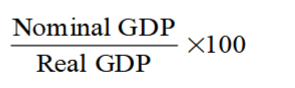
GDP Deflator
Nominal GDP / Real GDP x 100
Reasons for GDP understating total output
Nonmarket activities, Underground economy, Improved product quality
Nonmarket activities
Stay-at-home parenting or self-repair work completed
Underground economy
Illegal drugs, jobs done for cash and no tax paid
What are other factors that cause GDP to overstate national wellbeing?
Growth of GDP can bring negative by-products like pollution/congestion, social costs are not deducted, environmental degradation, improvements in society, non-economic sources of wellbeing are not included
What do economists define and measure economic growth as?
An increase in GDP occurring over some time period or an increase in GDP per capita occurring over some time period
Real GDP per capita formula
Real GDP / population
What does growth lessen the burden of?
Scarcity
What does rule 70 say about approximate number of years needed to double GDP?
70 / annnual percentage rate of growth
What does growth in Canada not account for?
Improved products and services, added leisure, other impacts
What institutional structures promote modern economic growth?
Strong property rights, patents and copyrights, efficient financial institutions, literacy and education, free trade, competitive market system
Six factors directly affecting direct growth rate and quality
4 supply factors, 1 demand factor, 1 efficiency factor
4 supply factors
Increases in quality and quantity of natural resources, increases in the quality and quantity of human resources, increases in the stock of capital goods, improvements in technology
Allocative efficiency
Producing the goods and services that are most wanted by society
Productive efficiency
Use its resources in the least costly way C
Categories of economic resources
Land, labour, capital, entrepreneurial ability
Land
All natural resources used in production, includes forests, mineral, oil deposits, etc
Human capital
Human skills and knowledge
Capital
All manufactured aids used in producing consumer goods/services like factories, tools, and even intangible ideas like software and designs used to produce goods
Investment
Purchasing of capital goods
Production possibilities model
An economic model that shows different combinations of two goods an economy can produce, assuming full employment, fixed resources and fixed technology
What does producing anywhere on the PPC line indicate?
It means the economy produces the max amount of both products, meaning the economy is efficient
What does producing within the PPC curve indicate?
They are attainable, but they are not efficient as full employment and productive efficiency is not realized
What does producing beyond the PPC curve indicate?
They are not attainable due to limited resources and a fixed technology
Optimal allocation of resources
Occurs at the point where both the quantities of both products maximize satisfaction, achieved when marginal benefit of producing one unit equals the marginal cost
What is required to get a growing economy? (note this can be reflected onto the PPC)
Increase in resource availability, improved resource quality, and technological advances
What is an individual nation limited by?
Its production possibility curve (PPC)
How can a nation overcome its limitations from the PPC?
Through international specialization and trade
How can society increase its real output and income?
By increasing its input of factors of production (land, labor, capital, and entrepreneurial ability)
By raising the productivity of those inputs
Real GDP formula when given values
Worker hours x labour productivity
% change in GDP
% change in worker hours + % change in productivity
Key productivity drivers
Technology, capital, education, economies of scale, resource allocation
What is the concept of no free lunch?
Everything has a cost, even if not directly to the consumer
Opportunity costs
Value of the next best alternative forgone when resources are used for a particular purpose
Utility
Satisfaction derived from consuming a good or service
Macroeconomics
Studies the overall economy’s performance and behavior, aggregates group individual units (like consumers) into larger categories
Microeconomics
Focuses on decision-making by individual consumers, workers, businesses, examines detailed behavior at a closer level
The Economic Problem
Individuals need to make choices because economic wants are unlimited, but the means to satisfy those wants are limited
Factors of production
Land, labour, capital, entrepreneurial ability
Fallacy of Composition
What’s true for one doesn’t always apply to the whole; avoid generalizing
Phases of the Business Cycle
Peak, Recession, Trough, Expansion
Trough
Output and employment reach rock bottom
Expansion
Real GDP, income and employment rise
What are the key drivers of business cycle fluctuations instead of smooth growth?
Sticky prices and economic shocks
Specifically what sources are linked to shocks that cause business cycles?
Irregular innovation, productivity changes, monetary factors, political events, financial instability
What happens when more money is created than expected?
An inflationary boom in output
What happens when less money is printed than expected?
Output decline and lower prices
Who is considered unemployable due to laws/circumstances?
People who are under 15 and/or institutionalized
How is labour force calculated?
The sum of employed and unemployed individuals
Unemployment rate
Unemployed / labour force x 100%
Frictional unemployment
Short-term temporary period of joblessness that occurs when workers are in the process of switching jobs or enter job market for the first time, and happens when there are labor market inefficiencies
Structural unemployment
Workers’ skills become outdated and do not match new jobs, requiring relocation or retraining
Cyclical unemployment
Unemployment caused by economic downturn (decline in total spending), typically during recessions
What worsens cyclical unemployment and how?
Wage stickiness because it prevents wages from being adjusted downwards in response to economic downturn
What does full employment mean the absence of?
Cyclical unemployment
When does full employment exist?
When ONLY frictional and structural unemployment exist
Potential output
The real output an economy can produce when it fully employs its available resources
The natural rate of unemployment
Reflects the unemployment rate consistent with full employment, where potential output is produced
GDP gap
actual gdp - potential gdp
Negative GDP gap
Occurs when unemployment is above the natural rate
Positive GDP gap
Occurs when unemployment is below the natural rate
Okun’s law
GDP gap = -2 x (actual unemployment rate - natural rate of unemployment)
What does high unemployment linked with/lead to?
Mental health issues, personal decline, skill loss, poverty, social tensions
What was Hitler’s rise in Germany triggered by?
Severe unemployment leading to political unrest
Consumer Price Index (CPI)
An index that measures the prices of a fixed market basket of goods and services that a typical consumer buys
CPI formula
( Price of fixed market basket in a given year / Price of that fixed market basket in the base year ) x 100