Pharm Quiz 1
 Call Kai
 Learn
Learn Practice Test
 Spaced Repetition
 Match
Match Flashcards
 Knowt Play
1/79

There's no tags or description
Looks like no tags are added yet.
Name | Mastery | Learn | Test | Matching | Spaced | Call with Kai | Chat |
|---|
No analytics yet
Send a link to your students to track their progress
80 Terms
pharmacology
study of how drugs work and how they affect our bodies
drugs
substances that have a physiological effect when introduced into the body
medicines
types of drugs that are an approved therapeutic goods that are used to treat or prevent specific health conditions
ligands
molecules that bind to a receptor
can be endogenous or introduced into the body (drug)
small molecule drug
<500 Da
small size may allow easier absorption into the body and crossing cell membranes
can be orally active
synthesized by chemists or purified from nature
peptide drugs
500 Da < 5000 Da
synthesized by chemists or purified from nature OR derived from living organisms
biologics
5 kDa < 150 kDa
include vaccines, blood/blood components, somatic cells, growth factors, recombinant peptides and proteins, immune modulators, monoclonal antibodies
synthesized by chemists or purified from nature OR derived from living organisms
peptides vs proteins
both made of chains of amino acids joined together by peptide bonds
peptides (<50 AA)
larger molecules (>50 AA) such as monoclonal antibodies, growth factors
large size and potential enzymatic digestion make them not suitable for oral administration, most by injection
nucleic acid-based therapies
targets components inside the cell to either correct or compensate for disease caused by genetic mutations or altered gene expression
gene therapy
antisense oligonucleotides
small interfering RNA
mRNA therapies
CRISPR/Cas9 editing
microRNA
inclisiran
targets the mRNA encoding PCSK9 a protein involved in regulating LDL levels, used in the treatment of homozygous familial hypercholesterolemia

3 drug names
IUPAC
International union of pure and applied chemistry
INN
international non-proprietary name
all lowercase
Brand or trademark
capitalized first letter
international non-proprietary name (INN)
approved by the WHO
each name is unique and globally recognized and is aka the generic name
must end in approved “stem”, same stem used for pharmacologically related substances
pharmacodynamics
what the drug does to the body
study of the molecular, biochemical, and physiological effects of drugs on cellular systems and their mechanisms
receptor
macromolecule (protein) that mediates the actions of endogenous and exogenous ligands
formation of the drug-receptor complex leads to a biological response
binding sites
region on the receptor where a ligand binds
the site where the endogenous ligand binds is the orthosteric site
binding sites outside of the orthosteric site are called allosteric sites
agonist
a ligand that binds to a receptor and stimulates it to function
antagonist
a ligand that blocks binding of agonist ligands to a receptor preventing signaling by the receptor
can bind to but not activate a receptor, thus blocking the actions of agonists at the receptor
if bind with high affinity but no efficacy
have an efficacy of zero
pharmacokinetics
what the body does the drug
study of absorption, distribution, metabolism, and excretion (ADME)
therapeutics
uses of drugs and the methods of their administration in the treatment of disease
drug target - what the drug binds to elicit an effect (receptor)
mechanisms of actions - how the drug works, how it modulates the function of the target
indications - what diseases or conditions the drug is used in the treatment of
contraindications - what disease or condition or patient population the drug should not be used in
routes of administration- how the drug can be given
pharmacokinetic parameters - ADME factors that affect the clinical efficacy of the drug
drug interactions - a change in a drug’s effect due to interactions with other drugs, food, or a medical condition
adverse effects or side effects
drug-drug interactions
a change in a drugs effect on the body and the body’s effect on the drug when it is taken together with another drug
drugs can have an additive effect or opposing effects due to their mechanisms of actions
can delay, decrease, or enhance absorption of either drug. it may change the metabolism or excretion of one or both drugs
may increase or decrease the effects of one or both drugs
adverse event
an unexpected medical event that is generally harmful to the participant that occurs during treatment with a pharmaceutical product, but which does not necessarily have a causal relationship with the treatment
adverse effects
unintended pharmacological effects that occur when a medication is administered correctly. include any unexpected medical event that is generally harmful to the participant due to taking the treatment. known to occur in a percentage of patients determined from clinical trials
very common >10%, common >1%, uncommon >0.1%, rare >0.01%, and very rare <0.01%
side effects
unintended but predictable symptoms that can develop while taking a drug
can happen at normal recommended doses and are unrelated to the intended purpose of the medication
side effects are often dose-related
side effects may be desirable, adverse, or inconsequential. adverse or negative side effect = adverse effect
can be due to actions at the intended target or unintended
dose response
when observing the effect of a drug in a whole animal or human (in vivo)
concentration can interact and changes over time due to ADME factors
concentration response
when observing the effect of a drug isolated cells or tissues (in vitro or ex vivo)
concentration doesn’t change because confined to known volume
drug development 3 things
unsent medical need: condition or symptom whose treatment or diagnosis is not addressed adequately by available therapy
target: specific molecules, often a protein, in the body that is closely linked to a particular disease process and can be influenced by a drug to produce a desired therapeutic outcome
lead: chemical compound that shows promise as a treatment for a disease and may lead to the development of a new drug
clinical trial phase 1
drug safety
20-100 healthy patients
drug side effects, MOA, safety
clinical trial phase 2
does it treat patient
up to several 100 with disease/condition
safety, efficacy, dosage and frequency
clinical trial phase 3
1-4 years
300-3,000 with disease/condition
benefits and risks within populations
efficacy
safety
drug affinity
physical interaction between the drug and receptor
measures how strongly a drug interacts with the receptor
governed by:
shape complementarity: if a molecule doesn’t fit into the binding pocket less van Der Waals interactions can occur leading to decreased affinity
strength and number of non-covalent interactions between the ligand and the receptor
specificity
case when a ligand has increased affinity for one receptor over others
governed by:
shape complementarity
specific interactions between the ligand and receptor
k on
forward constant of R + L = R.L. (complex)
units = 1/Ms concentration dependent rate
k off
reverse constant of R+L=R.L complex
units 1/s concentration independent rate
K(D)
binding dissociation constant
measures affinity
k off/k on = KD = [R][L]/[RL]
ligand concentration at which half of the total number of receptors are bound to ligand
units M
B max
binding max
totally density (concentration) of receptors in a sample of tissue or per cell
units = sites/cell or fmol/mg protein
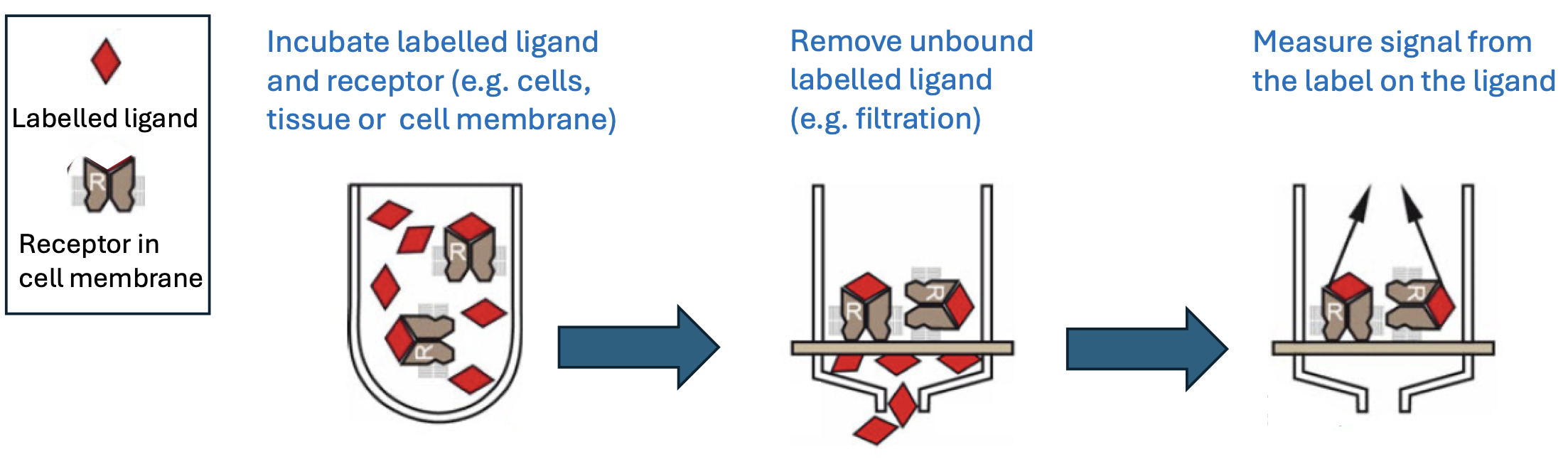
saturation assays
to experimentally measure affinity
use radioactive isotope or fluorescent molecule
use increasing concentrations of radioligand and require incubation until equilibrium is reached
lower KD is higher affinity
competition binding assay
experimentally measures affinity
use a single concentration of labelled ligand and increasing concentrations of unlabelled ligand and require incubation until equilibrium is reached
IC50
concentration of drug required for 50% inhibition of labelled-ligand binding in competition binding assays
lower value is higher affinity
Ki
experimentally measuring affinity
equilibrium dissociation constant for binding of the unlabeled drug to the receptor
property of receptor and unlabelled drug

efficacy
extent to which a drug can produce a response
agonist
compound that can bind to and cause activation of a receptor, thus mimicking the actions of the endogenous ligand
can be full or partial
antagonist
compound that can bind to but not activate a receptor, thus blocking the actions of the endogenous ligand
concentration response curve
graphically describe the relationship between the concentration of a ligand applied to cells and the resulting response
for measuring efficacy
hill slope
usually 1, occurs when a ligand binds to a single binding site
>1 indicates positive cooperativity
<1 indicates negative cooperativity
Emax
maximum response of a drug compared to a reference ligand
if 100% then it is a full agonist
functional assays
demonstrate that a ligand binds to a receptor and “does something” aka outcome
can be activation (agonist response) or inhibition/modulation of an agonist response (antagonism)
used to quantitate the response
in vitro, ex vivo, or in vivo
potency
refers to the dose/concentration of a drug that is required to produce a defined response or effect
depends on both recent (affinity, efficacy) and tissue or cell parameters (e.g. receptor numbers, intracellular mediator levels, drug accessibility

experimentally measuring potency
measured and reported as the dose/concentration of a drug that produces 50% of the drugs maximal effect (ED50 or EC50)
effective dose or effective concentration
EC50
concentration of the drug to reach 50% of drugs maximal effect
half maximal effective concentration
higher number is less potent
partial agonist
produce an effect if no agonist is present but act as competitive antagonists in the presence of a full agonists

types of antagonists
competitive
non-competitive/insurmountable
physiological
competitive antagonist
competes with an agonist for the same receptor binding site (orthosteric)
surmountable: increasing the concentration of agonist can overcome competitive antagonism
efficacy of the agonist is unchanged
potency of the agonist is reduced
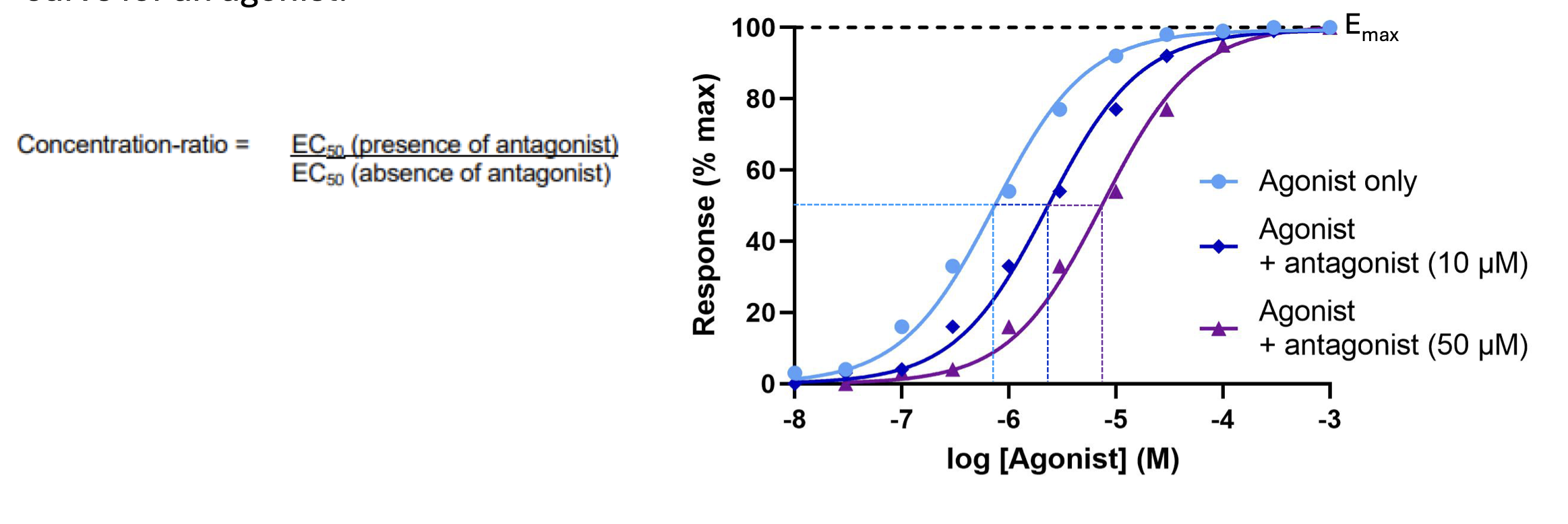
competitive antagonists graph
reduces agonist potency so higher EC50 but higher dose can still achieve max effect
Emax doesn’t change

physiological antagonists
does not directly compete with an agonist for the same receptor binding site
drug that counters the effects of another by binding to a different receptor and causing opposing effects
non-competitive/insurountable antagonists
alters the receptor so that an agonist can’t bind, or the receptor can’t produce an effect
insurmountable: increasing the concentration of agonist does not overcome antagonism
efficacy of agonist is reduced
potency of agonist may be reduced
three types:
negative allosteric modulation
orthosteric irreversible
orthosteric pseudo-irreversible
negative allosteric modulation antagonists
allosteric antagonist binds to a receptor at a site distinct from the active site
induces a conformational change in the receptor, which decreases the affinity of the receptor for the agonist or the agonist efficacy
efficacy of the agonist is reduced
potency of the agonist may be reduced
E max is reduced
orthosteric irreversible antagonists
irreversible antagonist binds covalently to the receptors orthosteric binding site and cannot be displaced by either competing ligands or washing
permanently deactivates the receptor
efficacy of the agonist is reduced
orthosteric pseudo-irreversible antagonist
stay bound to the receptor’s orthosteric binding site for extended periods of time (hours)
slowly dissociate from their receptor over time
in the timescale of the functional assay acts in a manner similar to irreversibly antagonists
efficacy of the agonist in reduced
experimentally measuring antagonist potency
IC50: concentration of antagonist required for 50% inhibition of a fixed concentration of agonist
functional assay
increasing concentrations of antagonist are added to the assay (e.g. cells) a set concentration of agonist is then added and the agonist response measured
pA2: negative logarithm of the molar concentration of an antagonist that would produce a 2-fold shift in the concentration response curve for an agonist
IC50
concentration of antagonist required for 50% inhibition of a fixed concentration of agonist
depends on three factors:
affinity of the antagonist to the receptor
the higher the affinity the lower the IC50 value
concentration of the agonist being displaced
higher concentrations of the ligand will require more antagonist to reach 50% inhibition and the IC50 values will increase
affinity (Kd) of the agonist for the receptor
lower the Kd value, the more concentration of the antagonist will be needed to displace the ligand and the IC50 will increase
pA2
negative logarithm of the molar concentration of an antagonist that would produce a 2-fold shift in the concentration response curve for an agonist
increasing concentrations of agonist are added to the assay, in the presence and absence of a set concentration of antagonist, the agonist response is measured
selectivity
refers to a drug’s ability to preferentially produce a particular effect and is related to the structural specific of the drug binding to receptors
relative between 2 receptors, does not equal specific
at low concentrations an agonist selective for receptor A will activate receptor A and not receptor B
at high concentrations, an agonist selective for receptor A will activate both receptor A and receptor B
agonists or antagonist drugs that are ‘selective’ for the intended receptor can still produce significant effects at other related receptors if high enough dose given
useful in clinical practice only when the ratio of the affinity of a drug at the target receptor verses other related receptors is 100x or more
when lower, difficult to predict drug doses that will exploit the difference in subtype activity. reduces off-target side effects

atropine selective example
atropine is selective for the muscarinic Ach receptor (mAchR) over the alpha-adrenoceptors, the dopamine receptors, and the histamine receptors so less side effects compared to chlorpromazine
receptor subtypes
receptors are often named on the basis of their major endogenous agonist (e.g. adrenergic, serotonin, opioid, dopamine)
were ‘subtyped’ on the basis of their selectivity for agonists or antagonists and sequence similarity
closely related receptors have similar binding sites. this means that drugs are more likely to have off-target effects at related receptors

how to achieve selectivity
many ligands share common binding site
sequence variation between drug-binding domain of the target and other members of its protein family improves selectivity and reduces side effects
alpha 1-adrenergic receptor selectivity
alpha 1A, 1B, 1D
smooth muscle of the prostate expresses predominantly alpha1A-AR. activation of this leads to contraction of the muscle further occluding the urethra
smooth muscle of the blood vessels of older men express predominantly alpha1B-AR
benign prostatic hyperplasia
long wait for stream of urine to begin, frequent/urgent need to urinate, weak and poorly directed stream, needing to urinate many times at night (nocturia), dribbling after urination has finished or an irregular stream
prostate keeps growing through life from testosterone which can occlude the urethra

prazosin moa
non-selective alpha 1-adrenergic antagonist
prevents activation of all three alpha 1-adrenergic receptors, preventing activation of smooth muscle contraction
preventing vasoconstriction and contraction of smooth muscle of prostate
prazosin indications
benign prostatic hyperplasia
Raynaud’s disease
hypertension
prazosin contraindications
known sensitivity to quinazolines
caution for patients with hypotension
prazosin side effects
postural hypotension (alpha 1) 14%
blurred vision (alpha 1) 4%
nasal congestion (alpha 1) 4%
priapism (sustained erection) (alpha 1) <1%
tachycardia <1%
palpitations 5%
detumescence pathway
sympathetic
removing an erection
alpha-adrenergic nerve → NE → - to smooth muscle cells
or endothelin → + rho kinase → - to smooth muscle cells

erection pathway
parasympathetic
cholinergic nerve → + Ach
NANC NO → + smooth muscle
NO from endothelial cells
tamsulosin moa
alpha 1A-adrenergic selective antagonist
prevents smooth muscle contraction
binding of drug to alpha 1A-adrenoceptors in the prostate results in relaxation of prostate smooth muscle followed by improvements in urodynamics
tamsulosin indications
relief of lower urinary tract symptoms (LUTS) associated with benign prostatic hyperplasia (BPH)
tamsulosin contraindications
cataract surgery
history of orthostatic hypotension
tamsulosin side effects
Abnormal ejaculation-failure of ejaculation or retrograde ejaculation (
off target affinity for dopamine D3-Receptor & serotonin 5HT1A-Receptor (2%)
amblyopia (poor pupil dilation) (α1-AR), dizziness (2%),
floppy iris syndrome
serotonin 5HT1A-Receptor
postural hypotension (α1B-AR) (<1%),
priapism (<0.01%) (α1-AR)
types of protein drug targets
receptor drug targets
ligand-gated ion channels
G protein-coupled receptors
catalytic receptors
nuclear receptors
non-receptor drug targets
voltage gated ion channels
transporters
enzymes
receptors vs non-receptor protein drug targets
receptors bind endogenous molecules (ligands) to induce cellular signaling
non-receptors do not bind endogenous molecules to induce cellular signaling, but instead have a unique function, e.g., enzymes catalyze reactions, transporters transport ions
transporters
non-receptor drug targets
move substances from one side of a cell membrane to the other
inhibition of CNS transporters can control neurotransmitter levels (monoamine transporters)
involved in absorption, distribution and elimination (pharmokinetics) of drugs
control concentration of drugs in particular organs or compartments, which can influence drug toxicity
responsible for development of resistance seen with some antiviral, antiviral, antibacterial and anticonvulsant drugs as they actively pump drugs out of target cells
ABC and SLC transporters