Sociological Theory Exam 1
 Call Kai
 Learn
Learn Practice Test
 Spaced Repetition
 Match
Match Flashcards
 Knowt Play
1/120

There's no tags or description
Looks like no tags are added yet.
Name | Mastery | Learn | Test | Matching | Spaced | Call with Kai | Chat |
|---|
No analytics yet
Send a link to your students to track their progress
121 Terms
What are the features of modernity?
Intentionality
Separation of Church and state
Capitalism
Belief in universal human nature and individual’s potential for infinite progress
What are Comte’s stages of human knowledge?
Theological
Metaphysical
Positive
What does positivism assume?
The universe operates under invariant laws that can be observed and applied towards human progress. Final answers cannot be discovered because they require faith.
What does empiricism mean?
Only thing that exists is the observable universe, universe is objective
What are invariant laws?
Laws are universal which means we can use them to control outcomes
Why did Marx disagree with positivism?
He believed that knowledge is not objective and progress occurs through disruption, rather than smoothly
Why did Weber disagree with positivism?
He believed that humans confer meaning to experiences and knowledge comes from a particular point of view.
What traits must a theory have?
Explains how something works and/or came into existence
Can be used to make generalizations
What is Marx’s idea of species-being?
Human nature is expressed through production.
What is Marx’s idea of material dialectic?
Every economic system has contradictions that eventually lead to upheaval and the establishment of a new economic system.
What is use-value?
The actual function of a product.
What is exchange value?
The rate of exchange between one commodity and another.
What creates exchange value?
Labor
What is profit?
The different between use value and exchange value.
What is surplus labor?
The difference between the workers’ compensation and the exchange value of goods.
How do capitalists increase their profit?
By increasing surplus labor
How do capitalists increase surplus labor?
By extending the workday (absolute surplus labor) and industrializing (relative surplus labor)
What is commodification?
Making more of the world into products that can be bought and sold
What happens in a market?
Commodities are bought and sold
What does money do?
Speeds up the exchange process
What are the means of production?
The methods and materials necessary to produce commodities.
Who are the bourgeoisis?
The people who own the means of production.
Who are the proletariat?
The workers
How does overt and intense conflict occur?
Through bipolarization
What are the consequences of overproduction?
The economy slumps, workers are laid off, small businesses close, and capital is concentrated among fewer people
What is alienation?
Becoming separated from one’s work and therefore one’s awareness of their humanity
What is commodity fetish?
Becoming obsessed with commodities as distinct from the labor that created them
What is false consciousness?
Basing our understanding of humanity on anything other than species-being
What is the natural division of labor?
Duties are divided based on abilities and desires
How does Marx define forced division of labor?
People are forced to work to survive
What is class consciousness?
Workers are aware of how their class position affects their prospects
How does class consciousness arise?
Workers have a greater sense of exploitation and alienation and a greater ability to communicate.
What are Weber’s ideal types?
“Measuring sticks” constructed through logic and used to compare the real world.
Where do historical ideal types get their characteristics?
From historical examples
Where do classificatory ideal types get their characteristics?
From logical speculation
What is verstehen?
The idea that understanding cultural and social expressions comes from understanding an action’s meaning to the actor and their motive.
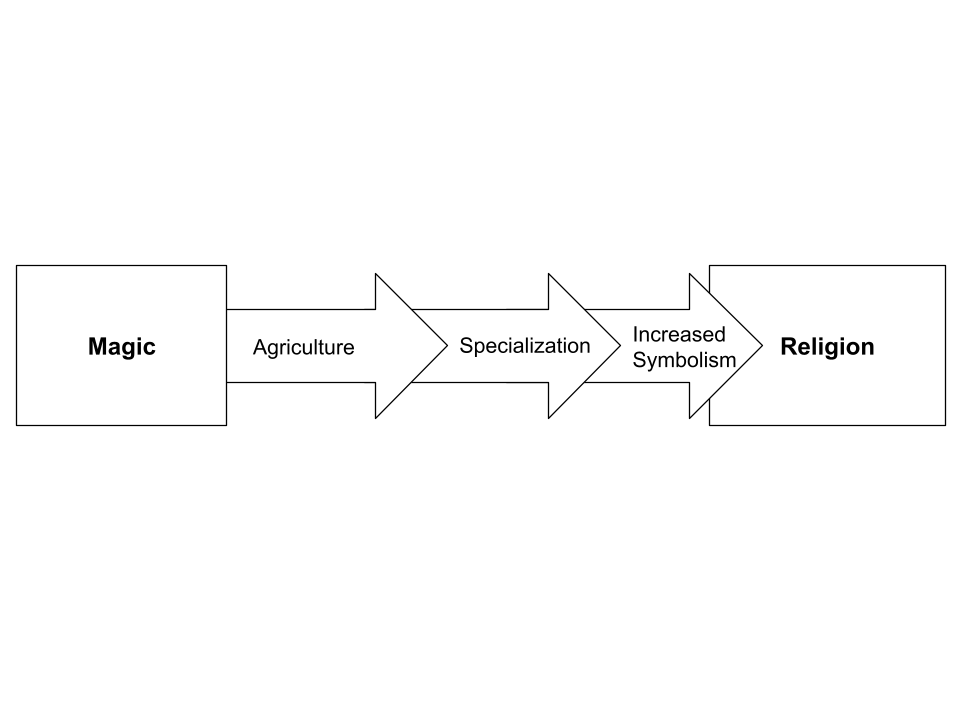
How did religion develop according to Weber?
What is ethical monotheism?
The belief in one god who cares about human behavior

How did ethical monotheism develop according to Weber?

What is rational capitalism?
Capitalism based on the principle of making more money for the sake of making more money
What is the “spirit of capitalism?”
A set of values that allowed capitalism to arise.
What are the maxims of rational capitalism?
Life should be lived with a specific goal in mind
Everyone has a duty to work efficiently
Actions are legitimized through qualitative calculations
How did Protestantism influence Capitalism?
Gave labor a moral dimension (“everyone has a calling” - Luther)
Hard work is a sign of salvation
Money used to make more money (abstinence from worldly pleasures)
How did the rise of nation-states influence capitalism?
Workers no longer attached to land or workers guilds
Money is standardized
Control of large territories
What are the preconditions for bureaucracy?
Large, spread out population
Complex tasks
Use of markets and money
Improved communication and transportation
Mass democracy
Complex and rationalized culture
What are the 6 traits of the ideal type of Bureaucracy?
Explicit division of labor and lines of authority
Presence of office hierarchy
Written rules and communication
Accredited training and technical competence
Management by emotionally neutral rules
Organization (not individual) owns career ladder and position
How does a bureaucratic personality arise?
People live more rationally, rely on expert systems for knowledge/advice, and are sequestered from life experiences (birth, sickness, death)
What is the iron cage of bureaucracy?
Everyone is trapped in bureaucracy — leaders become reliant on experts, experts become secret and self-admistering.
How do bureaucracy accelerate credentialing?
Every position in a bureaucracy comes from diplomas/certificate (education becomes about getting a job rather than learning)
What are the impacts of bureaucracy?
The development of the “iron cage,” bureaucratic personality, and social emphasis on credentialing
How does Weber define class?
One’s ability to buy and sell goods/services that bring you inner satisfaction and increase your health/longevity.
How does Weber define status?
Positive or negative privilege based on identity.
How does Weber define power/party?
One’s ability to execute one’s will.
What is legitimation?
The process through which people come to believe in a social structure.
What is charismatic authority?
Authority that comes from belief in the intrinsic gifts of an individual. (ex. Martin Luther King Jr.)
What is traditional authority?
Authority that comes from belief in time and custom. (ex. one’s parents)
What is rational-legal authority?
Authority that comes from belief in procedure (ex. one’s professor)
What is Weber’s theory of social change?
Social change will occur if…
The legitimacy of stratification is questioned
Group is in close proximity to competing group or mobility is limited
Charismatic leader arises
Clear goals/ideology
Ability to meet and communicate
Change results in routinization and the cycle begins again.
What are social facts?
The subject matter of sociology: the objective existence of social structures and processes.
How did Montesquieu impact Durkheim’s sociological imagination?
Durkheim saw Montesquieu as the origin of “sociology as a science”
What is a typology?
A classification
How is sociology a science?
Sociology has
definite subject matter
ability to create typologies
discovery of causal laws
method
What is general will?
Rousseau’s idea of the people’s will for the common good.
What is social contract?
People give up their self-sovereignty to societal authority to promote peace.
What does “society sui generis” mean?
Society exists as it’s own entity—more than the sum of its parts.
What is collective consciousness?
Shared ideas and sentiments that unify a group.
How is society based in religion?
Our basic categories of understanding, such as time and space, are based on gatherings and rituals.
How does Durkheim define religion?
A unified system of beliefs and practices regarding sacred things.
How do sociologists use the term “moral?”
To refer to a group whose behaviors, beliefs, speech, language, etc. is controlled by strong group norms and viewed in terms of right and wrong.
How do sacred symbols and rituals develop?
Large gatherings lead to the feeling of effervescence. Rituals and sacred symbols arise to recapture the feeling of effervescence.
What factors influence efferverscence?
Degree of physical closeness (co-presence)
Degree of shared feeling (common emotion)
Degree to which participants are attending to same object, symbol, or idea (common focus)
What is social solidarity?
The degree to which social units are integrated.
What did Durkheim consider problems of modernity?
A large, dense population
Increased division of labor
What factors shaped social solidarity?
How much do individuals feel part of the collective? (psychological)
How much are individual desires constrained? (behavioral)
How are activities coordinated and adjusted to one another? (structural)
What are the features of mechanical solidarity?
Individuals directly related to collective consciousness
Joined by common beliefs
Limited options regarding social worlds/relationship
Strong attachment to family/tradition
Repressive law
What are the features of organic solidarity?
Intermediary between individuals and collective consciousness
Joined by utility
Unlimited options regarding social worlds/relationships
Weak attachment to family/tradition
Restitutive law

How does organic solidarity arise from structural and social diversity?

What is mob mentality?
Group behaviors that are not beneficial for the group
What is anomie?
Social instability and personal unrest due to overly rapid population growth and excessive division of labor that prevents groups from interacting.
How does Durkheim define forced division of labor?
Division of labor derived by elite’s desire for profit rather than population growth and density.
What causes altrustic suicide?
Complete fusion with the group and loss of individual identity. (ex. suicide bomber)
What causes egotistic suicide?
Extreme individualism, loss of reality and purpose. (ex. unmarried man)
What causes anomic suicide?
Lack of regulation of individual’s desires and increase in feelings of meaninglessness. (ex. someone whose undergone major economic or personal upheaval)
What causes fatalistic suicide?
Overregulation leading to the loss of individual effectiveness and hopelessness. (ex. prisoner)
What is the “cult of the individual?”
Concept that the individual is the recipient of social rights and responsibilities. (the basic unit of society)
How does the cult of the individual help produce organic solidarity?
The emphasis on individual rights provides a unifying moral framework
What does pragmatism propose?
Truth is relative to time, place, and purpose. People find ideas to be true if they are useful.
What is emergence?
The process through which new entities are created from different elements. The “true” meaning of an object cannot be known, rather the meaning of emerges from interactions.
What is Mead’s definition of action?
Feeling an impulse, taking in one’s environment, considering the consequences/means of the action, and executing it.
What are natural signs?
Signs learned through experience. The sign and object have a relationship. (ex. clouds and rain)
What are significant gestures? (aka symbols)
Abstract, no basis in natural relations. (ex. days of the week)
What are social objects?
Ideas or objects whose meaning is produced through interactions.
What is an interaction?
The negotiation and combination of individual actions and meanings.
What are the steps of an interaction?
Cue - response - response to response
What is role taking?
Putting oneself in the position of the other to understand how they want you to act.
How does Mead define perspective?
A meaning creating position
How does Mead define self?
A perspective that considers our actions, feelings, and thoughts.
What behaviors make up the mind?
Using symbols to denote objects
Ability to talk to itself
Reading and interpreting another’s gestures and using them as further stimuli
Ability to suspend response
Rehearsing behaviors in imagination before behaving
What are the stages of role taking?
Play stage
Game stage
Generalized other
What happens in the play stage?
One physically takes the role of significant others to assume perspective (ex. child playing teacher)