Prin. of Bio Exam 2
 Call Kai
 Learn
Learn Practice Test
 Spaced Repetition
 Match
Match Flashcards
 Knowt Play
1/114

There's no tags or description
Looks like no tags are added yet.
Name | Mastery | Learn | Test | Matching | Spaced | Call with Kai | Chat |
|---|
No analytics yet
Send a link to your students to track their progress
115 Terms
diffusion
random, net movement of molecules from areas of high to low concentration
equilibrium
when there is no more net movement in any direction, molecules are randomly distributed
fluid mosaic model
the cell membrane is a phospholipid bilayer with embedded proteins
phospholipid bilayer
the membrane of cells, made up of polar hydrophilic heads and non polar hydrophobic tails
integral membrane proteins
proteins embedded in the membrane
transmembrane proteins
completely cross membrane with hydrophilic portions exposed on both sides
peripheral membrane proteins
not embedded in bilayer, but near membrane
selective permeability
means that the membrane is semi-permeable, allowing movement of some but not all molecules
passive transport
movement into and out of the cell that doesn’t require energy
osmoses
diffusion of water across membranes
facilitated diffusion
passive transport (doesn’t require energy), includes channel proteins, gated channels, and carrier proteins/transporters
what is phosphorylation
when protein kinase regulates other proteins by adding phosphate groups to them
channel proteins
allow transport of specific ions and polar molecules through a hydrophilic channel through the membrane
gated channels
may open and close to control diffusion, responds to ligands
carrier proteins
one way gate, changes shape during transport process, moves solutes down a concentration gradient

active transport
requires energy, two kinds: primary and secondary
protein pumps
membrane bound proteins that actively move molecules through the membrane
what are the two kinds of primary active transport
uniporter and antiporter
uniporter
moves single substance in 1 direction
antiporter
moves two substances in opposite directions
secondary active transport / symporter, and why is it called secondary?
moves two substances in the same direction, called secondary because only one of the substances is directly causing energy consumption to be moved across the membrane, while the second substance is just required to get through the symporter
botulinum toxin (botox)
toxin that causes paralysis of muscles
how do neurons communicate?
through exocytosis; vesicles filled with acetylcholine (ACh) fuse with the membrane of a cell and move outward
exocytosis
active transport out by vesicles
endocytosis
active transport into the cell via vesicles
phagocytosis
endocytosis through “eating”
pinocytosis
endocytosis through “drinking”
how does botox enter neurons?
through receptor mediated endocytosis
reception mediated endocytosis
repector proteins on outer membrane bind substance, reception initiates endocytosis
steps of cell signaling
signal, reception, response, deactivation
how does cell signaling and reception work
the cell receives a signal through membrane receptors
ligand gated channel
type of membrane receptor the opens when bound to signal protein (ligand)
protein kinase receptor
a kinase enzyme activated by a ligand
kinase
enzyme that takes a phosphate from ATP and places it on another enzyme, activating it

protein kinase cascades
chain reaction where one enzyme activates the next by adding a phosphate group
intracellular receptors
located inside the cell, responds to signals like light or lipid soluble signals that can pass through the membrane
how is cell signaling deactivated?
enzymes like protein phosphotase deactivate or degrade messengers

direct communication through cytoplasmic connections
allows direct transfer of primary and secondary signals through gap junctions (animals) and plasmodesmata (plants), supports multicellularity
quorum sensing
signals released into environment which allows multiple individuals to coordinate activity
forms of biological energy
chemical, light, electrical, thermal, mechanical
potential energy
stored energy (in any form)
kinetic energy
energy of movement that does work (work is the conversion of energy)
thermodynamics
“energy change”, the properties of energy and how it interacts with matter
what are the two laws of thermodynamics?
energy is neither created or destroyed; it can be transformed from one form to another
transfer of energy increases entropy, no transfer of energy is 100% efficient
entropy
the degree of random disorder in a system
metabolism
sum total of chemical reactions in an organism
anabolic reactions
making more complex things from less complex things, require input of energy to make chemical bonds
catabolic reactions
break down of complex reactants into less complex reactants, releases energy stored in chemical bonds
coupled reactions
catabolic reactions supply energy to anabolic reactions, ATP serves as a common carrier energy
catalysts
increase the reaction rate by reducing the activation energy required to proceed, are not used up or changed by a reaction
enzyme
biological catalysts, usually proteins but includes ribosymes
active site
where reactions occur on a protein, specific to the reactant (substrate)
orient substrate
control the spatial alignment of molecules to fit the active site

strain substrates
induced fit occurs when enzyme changes shape when bound to substrate
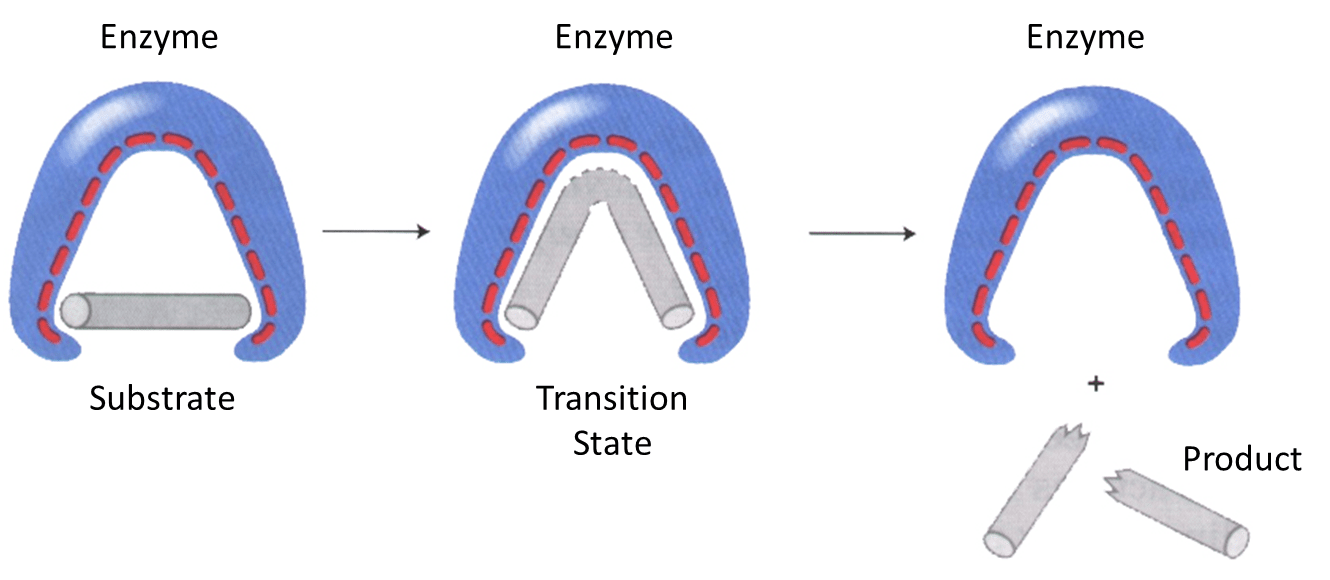
enzymes that temporarily add chemical group
one of the ways that enzymes work to induce reactions
irreversible inhibition
inhibitor covalently (permanently) bonds to enzyme, blocking the active site
reversible (competitive) inhibition
inhibitor similar in shape and size to reactant bonds to active site but is unable to participate in reaction, so nothing happens
pathway regulation
feedback inhibition occurs when the end product inhibits an upstream enzyme
redox reactions
electrons transferred from one compound to another
reduction reaction
gaining electrons (reducing)
oxidation
losing electrons
NAD+ (nicotinamide adenine dinucleotide)
acts as an “empty bucket”, picking up electrons through reduction, becoming NADH
(FAD+) flavin adenine dinucleotide
picks up electrons through reduction, becoming FADH2
glycolysis
“cut sugar”, the process that has a net gain of 2 ATP (2 required, 4 produced), also produces pyruvate and NADH
citric acid cycle
starts with oxidizing CO2 (electrons lost), produces 2 ATP, 6 NADH, and 2 FADH2
oxidative phosphorylation
occurs in inner membrane of mitochondria, includes the electron transport chain and chemiosmosis
electron transport chain
aerobic, the final electron acceptor, oxidizes NADH and FADH2 and reduces O2, the transport of protons powers ATP synthesis
chemiosmosis
occurs right after electron transoprt chain, protons move down electromechanical gradient through ATP synthase, making ATP
cellular respiration
includes glycolysis, the citric acid cycle, the electron transport chain, and chemiosmosis, produces roughly 32 ATP
respiration chart/process

fermentation
recycles NAD+ and then uses it for the continuation of glycolysis and a small amount of ATP production, creates lactic acid in animals and ethanol in plants
what causes fermentation?
lack of O2 (anaerobic) causes the electron transport chain to back up, NADH and FADH2 can’t be recycled
what does photosystem 2 do and what happens in it
electron energized by light capture, chlorophyll donates electron to electron transport chain but regains electron from water, producing O2, produces 1 ATP
photosystem 1
second part of the light reaction, electron finally accepted by photosystem 1 chlorophyll, reduces NADP+ to NADPH,
what is the problem of light reactions
ATP and NADPH are used to synthesize carbs, and there needs to be more ATP than NADPH but they are produced in roughly equal quantities
what is the solution for the problem of light reactions
cyclic electron transport
cyclic electron transport
excited electrons from photosystem 1 are put back into electron transport train, only produces more ATP, not NADPH
what are the three parts of the Calvin cycle
fixation of CO2
reduction of 3PGA to G3P
regeneration of RuBP from G3P
what fixes (attaches) the CO2 to RuBP
BUBISCO
discribe the reduction state of the calvin cycle
ATP and NADPH are used to produce G3P, which can be used to generate things like glucose, sucrose, starch, cellulosede
describe the regeneration stage of the calvin cycle
6 G3P produced in reduction, 5 of them used to reform RuBP, for every one cycle, one CO2 is fixed and one acceptor regenerated
C3 photosynthesis
normal, fixed CO2 into three carbon compounds
C4 photosynthesis
fixes CO2 into a four carbon compound, increases efficiency of carbon delivery for fixation in hot environments
CAM photosynthesis
stores CO2 at night as a four carbon compound for use during the day, decreases water loss from open stomata during the day, common in dry environments
four stages of cell division
reproductive signal
DNA replication
DNA segregation
cytokinesis
how do prokaryotes divide? describe the signal, replication, and segregation
binary fission, produces identical cells
signal: beneficial environmental conditions
replication: begins at ori (origin) and ends at ter (terminus)
segregation: ori regions move apart through replication
describe the eukaryotic signal stage
cell divides only when growth will benefit the whole organism, cell cycle regulated by checkpoints
growth factors
external signals for cell division
what are cancer cells
cells that divide without a growth factor present, benign tumors divide but aren’t invasive and don’t spread, malignant tumors divide and spread to near and distant tissues, which is called metastasis
Henrietta Lacks
diagnosed with and died of cervical cancer, some of her cancer cells taken for research and are still dividing today, HeLa cells used for all kinds of research
describe segregation in eukaryotic cells
DNA is separate from the rest of the cell, so segregation and cytokinesis are separate events, two types of segregation: mitosis and meiosis
interphase
the majority of the cell cycle, period of ordinary cell metabolism and functions, DNA highly extended and possibly replicated if the cell is going to divide
mitosis
occurs after interphase, PMAT
prophase
chromosomes condense, 2 sister chromatids per chromosome, nuclear envelope disintegrates
metaphase
chromosomes align in middle at metaphase plate, spindle fibers form
anaphase
centromeres holding sister chromatids split and chromosomes are pulled apart
telophase
opposite of prophase, nuclear envelope forms, DNA decondenses
cytokinesis
follows mitosis, cleavage in animal cells, cell wall constructed through the middle of the cell
karyokinesis
mitosis and meiosis
diploid organisms
have 2 sets of every chromosome