Merieb Chap. 1: Textbook Questions
 Call Kai
 Learn
 Practice Test
 Spaced Repetition
 Match
 Flashcards
 Knowt Play
1/47

Earn XP
Description and Tags
13th edition of Essentials of Human Anatomy & Physiology by Elaine N. Marieb - Chapter 1
48 Terms
Did You Get It?
Why would you have a hard time learning and understanding physiology if you did not also understand anatomy?
A. Function depends on structure.
B. Anatomy studies diseases, not functions.
C. They are completely unrelated fields.
D. Physiology only applies to dead organisms.
Function depends on structure.
Did You Get It?
Kidney function, bone growth, and beating of the heart are all topics of anatomy. True or false? State why.
False
These are topics of physiology, as they deal with how body parts function.
Did You Get It?
At which level of structural organization is the stomach? At which level is a glucose molecule?
A. Stomach is cellular level; glucose is tissue level.
B. Stomach is organ level; glucose is chemical level.
C. Stomach is tissue level; glucose is organ system level.
D. Stomach is organ system level; glucose is cellular level.
Stomach is organ level; glucose is chemical level.
Did You Get It?
Which organ system includes the trachea, lungs, nasal cavity, and bronchi
A. Cardiovascular system
B. Respiratory system
C. Urinary system
D. Nervous system
Respiratory system
Did You Get It?
Which system functions to remove wastes and help regulate blood pressure?
A. Digestive system
B. Urinary system
C. Integumentary system
D. Reproductive system
Urinary system
Did You Get It?
In addition to being able to metabolize, grow, digest food, and excrete wastes, what other functions must an organism perform if it is to survive?
A. Responsiveness, movement, and reproduction
B. Photosynthesis and transpiration
C. Hibernation and estivation
D. Voluntary skeletal muscle contraction exclusively
Responsiveness, movement, and reproduction
Did You Get It?
Oxygen is a survival need. Why is it so important? In which life function does oxygen participate directly?
A. It functions as a chemical buffer system to maintain blood ph levels.
B. It is required to drive cellular respiration and release energy from food.
C. It acts as a catalyst to stimulate enzyme production during cellular protein synthesis.
D. It regulates fluid balance to maintain liquid volume within the interstitial space.
It is required to release energy from food during cellular respiration.
Understanding Check!
The wrist is _____________ to the hand.
A. distal
B. proximal
C. medial
D. latera
proximal
Understanding Check!
The breastbone is _____________ to the spine.
A. posterior
B. inferior
C. anterior
D. lateral
anterior
Understanding Check!
The brain is _____________ to the spinal cord.
A. inferior
B. superior
C. distal
D. lateral
superior
Understanding Check!
The thumb is _____________ to the fingers.
A. lateral
B. medial
C. proximal
D. distal
lateral
Did You Get It?
What is the anatomical position, and why is it important that an anatomy student understand it?
A. Standing upright, facing forward, palms facing forward; used as a standard reference.
B. Lying flat on the back, arms folded across chest; used as a standard resting pose.
C. Sitting upright, feet flat, palms facing backward; used as a standard muscle check.
D. Lying completely face down, hands extended downward; used as a standard prone pose.
Standing upright, facing forward, palms facing forward; used as a standard reference.
Did You Get It?
13. The axillary and the acromial areas are both in the general area of the shoulder. To what specific body area does each of these terms apply?
A. Axillary = armpit; acromial = point of the shoulder.
B. Axillary = shoulder blade; acromial = collarbone.
C. Axillary = upper arm; acromial = anterior chest.
D. Axillary = posterior elbow; acromial = distal wrist.
Axillary = armpit; acromial = point of the shoulder.
Did You Get It?
Use anatomical language to describe the location of a cut to the back of your left forearm.
A. Anterior, right antecubital cut
B. Posterior, left antebrachial cut
C. Superior, cranial cut
D. Inferior, crural cut
Posterior, left antebrachial cut
Did You Get It?
If you were dissecting a cadaver and wanted to separate the thoracic cavity from the abdominal cavity, which type of section would you make?
A. Sagittal (vertical) section
B. Transverse (horizontal) section
C. Frontal (coronal) section
D. Midsagittal (middle) section
Transverse (horizontal) section
Did You Get It?
Which of the following organs are in the abdomino pelvic cavity: spinal cord, small intestine, uterus, heart?
A. Spinal cord, small intestine, uterus, heart
B. Small intestine and uterus
C. Brain and lungs only
D. Trachea and brain
Small intestine and uterus
Did You Get It?
Joe went to the emergency room, where he com plained of severe pains in the lower right quadrant of his abdomen. What might be his problem?
A. Appendicitis
B. Heart attack
C. Pneumonia
D. Meningitis
Appendicitis
Did You Get It?
When we say that the body demonstrates homeostasis, do we mean that conditions in the body are unchanging? Explain your answer.
A. Yes, conditions are completely static with zero fluctuation.
B. No, it is a dynamic equilibrium within narrow, safe limits.
C. Yes, all body variables freeze during rest.
D. No, homeostasis means conditions change wildly without regulation.
No, it is a dynamic equilibrium within narrow, safe limits.
Did You Get It?
When we begin to become dehydrated, we usually get thirsty, which causes us to drink liquids. Is the thirst sensation part of a negative or a positive feedback control system? Defend your choice.
A. Positive feedback, because it increases the dehydration level.
B. Negative feedback, because drinking water cancels the original deficit.
C. Positive feedback, because it stops all drinking behavior.
D. Neither, it is an unregulated reflex.
Negative feedback, because drinking water cancels the original deficit.

Review Questions
Multiple Choice: More than one choice may apply.
Which level of organization consists of groups of cells with similar structures and functions?
A. Chemical level
B. Tissue level
C. Organ level
D. Organ system level
Tissue level
Review Questions
Multiple Choice: More than one choice may apply.
Which is not essential to survival?
a. Water
b. Oxygen
c. Gravity
d. Atmospheric pressure
e. Nutrients
Gravity
Review Questions
Multiple Choice: More than one choice may apply.
Using the terms listed below, fill in the blank with the proper term.
anterior, superior, medial, proximal, superficial,
posterior, inferior, lateral, distal, deep
The heart is located _________ to the diaphragm.
superior
Review Questions
Multiple Choice: More than one choice may apply.
Using the terms listed below, fill in the blank with the proper term.
anterior, superior, medial, proximal, superficial,
posterior, inferior, lateral, distal, deep
The muscles are _________ to the bone.
superficial
Review Questions
Multiple Choice: More than one choice may apply.
Using the terms listed below, fill in the blank with the proper term.
anterior, superior, medial, proximal, superficial,
posterior, inferior, lateral, distal, deep
The shoulder is _________ to the elbow.
proximal
Review Questions
Multiple Choice: More than one choice may apply.
Using the terms listed below, fill in the blank with the proper term.
anterior, superior, medial, proximal, superficial,
posterior, inferior, lateral, distal, deep
In anatomical position, the thumb is _________ to the index finger.
lateral
Review Questions
Multiple Choice: More than one choice may apply.
Using the terms listed below, fill in the blank with the proper term.
anterior, superior, medial, proximal, superficial,
posterior, inferior, lateral, distal, deep
The vertebral region is _________ to the scapular region.
medial
Review Questions
Multiple Choice: More than one choice may apply.
Using the terms listed below, fill in the blank with the proper term.
anterior, superior, medial, proximal, superficial,
posterior, inferior, lateral, distal, deep
The gluteal region is located on the _________ surface of the body.
posterior

Review Questions
Multiple Choice: More than one choice may apply.
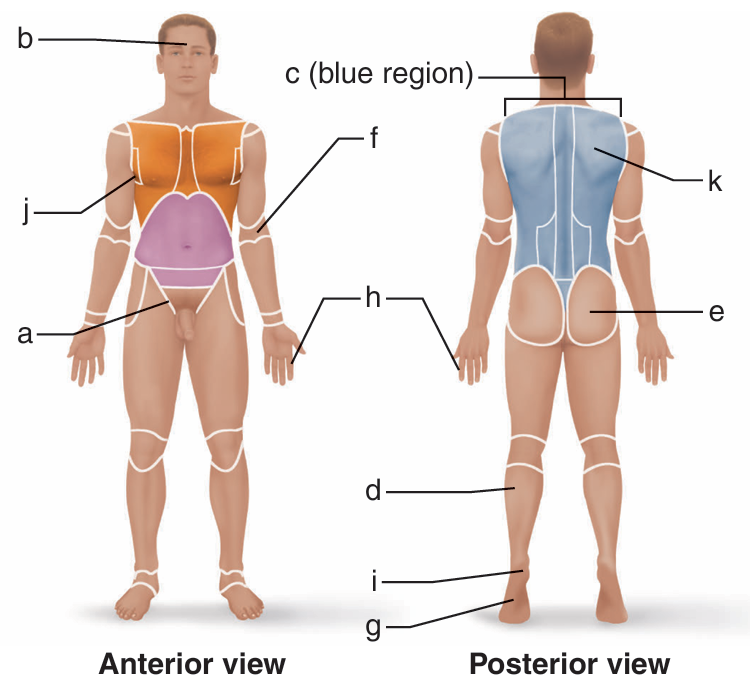
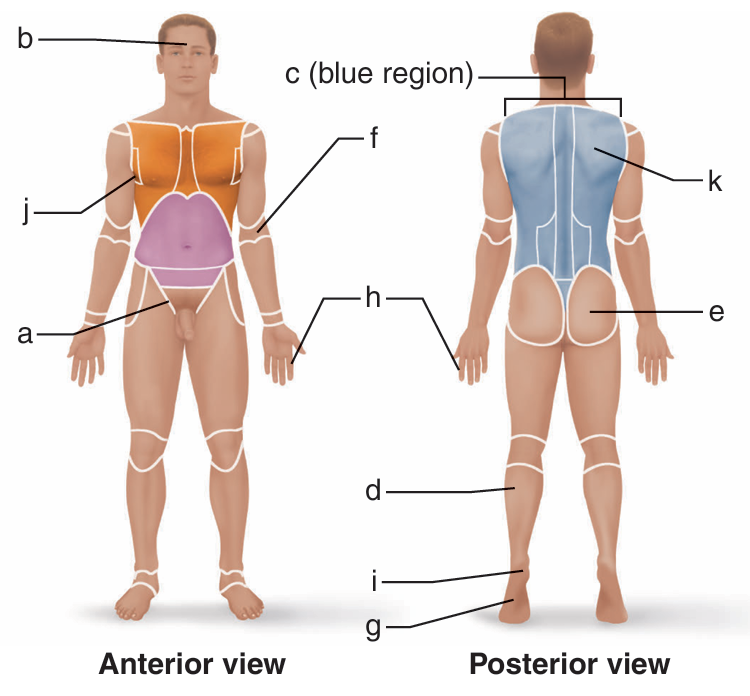
Match each anatomical region shown in the image with the anatomical term that describes it.
____ digital
h

Review Questions
Multiple Choice: More than one choice may apply.
Match each anatomical region shown in the image with the anatomical term that describes it.
____ dorsal
c

Review Questions
Multiple Choice: More than one choice may apply.
Match each anatomical region shown in the image with the anatomical term that describes it.
____ gluteal
e

Review Questions
Multiple Choice: More than one choice may apply.
Match each anatomical region shown in the image with the anatomical term that describes it.
____ inguinal
a

Review Questions
Multiple Choice: More than one choice may apply.
Match each anatomical region shown in the image with the anatomical term that describes it.
____ plantar
g
Review Questions
Multiple Choice: More than one choice may apply.
Match each anatomical region shown in the image with the anatomical term that describes it.
____ frontal
b
Review Questions
Multiple Choice: More than one choice may apply.
Match each anatomical region shown in the image with the anatomical term that describes it.
____ calcaneal
i

Review Questions
Multiple Choice: More than one choice may apply.
Match each anatomical region shown in the image with the anatomical term that describes it.
____ sural
d

Review Questions
Multiple Choice: More than one choice may apply.
Match each anatomical region shown in the image with the anatomical term that describes it.
____ antecubital
f
Review Questions
Multiple Choice: More than one choice may apply.
Anatomical terms that apply to the backside of the body in the anatomical position include
a. Ventral and anterior
b. Back and rear
c. Posterior and dorsal
d. Head and lateral
Posterior and dorsal
Review Questions
Multiple Choice: More than one choice may apply.
A neurosurgeon orders a spinal tap for a patient. Into what body cavity will the needle be inserted?
a. Ventral
b. Thoracic
c. Dorsal
d. Cranial
e. Pelvic
Dorsal
Review Questions
Multiple Choice: More than one choice may apply.
Which of the following body regions are subdivisions of the abdominopelvic cavity?
a. Thoracic
b. Epigastric
c. Hypogastric
d. Right hypochondriac
e. Spinal
Epigastric, Hypogastric, Right hypochondriac

Review Questions
Multiple Choice: More than one choice may apply.
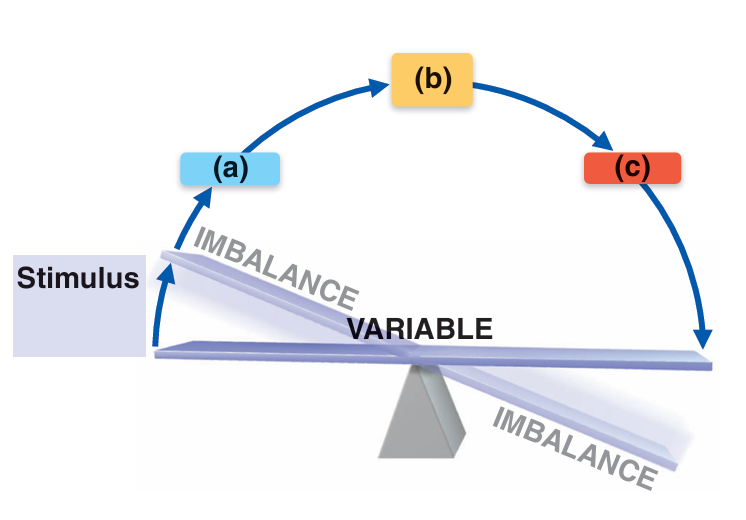
Which component of homeostatic control is responsible for the following? See the figure.
Sends signal to effector.
A. Stimulus
B. Control center
C. Receptor
D. Variable
Control center

Review Questions
Multiple Choice: More than one choice may apply.
Which component of homeostatic control is responsible for the following? See the figure.
Sends signal to control center.
A. Effector
B. Receptor
C. Variable
D. Feedback loop
Receptor

Review Questions
Multiple Choice: More than one choice may apply.
Which component of homeostatic control is responsible for the following? See the figure.
Receives signal of environmental change.
A. Control center
B. Effector only
C. Skeletal system
D. Epithelium
Control center
Review Questions
Multiple Choice: More than one choice may apply.
Which component of homeostatic control is responsible for the following? See the figure.
In negative feedback, reduces original stimulus.
A. Effector
B. Stimulus
C. Control center
D. Receptor
Effector
Review Questions
Short Answer Essay
Define anatomy and physiology.
A. Anatomy is structure; physiology is function.
B. Anatomy is external; physiology is invisible.
C. Anatomy is genetics; physiology is evolution..
D. Anatomy is internal; physiology is external.
Anatomy is structure; physiology is function.
Review Questions
Short Answer Essay
Which regions of the body do the following body landmarks refer to—acromial, crural, inguinal, popli teal, and sural?
A. Acromial = point of shoulder; crural = leg (shin); inguinal = groin; popliteal = back of knee; sural = calf.
B. Acromial = point of elbow; crural = thigh (femur); inguinal = chest; popliteal = front of ankle; sural = armpit.
C. Acromial = anterior groin; crural = calf (back); inguinal = shoulder; popliteal = shin (front); sural = knee.
D. Acromial = back of knee; crural = top shoulder; inguinal = leg (shin); popliteal = upper calf; sural = groin.
Acromial = point of shoulder; crural = leg (shin); inguinal = groin; popliteal = back of knee; sural = calf.
Review Questions
Short Answer Essay
a) Which of the following organ systems—digestive, cardiovascular, respiratory, reproductive, circulatory, urinary, or muscular—are found in both subdivisions of the ventral body cavity?
b) Which are found in the thoracic cavity only?
c) In the abdominopelvic cavity only?
a) Digestive, cardiovascular, respiratory, reproductive, and urinary
b) Cardiovascular and respiratory
c) Digestive, reproductive, and urinary
Review Questions
Short Answer Essay
Explain the meaning of homeostasis as applied to the living organism.
A. Maintaining a relatively stable internal environment despite external changes.
B. Total shutdown of metabolism whenever an organism faces external stress.
C. Uninhibited fluid accumulation in body cavities to prevent chemical exchange.
D. Rigid locking of body temperature at sub-zero levels during periods of rest.
Maintaining a relatively stable internal environment despite external changes.
Review Questions
Short Answer Essay
What is the consequence of loss of homeostasis, or homeostatic imbalance?
A. Disease, illness, or potential death if uncorrected.
B. Increased efficiency of all organ systems.
C. Rapid physical growth paired with muscular hypertrophy.
D. Permanent hibernation and metabolic suppression.
Disease, illness, or potential death if uncorrected.