Q6 peds Rubber Dam and Sequencing Restorations (qtl)
 Call Kai
 Learn
 Practice Test
 Spaced Repetition
 Match
 Flashcards
 Knowt Play
1/113

There's no tags or description
Looks like no tags are added yet.
114 Terms
What is a significant aid in successful pediatric restorative procedures in terms of isolation?
- The rubber dam

What are three ways the rubber dam improves the quality of restorations?
1. Provides improved visibility
2. Maintains a relatively dry operating field
3. Limits tongue mobility

How does the rubber dam maintain a dry operating field?
- By isolating the tooth and preventing saliva or moisture from interfering
What safety benefit does a rubber dam provide regarding foreign bodies?
- It can prevent aspiration or swallowing of foreign bodies.

Which children are at higher risk of aspirating or swallowing foreign bodies?
- Supine
- emotionally upset children
- children who become startled unexpectedly during a procedure

How does a rubber dam protect against accidental injury?
- It protects the patient against mechanical or chemical injury during procedures
What psychological effect can a rubber dam have on children?
- may serve as a calming barrier between the child and instruments or medicaments

What is one requirement for clamp placement in rubber dam use?
- Teeth must be adequately erupted
What is required regarding anesthesia for rubber dam placement?
- Adequate anesthesia should be obtained, or a non-invasive clamp must be comfortably placed

Why is clamp placement often painful in primary teeth without anesthesia?
- Because the height of contour is at or below the crest of the marginal gingiva

How does the clamp interact with the tooth's height of contour?
- The clamp engages the height of contour area, which can be sensitive in non-anesthetized patient

Can the rubber dam still be used if the clamp must be removed to complete the restoration?
Yes, it can.
Why is a rubber dam essential for pulp therapy in primary teeth?
- It prevents contamination of the accessed pulp and pulp spaces.

How does using a rubber dam affect the success rate of pulp therapy?
It enhances the success rate.
How effective are recent isolation aids, like the Isolite™ apparatus, compared to a rubber dam?
- They can be effective
- they typically do not provide the high degree of isolation afforded by a rubber dam

Are alternatives to rubber dam suitable for pulp therapy with direct pulpal access?
No, these alternatives do not provide adequate isolation for pulp therapy procedures involving direct pulpal access.
What rubber dam material is used in your practice?
- Non-latex rubber dam material, 5"x5", medium weight

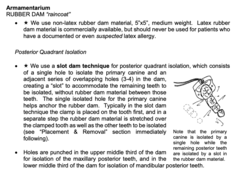
What is the "slot dam" technique for posterior quadrant isolation?
- A single hole isolates the primary canine
- 3-4 overlapping holes create a "slot" for the remaining posterior teeth
- No rubber dam material is between the teeth in the slot
- The clamp is placed on the tooth first, then the rubber dam is stretched over the clamped tooth and other teeth

Why is the primary canine isolated with a single hole in the slot dam technique?
- It anchors the rubber dam and allows the remaining posterior teeth to be isolated using a slot

Where are holes punched for maxillary posterior teeth isolation?
In the upper middle third of the rubber dam.
Where are holes punched for mandibular posterior teeth isolation?
In the lower middle third of the rubber dam.

What typical follow-up reassurance might parents need?
- It will not hurt their child
- It's completely safe
- It allows the dentist to do a better and longer-lasting restoration
How are primary anterior teeth isolated using a rubber dam?
- Individual holes are punched for each tooth to be isolated and/or clamped, centered in the upper or lower middle third of the rubber dam

How can an anterior rubber dam be retained?
- By floss ligatures around each tooth
- by bilateral use of rubber dam clamps, typically placed on both primary first molars in the quadrant

What type of holes are punched for primary anterior tooth isolation?
Individual holes for each primary anterior tooth.
What types of clamps can be used for pediatric rubber dam isolation?
- Both winged and wingless clamps

Why are wingless clamps often preferred in pediatric patients?
- They are smaller in bucco-lingual dimension, making them easier to accommodate in small mouths

How are wingless clamps denoted?
- With a 'W' preceding the clamp number (e.g., W14A is a wingless clamp)
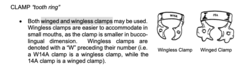
How are winged clamps different from wingless clamps?
- Winged clamps facilitate placement of the clamp and rubber dam in a single step, especially for individually isolated posterior teeth.

Why is individual tooth isolation less frequently used in pediatric patients than adults?
- Children have smaller mouths
- may be less cooperative
- making the slot dam technique more practical
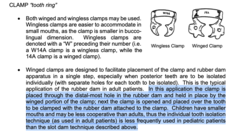
In the slot dam technique, when are clamps placed?
- Clamps (winged or wingless) are placed first
- the rubber dam is placed over them

What clamps are most commonly used in the Pediatric Clinic?
W14 - primary molars
W14A - permanent molars
8A - primary or permanent molars

How does the winged clamp work in adult posterior tooth isolation?
- The clamp is placed through the distal-most hole in the rubber dam, held by the wings, then opened and placed over the tooth with the rubber dam attached
What are rubber dam forceps used for?
- used to open and place the rubber dam clamp onto the tooth and to remove it after the procedure

How are rubber dam forceps opened?
- By squeezing the handles together, which spreads the working end of the forceps and the attached clamp
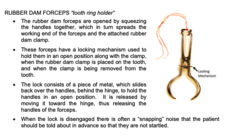
What mechanism do rubber dam forceps have to keep them open during clamp placement?
A locking mechanism
When is the locking mechanism used on rubber dam forceps?
- positioning the clamp on the tooth
- removing the clamp from the tooth

How does the locking mechanism on rubber dam forceps work?
- piece of metal slides back over the handles behind the hinge to hold them in the open position
How is the lock on rubber dam forceps released?
- sliding the metal piece back toward the hinge to release the handles
What should the child/patient be warned about when using rubber dam forceps?
The 'snapping' noise that occurs when the lock is disengaged, so they are not startled.
What is the main function of the rubber dam frame?
- stretch and stabilize the rubber dam before placement and during the procedure.

How does the rubber dam frame hold the dam in position?
- has protrusions along the sides and bottom that engage the rubber dam and maintain its stretched position

At what point is the rubber dam stretched onto the frame?
- Before placing the dam in the patient's mouth

How does the rubber dam stay retained on the frame once tension is released?
- stretched rubber dam catches on the protrusions of the frame and remains held in place

What special feature exists on the rubber dam frame for emergency removal?
- Two larger ball-ended protrusions on the sides of the frame.

How is this safety protrusion used during rubber dam placement?
The clamp ligature is wrapped repeatedly around the protrusion on the side where the clamp is placed

How might a rubber dam affect a child with upper airway obstruction (e.g., enlarged tonsils or nasal congestion)?
- may increase anxiety about their ability to breathe

Do these physiologic changes typically cause true respiratory distress in neurologically healthy patients?
No, but they can create a distressing sensation of breathing difficulty.
How can the rubber dam be introduced to reduce anxiety?
- Tell-Show-Do

What does the "Show" portion of Tell-Show-Do include for rubber dam placement?
- Showing the patient the prepared rubber dam
- letting them place a finger through the hole to demonstrate isolation
- using a small hand mirror to show what it will look like in place

What child-friendly explanation is often given for the rubber dam?
It will "keep all the yucky stuff out of your mouth" and help keep the teeth dry

What euphemism is used to describe the feeling of clamp pressure?
"Hugging" the tooth
What euphemism is used to describe stretching of the dam onto the teeth?
"Stretching"
What should the patient be reassured about regarding swallowing?
They can still swallow with the rubber dam in place.
What helps manage excess saliva under the rubber dam?
A saliva ejector placed beneath the rubber dam.
What should the patient be reminded regarding the duration of rubber dam use?
That the "raincoat" will be removed as soon as the procedure is done
Why must the clamp be pre-ligated?
- To avoid loss by ingestion or aspiration in an uncooperative or agitated patient
What additional safety advantage does a ligated clamp provide?
It allows rapid removal of the entire rubber dam assembly in an emergency (vomiting, distress, etc.).
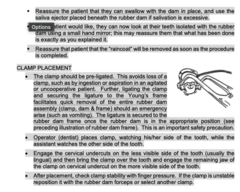
When is the ligature secured to the rubber dam frame?
- Once the rubber dam is in the correct position on the frame.

Which side of the tooth should be engaged first when placing the clamp?
- less visible cervical undercut (usually lingual).

What should be done after the first side is engaged?
- Bring the clamp over the tooth and engage the remaining jaw on the more visible side
What must be done after clamp placement?
- Check clamp stability with finger pressure
What if the clamp is unstable?
- Reposition it or select a different clamp
Is the rubber dam mounted onto the frame before or after placement in the mouth?
- Before intraoral placement
How is the clamp ligature passed during placement?
Through the prepared slot in the rubber dam.
Where should floss be used to seat the dam material?
- Below the height of contour on the mesial of the primary canine and/or between distal of primary canine and mesial of primary first molar if a separate canine hole is used

How is the ligature secured once the dam is in position?
Passed between the dam and frame and wrapped repeatedly around the small raised knob on the rubber dam frame.

Why might the edges of the slot be inverted?
To enhance isolation and keep material away from the operating field

What final check must be made before working?
Ensure the dam is secure on the frame.

Is the anterior rubber dam also placed on the frame before going into the mouth?
Yes.
How is anterior dam placement different from posterior?
The dam is placed over each tooth individually rather than over a clamp first.

Is inversion of the dam around primary anterior teeth easy to achieve?
No, inversion is desirable but often difficult because of primary tooth anatomy.

What can be done if inversion is not successful with finger pressure alone?
The dam material can be flossed between teeth to secure it below the height of contour.

How is the anterior rubber dam retained in place?
- With floss ligatures around each tooth (typically canine to canine)
- with bilateral clamps on primary canines or more commonly primary first molars.

How are clamps secured when bilateral clamps are used for anterior isolation?
- They are ligated and secured to the rubber dam frame.

How is the rubber dam usually removed from the tooth?
1. Rubber dam forceps are placed on the clamp
2. the clamp is opened and locked open
3. dam, clamp, and frame are removed as one unit.

When might you remove a clamp in the reverse sequence of placement?
In larger teeth or when visualization is difficult
What must be done first when anterior isolation is retained with floss ligatures?
- Carefully remove the floss ligatures before taking off the rubber dam.

Why is it important to check for leftover floss ligatures?
None should be left behind inside the mouth after dam removal (mainly for anterior)

What is done immediately after the rubber dam is removed?
- An immediate team rinse (dentist retracts cheeks, assistant rinses and suctions).

How is the rubber dam removed quickly in an emergency (such as vomiting)?
- Grab the frame (because the clamp ligature is attached to it), and remove the dam, frame, and clamp as one unit.
When is emergency removal ONLY effective?
When the clamp has been securely ligated to the rubber dam frame.
What happens if you fail to test clamp stability before placing the dam?
The clamp and dam may displace.

What problem results from incorrect clamp selection?
Patient discomfort or displacement of the clamp and rubber dam.

Why is it usually better to work from distal to mesial?
Because fluids like blood can flow backward and block visibility, and the distal-most tooth is the hardest to access and needs the most patient cooperation early in the appointment
Why should you complete all preparations at one time?
It improves efficiency, avoids returning to the handpiece multiple times, and is better tolerated by pediatric patients who dislike the sound of "Mr. Whistle."
What should you do if you think the child won't cooperate long enough for all restorations?
Prioritize the teeth and restore them one by one, progressing based on the patient's behavior and cooperation.
What should you do if the terminal tooth (like a partially erupted permanent first molar) cannot be isolated with a rubber dam, but alternate isolation is adequate?
Numb the tooth, restore it using alternate isolation (like Isolite, cotton rolls, or dri-angles), then place the rubber dam on the next most distal fully-erupted tooth and complete the rest of the quadrant.
Ideally, how long should the rubber dam and clamp stay on a tooth being prepared for an SSC?
For the entire preparation.
What if the clamp blocks part of the preparation?
Remove the clamp and dam to finish that part, then decide whether to replace the dam or use alternative isolation.
Why is the SSC usually cemented without the rubber dam?
Because the rubber dam gets in the way during crown cementation.
After cementation, what must you be careful of if the clamp is replaced?
Make sure the clamp does not displace the newly cemented SSC.
If the rubber dam cannot be used during SSC cementation, what safety step must be taken?
Place an unfolded 2x2 gauze in the back of the mouth as a 'tooth net' to reduce risk of aspiration of the crown.
Why should you avoid saving composites and sealants for the very end of the visit?
Rubber dams and other items in the mouth increase saliva flow, so the procedures needing the best isolation should be done sooner.
Why should an SSC be placed before adjacent Class II alloy or composite restorations?
It helps create good proximal contacts and prevents fracture of a freshly placed alloy during SSC seating and cementation.
Case 1

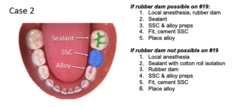
Case 2
Case 3

Why can sequencing be critical when placing adjacent SSCs in the same quadrant?
Because space loss from tooth drift after decay may make it hard to fit two properly contoured crowns onto teeth that are now too close together.

What problem does an over-crimped SSC cause?
It creates too much proximal contour, making the crown hard to seat.
