Contemporary urban environments
 Call Kai
 Learn
Learn Practice Test
 Spaced Repetition
 Match
Match Flashcards
 Knowt Play
1/66

Earn XP
Description and Tags
Name | Mastery | Learn | Test | Matching | Spaced | Call with Kai | Chat |
|---|
No analytics yet
Send a link to your students to track their progress
67 Terms
urbanisation
the growth in the proportion of a country living in urban areas
millionaire city
a city with over one million people
world city
A city that acts as a major centre of finance, trade, business, politics, culture, science, information gathering, publishing and mass media. Generally serves the whole world (NY, London, Tokyo).
mega city
Metropolitan area with a total population of over 10 million. Density is usually over 2000 people/km².
rural-urban migration
Movement of people from rural to urban areas, this drives urbanisation. Most migrants are young and are drawn to pull factors in cities.
natural increase
Birth rate exceeds death rate, growing the population.
economic development
Cities that trade grow financially, creating more jobs. This attracts more people to he city, leading to urbanisation.
established city
A large and significant city with a defined population, infrastructure, and governance, often recognized for its economic, cultural, and social contributions. These places typically have a history of development and may serve as a centre for commerce, education, and transportation. (London)
maturing city
A phase in urban development characterized by the transition from rapid growth to a more stable state. This stage often involves improved infrastructure, increased investment in public services, and a focus on sustainability. Challenges may include managing population density, ensuring affordable housing, and maintaining economic vitality while preserving cultural identity. (Sao Paulo)
immature city
A city that lacks development, infrastructure, and urban planning, often characterized by informal settlements, limited services, and a high degree of informality in its economy? This type of city typically faces challenges such as inadequate housing, poor sanitation, and limited access to education and healthcare, often resulting from rapid urbanization and population growth without corresponding investment in urban infrastructure. (Lagos)
consolidating city
A city type that refers to a city that merges with sub urban surrounding areas to form a larger, unified urban city. This process often aims to improve governance, streamline services, and enhance economic development. Consolidation can lead to more efficient resource allocation and better infrastructure planning.
push factors
Reasons to leave a rural area for a city: lack of well-paid employment, lack of services, lack of investment, food insecurity, frequent natural disasters, mountainous terrain, poor leadership, pressure on land, war/conflict
pull factors
Reasons cities attract people from rural areas: plenty of well paid jobs, more comfortable houses, better QOL, reliable food source, more development, freedom - religious practises can be carried out safer.
challenges of urbanisation
Overcrowding: Increased population density leads to strain on infrastructure and services.
Housing Shortages: Demand for affordable housing often exceeds supply.
Traffic Congestion: More vehicles result in longer commute times and pollution.
Environmental Degradation: Urban expansion can lead to loss of green spaces and biodiversity.
Social Inequality: Disparities in wealth and access to services can widen.
Public Health Issues: Higher population density can facilitate the spread of diseases.
bengaluru
One if India’s fastest growing cities, used to be small, sustainable and green but now focuses on technology and quaternity sectors so its economy and population has grown rapidly. Caused issues of a growing divide between social class levels. Population has doubled from 2001 to 2015 and will continue to expand due to the young migrants.
city rankings:
alpha ++
alpha +
alpha/ alpha -
beta
gamma
description:
most integrated with world (London/New York)
highly integrated (Tokyo/Paris/Sydney)
very important, links major economic regions to world (Chicago/Milan/Sao Paulo)
important, link their region into the world economy (Bangalore/Copenhagen/Cairo)
links smaller regions to world economy, not as advanced (St Petersburg/Durban/Bristol)
employment sectors
primary - extraction of raw materials
secondary - manufacturing
tertiary - services
quaternary - research and development
deindustrialisation
decline of primary and secondary sector jobs because people wanted higher paying, less intensive jobs and globalisation meant it became cheaper to import manufactured goods from LICs
decentalisation
businesses relocating out of the inner-cities central business district (CBD) because less congestion and more space
suburbanisation
growth of suburbs of city as houses and services are built to accommodate the increase of people
counter-urbanisation
urban to rural migration
urban decline
deterioation of inner-cities due to lack of investment, decline in population and high unemployment
urban regenation
improvement of an area that has suffered decline, improving the areas physical structure and its economy
London Docklands Development Cooperation - case study
London’s port was once one of the busiest in the world but as container ships got too large, the docks and surrounding residents suffered a massive decline. An urban development corporation (UDC) was set up and improved accessibility to the rest of London, 17 conservation areas were set up, 200k trees were built, the city Airport was built, 2,700 business trading, establishment of Cary Wharf, 22,000 new houses built, investment in services and job training
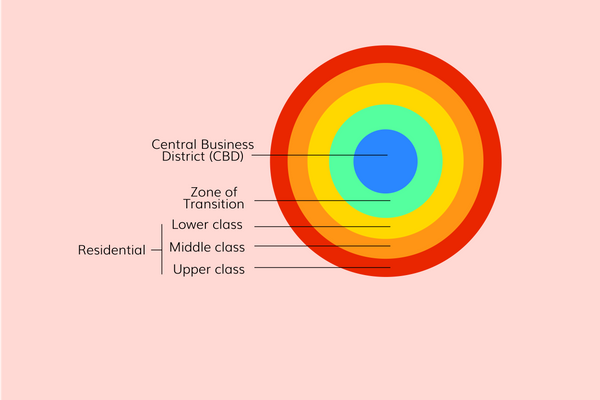
burgess concession ring model
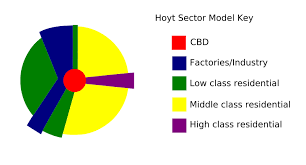
hoyts sector model
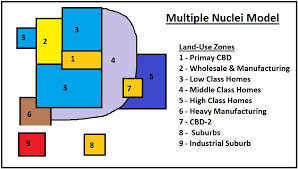
Harris and Ullmans multiple nuclei model
Post modern cities
Art and architecture of a city moving away from what people expect, lots of different styles of infrastructure e.g. Las Vegas
Urban deprivation
the state where individuals or groups in a city live below a standard of living that is considered acceptable for the majority, resulting in a lack of access to resources and opportunities
albedo
the reflectivity of a surface - light surfaces reflect more energy than dark surfaces so have a greater albedo
microclimate
small-scale changes in temperature, precipitation, humidity, wind speed and evaporation that occurs in a particular environment
particulate air pollution
form of air pollution caused by the release of particles and noxious gases into the atmosphere, can occur naturally but often a result of burning fossil fuels
photochemical pollution
a form of pollution caused by exhaust fumes being trapped by temperature inversions in the presence of sunlight forming low-level ozone, can be dangerous to health
temperature inversion
an atmospheric condition where temperature increases with height, trapping pollution in the lower layer of the atmosphere
urban heat island
the zone around and above an urban area having higher temperatures than surrounding rural areas
Why is fog a threat
Causes breathing problems and increased risk of road accidents
Why are thunderstorms more common in urban areas
Need hot humid air to form (UHI effect and water vapour from industry)
How do thunderstorms form
Hot humid air rise into the atmosphere, the air cools and condenses rapidly forming water droplets, hail and ice which charge the thundercloud and the release of this charge is the lightning
Urban canyon
Narrow streets bordered by high rise buildings funnelling and concentrating winds
Venturi effect
Violent form of gusting caused in narrow gaps by air rushing to replace low pressure vortices beyond structures
Why is lightning more common in urban areas and how is it formed?
Cities produce more water vapour which then cools, condenses and crystallises. It gets too heavy to be supported by updraft so sinks, meeting rising ice crystals which strike, causing a transfer of electrons creating a battery effect in the cloud which meets with the positive charge in the ground leading to a discharge of electricity (lightning)
Why is precipitation higher in urban areas?
UHI effect means more evapotranspiration and conventional weather patterns, mixed heights of buildings increases air turbulence, low pressure draws air in from rural areas to form cumonimbulus clouds, higher rates of pollutants in air attracts water, more water vapour in air from industry
Why are thunderstorms more common in urban areas?
Higher temperatures increase likelihood by 25% as they develop in hot, humid air. The hot air rises, cools rapidly forming tall clouds which can lead to high precipitation, thunder and lightning
3 Impacts urban structures have on wind
Frictional drag buildings creates turbulence and slows wind speeds
The UHI effect can draw in strong localised winds from surrounding cooler areas
High rise buildings can channel air into canyons which can sway buildings
How is photochemical smog caused?
Pollutants from burning fossil fuels come into contact with the suns UV which breaks the particles down into harmful chemicals
What are suds, what do they do and why are they needed?
sustainable urban drainage systems, increase storage of water, encourage infiltration, slow water movement, improve water quality ect. needed because high amounts of impermeable surfaces and the UHI effect mean urban areas are more prone to flooding
What can suds include?
Permeable paths, green roofs, wetlands, more vegetation, rain gardens, ponds and bioretention areas
Opportunities of urban landfill
Provides jobs and income in lower income countries
Small percentages of the waste will be recycled
Challenges of urban landfill
Plastic and visual pollution
Release of greenhouse gas contributes to global warming
Contaminates ground water and rivers
Encourages disease and infection
Industrial waste
Produced by manufacturing industry such as scrap metals and chemicals
Commercial waste
Produced by businesses, often cardboard and plastics
Personal waste
From private homes such as plastic and food waste
__ million tonnes of waste produced by UK in 2018
__ million tonnes of this was from construction and demolition
___% of food gets wasted by each person
225
140
20
What’s the biggest components of global waste?
46% organic, 16% paper, 14% plastic
Why is plastic waste so difficult to manage?
It’s longevity and not all types are recyclable
Waste stream
Flow of waste from its origin through to its eventual disposal
Factors that effect waste streams
Economic - richer incomes consume more foods, more developed countries will have recycling schemes
Lifestyles - food waste, overconsumption, fast fashion
Attitudes - throw away culture, generational differences, health concerns
Burial and submergence
methods of waste disposal involving burying waste in manmade landfills or submerging it in water bodies. These methods can lead to environmental concerns, such as soil and water contamination and greenhouse gases being released, however it can generate electricity
Recycling
Selective exraction of waste for a specific next use, reducing the amount of waste sent to landfills amd energy required to produce new products, however it isn't always done right and people make mistakes
Recovery
The process of extracting valuable materials or energy from waste, aiming to minimize landfill use and return materials to the economy
Trade
Countries import differnet types of waste which produces them energy and jobs but can be dangerous work in LICs with little education on harmful chemicals and toxins may pollute groundwater, poisoning local people
Unregulated waste disposal
is the improper or illegal dumping of waste without following environmental regulations, leading to pollution, health hazards, and degradation of local ecosystems
Landfill
A site for the disposal of waste materials which can be regulated and takes all different types of waste but it's unsightly, opposed by locals, poses a risk of chemical leaching and it takes up lots of space
Incineration
The process of burning waste materials at high temperatures to reduce their volume by 90% and generate energy, but it can release harmful emissions if not properly managed, can't be used for all waste types, is expensive and unpopular for local residents
Waste disposal strategies in Amsterdam
Government taxed highly on each tonne of material in landfill to encourage recycling, ‘waste to energy’ strategy introduced included an international plant capable of producing one million joules of electricity annually and has assures in place to reduce environment impact on gases released
4 pillars of sustainability
Social, economic, environmental and political/governance
Sections of the Egan wheel
Social + cultural, housing and built infustructure, equity, environment, services, transport, governance and economy