ANSC 212: The Digestive System
 Call Kai
 Learn
Learn Practice Test
 Spaced Repetition
 Match
Match Flashcards
 Knowt Play
1/60

Earn XP
Description and Tags
Vocabulary flashcards defining core terms, organ structures, and physiological processes of monogastric, avian, and ruminant digestive systems from ANSC 212.
Name | Mastery | Learn | Test | Matching | Spaced | Call with Kai | Chat |
|---|
No analytics yet
Send a link to your students to track their progress
61 Terms
Feed
A material that, after ingestion by animals, is capable of being digested, absorbed, and utilized to meet their nutrient requirements.
Digestion
The process by which large complex molecules are broken down into simpler molecules capable of being used by the animal for metabolism.
What are the major complex molecules
protein
fats
carbohydrates
fiber
starch (rapidly digested)
Energy sources for livestock
corn
carbohydrates = cheapest option
fats = best for energy supply, but expensive and animals won’t eat a %100 fat diet
Protein sources for livestock
peas, canola, soybean, alfalfa
Functions of digestive system
ingestion of food
breakdown of food into nutrients
absorption of nutrients
elimination of waste products
What is contained in the Digestive system ?
mouth
pharynx
esophagus
stomach
small intestine
large intesine
rectum
accessory glands (salivary glands , liver , gallbladder , pancreas )
What animal does not have a gallbladder ?
horse
→ this means that they cannot store the bile produced by liver
Prehension
The manner in which animals harvest and convey feed to their mouth using structural adaptations such as lips ( horses ), teeth, tongue ( cattle ), or beak ( poultry ) .
Mastication
The mechanical reduction of feed particle size that increases surface area for enzymatic and microbial digestion
mixes feed with saliva for swallowing
Ruminants - eat feed quickly, then re-masticate at a later time
Chickens - rely on their gizzards to mechanically grind their feed
Herbivore
An animal classification for species that depend entirely on plants for nutrients
ex. sheep, cattle, horses, and deer.
Carnivore
An animal classification for species that depend almost entirely on meat for nutrients
ex. cats and wolves.
Omnivore
An animal classification for species that consume both meat and plants
ex. swine, chickens, humans, and dogs.
What are the three types of digestion ?
Mechanical - mastication and muscular contractions of alimentary canal
Chemical - enzymes secreted by animal in digestive juices and saliva
Microbial - activities of bacteria , protozoa , and fungi

Monogastric
An animal digestive system featuring a single true stomach compartment, limited gut capacity, primary reliance on enzymatic digestion, and limited fiber digestion ability
ex. dog , cat , pig , human , chicken , horse
Ruminant
An animal digestive system featuring four stomach compartments: the rumen, reticulum, omasum, and abomasum.
ex. cattle , sheep , goat , deer , elk , moose , giraffe
Pseudo-ruminant
An animal digestive classification for species that possess a three-chambered stomach system.
ex. camels , llama , alpaca
What animal does not enzymes in their saliva ?
cattle
microbial breakdown food more than chemical digestion
Digestion in the mouth
teeth and lips grasp and chew feed to begin breaking it down to increase surface area
mix it with saliva before swallowing (lubrication)
Digestion of carbohydrates begin taking place via salivary amylase for pigs and dogs
^ cattle don’t have salivary amylase enzymes
Traits of mono gastric digestion
single stomach (single compartment)
limited gut capacity → can’t digest all fibre
Digestion is aided by enzymes
Limited microbial activity → BUT present in large intestine
Why do mono gastric animals have a limited ability to digest fibre?
don’t have enough enzymes or bacteria to break it down
Functions of stomach
Feed travels down esophagus to stomach which serves as reservoir for short term storage and digestion
Enzymes start to break down food
organic compounds (proteins )
speeds up the chemical reaction without being used up in process
stomach enzyme = PEPSIN
Low pH (around 2 or 3) in the stomach breaks down some feed particles
Hormone secreting area → GHRELIN = hunger hormone
Pepsin
A proteolytic stomach enzyme activated from pepsinogen by hydrochloric acid (HCl) that initiates the chemical breakdown of proteins.
Ghrelin
A hormone secreted in a specific area of the stomach that acts as the hunger hormone, with secretion levels increasing when the animal is hungry.
Small intestine
main site of Digestion and Absorption
presence of bile
digestive enzymes secreted largely from pancreas to help with breakdown
about 20 times the length of the animal
three sections of small intestine
Duodenum
Jejunum
Ileum
Duodenum
The first section of the small intestine that receives digestive juices and secretions from the pancreas, gallbladder (just stores the juices) , and liver.
Jejunum
The middle and longest section of the small intestine responsible for enzymatic digestion and nutrient absorption
Ileum
The final section of the small intestine closest to the large intestine, functioning primarily in nutrient absorption.
Mesentery
A supportive connective tissue fold in the abdominal cavity that holds the loops of the small intestine together.

Villi
Finger-like tissue projections in the small intestine that increase surface area of intestine
secrete digestive enzymes,
contain specialized cells that transport absorbed nutrients into the bloodstream
What enzymes are produced by the Villi ?
Sucrase - converts sucrose to glucose and fructose
Maltase - converts maltose to two molecules of glucose
Lactase - hydrolyses lactose to one molecule of glucose and one of galactose
Aminopeptidases - act on the peptide bond adjacent to the free amino group of simple peptides
Dipeptidases - complete the breakdown of dipeptides to amino acids
Parts of large intestine
Cecum
Colon
Rectum
microbial fermentation occurs in the large intestine
Cecum
A large pouch located at the junction of the small and large intestines
serves as a site for hindgut microbial fermentation in animals like horses, pigs, and chickens.
Colon
A segment of the large intestine primarily responsible for water reabsorption, microbial activity, and digesta passage.
Rectum
The final segment of the large intestine responsible for waste storage and the excretion of waste products.
Unique features of Avian digestive tract
Beak / mouth
Crop
Proventriculus
Gizzard
Cloaca
Vent
Cloaca
A common chamber in the avian digestive system shared by both the gastrointestinal and urinary tracts.
both feces and urine are expelled from this single opening
Vent
The common external opening and exit for both the gastrointestinal and urinary tracts in poultry
very similar to rectum
Crop
An expanded pouch of the esophagus in birds used for feed storage, moistening, and softening prior to chemical digestion.
Proventriculus
The glandular stomach of birds that secretes hydrochloric acid (HCl) and pepsin to chemically break down feed
Gizzard (Ventriculus)
The muscular stomach of birds responsible for the mechanical breakdown and grinding of feed.
Accessory glands for digestion
salivary glands , liver , pancreas
Liver
An accessory digestive gland divided into right and left lobes
functions in detoxification, vitamin and carbohydrate storage, and bile formation (bile salts play big role in digestion of fats via saponification )
Pancreas
An organ positioned in the duodenal loop functioning as both an endocrine and exocrine gland
Functions: produces insulin, glucagon, and enzymes like amylase (starch) , lipase (fat) , proteases (protein), and nucleases (DNA / RNA )
What animals are ruminants?
sheep, cows and goats
Saliva
Fluid secreted by salivary glands producing up to 180–250 L/d in dairy cattle,
Functions:
lubrication
enzymatic activity → baby calves have enzymes when young to drink and breakdown milk
sources of nutrients for ruminal microorganisms
influences nutrient removal rate
Buffer capacity → VERY IMPORTANT to off set basic pH of rumen
antifoaming agent
source of antibodies
Ruminant stomach compartments
Rumen ( located on left side of animal body ) full of bacteria, fungi / microbiome
Reticulum
Omasum
Abomasum ( most like monogastric stomach )
then goes into the small intestine
Rumination
The process in resting ruminants of regurgitating ingesta from the reticulum back to the mouth for re-mastication and re-swallowing.
Eructation
The oral release of fermentation gases, primarily carbon dioxide (CO2) and methane (CH4), produced in the rumen.
release of gas mainly happen in mouth via burps
*can’t remove this from animal, but can manipulate and change diet to try to limit it
Rumen
The largest compartment of the ruminant stomach
functioning as an anaerobic fermentation vat lined with papillae to absorb short-chain fatty acids and increase absorptive surfaces
there are three levels of feed in the rumen with layer of gas on top
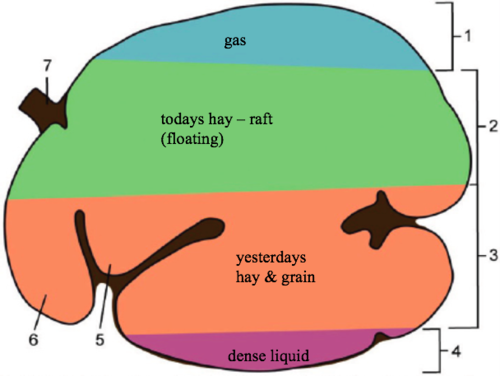
How does the rumen work symbiotically with mircobial
microbes digest or ferment feed to make short chain fatty acids (SCFA) like acetate , propionate , butyrate
rumen walls absorbs SCFA as energy source for animal
When bacteria die , they are digested as protein source for animal
Short-Chain Fatty Acids (SCFAs)
Fermentation end-products—principally acetate, propionate, and butyrate—produced by ruminal microbes that provide ruminant's energy
Functions of rumen
major feed/ digesta storage site → allows for large meals and regurgitation
digestion through anaerobic fermentation * no O2 because of microbiome
contains billions of microorganisms
bacteria, protozoa , fungi, archaea
give ability to digest fibre for energy producing 75% of energy supply
make vitamin K and B
Type of micro-organisms chains with the type of feed consumed (grain vs forage)
Produce gases such as CO2 and CH4
Normal rumen pH
5.5 to 6.9
High grain diet = more acidic
high forage diet = more basic
How long does it take to change / adapt ruminal microbial populations?
14-21 days , around 3 weeks
Ruminal Acidosis
A pathological metabolic condition in ruminants caused by excessive production of short-chain fatty acids that lowers ruminal pH below normal levels (5.5–6.9).

Reticulum
A pouch-like ruminant stomach compartment located near the heart with a distinct honeycomb inner lining that connects to the rumen and assists in regurgitation.
it is hard to determine the start and end of rumen to reticulum because they look very similar and are very interconnected
Esophageal Groove
Muscular folds in young ruminants that close to bypass the rumen, reticulum, and omasum, directing ingested milk directly into the abomasum.
Omasum
A globe-shaped ruminant stomach compartment containing laminae (leaf-like folds) that squeezes and absorbs excess fluids and short-chain fatty acids from digesta.
Abomasum
The fourth stomach compartment of ruminants, known as the true stomach, where glandular (only compartment with glands) secretions of acid and enzymes
conduct digestion similar to a monogastric stomach