L3-Micronutrients
 Call Kai
 Learn
Learn Practice Test
 Spaced Repetition
 Match
Match Flashcards
 Knowt Play
1/55

There's no tags or description
Looks like no tags are added yet.
Name | Mastery | Learn | Test | Matching | Spaced | Call with Kai | Chat |
|---|
No analytics yet
Send a link to your students to track their progress
56 Terms
Characteristics of vitamins
organic compounds (carbon skeleton)
can be lipid or water soluble
may or may not be considered ‘essential’ (depends on species)
Functions of vitamins
metabolic regulation
coenzymes
antioxidants
Functions of Vitamin A
Vision
Growth
Tissue maintenance
Immune function
Embryonic development
Forms of Vit A
Biologically active forms:
Retinol
Retinal (retinaldehyde)
Retinoic acid
Storage (inactive) forms:
Retinyl ester → from animal products (stored in liver)
beta-carotene → (mostly) from plant products (red/orange pigmentation)

Rhodopsin and iodopsin=
Retinal+opsin (light sensitive protein)
Where is rhodopsin and purpose
Photoreceptor found in rod cells of the retina
Black and white vision
Dim light vision (‘night vision’)
Where is iodopsin and purpose
Photoreceptor found in cone cells of the retina
Colour vision
Bright light vision
Vitamin A toxicity
Hypervitaminosis A
Due to excess preformed Vit A (not beta-carotene
Vitamin A deficiencies
fetal abnormalities
impaired growth
night blindness

Vitamin A (preformed) is essential for which animals
felids
marine birds
most carnivorous mammals
*Lack sufficient quantities of 15,15’dioxygenase, which converts beta-carotene into retinal
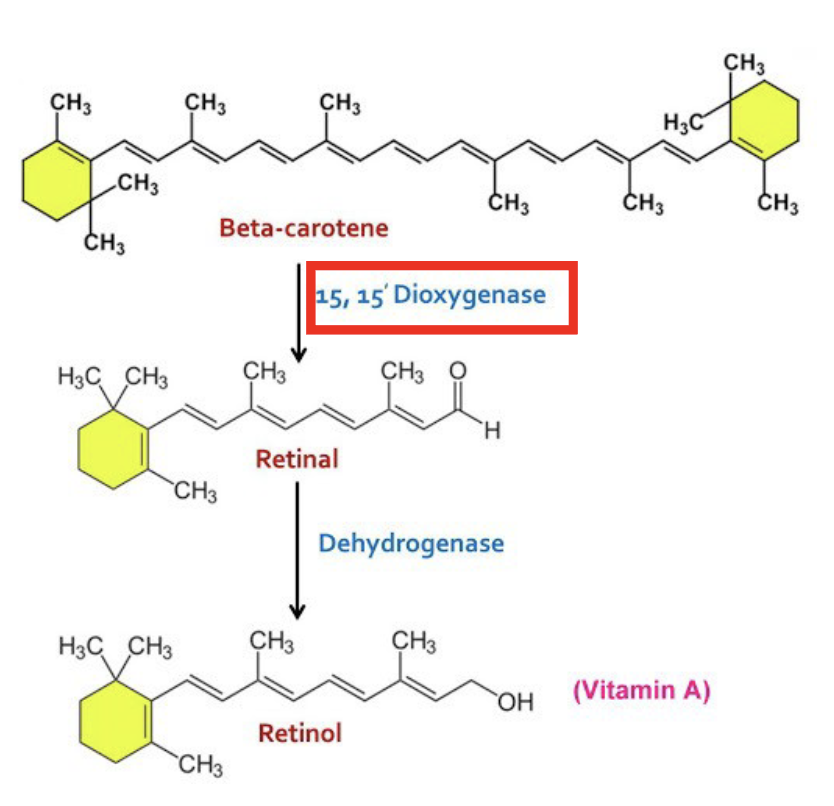
Vitamin A (preformed) is not essential for which animals
canids (e.g. foxes, coyotes, wolves)
most herbivores
most omnivores
*Readily convert beta-carotene to Vitamin A
Functions of Vitamin D
Homeostatic regulation of calcium and phosphorus
Growth
Bone remodeling
Eggshell formation
Sources of Vitamin D
D2 = ergocalciferol
very few natural sources (foods often fortified with D2)
D3 = cholecalciferol
sunlight (UV-B exposure), phytoplankton, zooplankton, marine fish
Active and Inactive forms of Vitamin D3
Inactive
D2(diet)
D3 (sunglight, diet)
Active
Calcitrioll 1,25-dihydroxycholecalciferol, 1,25-dihydroxyvitamin D 3 or 1,25(OH)2D
Vitamin D3 synthesis steps
Ultraviolet B (UV-B) radiates the skin
UV-B initiates conversion of 7-dehydrocholesterol → Vit D3 (cholecalciferol)
Conversion of Vit D3 → 25-hydroxyvitamin D3 (calcidiol or 25(OH)D) in the liver
25-hydroxyvitamin D3 → 1,25-hydroxyvitamin D3 (calcitriol or 1,25(OH) 2D) in the kidney
*This active form of VitD (calcitriol) is what regulates Ca/P

Which animals require Vitamin D
Only required in the diet for mammals with insufficient sun exposure
Polar regions
Fossorial/subterranean
Nocturnal

Which animals is Vitamin D3 essential for
amphibians
birds
reptiles
- Cannot use Vitamin D2
- Mammals can use D2 or D3
Vitamin D toxicity
Hypervitaminosis D (hypercalcemia)
Calcium builds up in soft tissues and organs (ex. muscle, organs, brain, tissue)
Vitamin D deficiency
Rickets (soft bones, young animals)
Osteomalacia (brittle bones, adults)

Vitamin E function
Antioxidant
Inhibits/prevents oxidative damage
Scavenges free radicals (unstable/reactive atoms)
Vitamin E sources
Tocopherols (alpha, beta, gamma, delta)
Organic compounds with various methylated phenols
Alpha-tocopherol = most active form of Vitamin E
Tocotrienols (alpha, beta, gamma, delta)
Vitamin E toxicity
hypervitaminosis E
can counteract the actions of Vitamin K (blood coagulation)
Vitamin E deficiencies
Muscular dystrophy (muscle weakness, paralysis)
Nerve damage
Infertility in rats and birds
Vitamin K function
Coagulation (blood clotting)
Vitamin K sources
K1 = phylloquinone
Leaves of green plants
K2 = menaquinone
Animal tissue and gut bacteria (both convert K1 → K2)
K3 = menadione
Synthetic precursor
Inactive in synthetic form
Plants and bacteria can activate it (animals cannot)

Vitamin K toxicity
K1 and K2 are innocuous (harmless), even in very large amounts
K3 can be toxic (not used as a supplement anymore)
Vitamin K deficiencies
Risk of hemorrhage or excessive bleeding

Types of B vitamins
B1- thiamine
B2- riboflavin
B3- niacin (nictonic acid & nicotinamide)
B5- pantothenic acid
B6- pyridoxine & pyridoxamine
B7- biotin
B9- folate/folic acid
B12- cobalamin
Thiamine function and deficiency
Function: Coenzyme/precursor for cell metabolism
Deficiency: Beriberi → edema, heart problems
Riboflavin function and deficiency
Function: Coenzyme/precursor for cell metabolism
Deficiency: Ariboflavinosis → skin disorders, edema
Niacin(nicotinic acid) and Nictoinamide function and deficiency
Function: Coenzyme/precursor for cell metabolism; can be synthesized from tryptophan (poor efficiency)
Deficiency: Pellagra → skin disorders, dementia, diarrhea
Pantothenic Acid function and deficiency
Function: Precursor for Coenzyme A → critical for TCAC
Deficiency: Rare
Pyridoxine & Pyridoxamine function and deficiency
Function: Amino acid metabolism; higher requirement in carnivores
Deficiency: Dermatitis
Biotin function and deficiency
Function: Coenzyme/precursor for cell metabolism; can be synthesized by gut bacteria so may not be essential for ruminants
Deficiency: Anemia + hair loss
Folate/folic acid function and deficiency
Function: Coenzyme/precursor for cell metabolism; can be synthesized by gut bacteria so may not be essential for ruminants
Deficiency: Folate-deficiency anemia
Cobalamin
Function: Coenzyme/precursor for cell metabolism; synthesized by gut bacteria so all animals depend on microbially synthesized B12
Deficiency: Severe + irreversible brain and CNS damage
Vitamin C (ascorbic acid) functions
Antioxidant
Collagen formation
Hormone synthesis
Absorption of iron

Vitamin C deficiencies
Scurvy (skin disorders, impaired wound healing, risk of hemorrhage)
Who is Vitamin C essential and not essential to?

Vitamin C synthesis

Choline and Inositol functions
Structure of cellular membranes (both); Phosphatidyl-Inositol & Phosphatidylcholine
Lipid transport and metabolism (Choline)
Neurotransmitter synthesis (Inositol)

Characteristics of Choline and Inositol
Choline (‘Vitamin B4 ’)
conditionally essential
Synthesized from methionine*
Inositol (‘Vitamin B8 ’)
non-essential
Synthesized from glucose*
*Synthesis is slow (potentially insufficient) during growth and geriatric phases
Characteristics of minerals
Inorganic compounds (no carbon skeleton)
All are essential (cannot be synthesized by any animal or plant)
How can minerals be obtained in diet
From plants (who accumulate minerals from the soil)
From animals (who accumulate minerals from eating plants/animals)
From free water
Thus environment has large influence on mineral availability
Types of macro & microminerals
* Although these are the main trace minerals, there are more than a dozen which can be found in the body including: arsenic, nickel, silicon, and boron
** ruminants only

Function of minerals
Part of skeletal structures; e.g. calcium & phosphorus in bone
Maintenance of osmotic pressure; e.g. sodium in extracellular fluid/potassium in intracellular fluid
Regulation of acid/base balance; e.g. chloride in the kidneys
Components of enzymes; e.g. cobalt as part of vitamin B12
Activators of enzymes; e.g. calcium activates enzyme CaMKII
Components of biological units; e.g. hemoglobin contains iron and thyroxine contains iodine
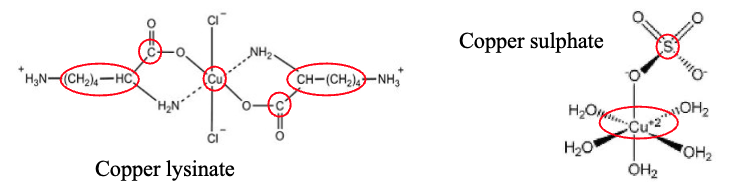
Organic vs Inorganic Minerals
Nutritionally Organic Minerals
Minerals which are chelated (bound) to a carbon containing compound (e.g. amino acid)
Generally, more bioavailable
Nutritionally Inorganic Minerals
Elements or molecules without carbon
Generally, less bioavailable
Two most abundant minerals in the body are:
Calcium and Phosphorus
Calcium function and where it’s found
formation of bone/teeth/antler/eggshell/milk (main role)
found in milk, eggs, bone, vegetation
Phosphorus function and where it’s found
formation of bone/ATP/phospholipids (main role)
found in animal tissue, milk, grains*, vegetation*
*In plants, much of the P may be present as phytate

Calcium/Phosphorus deficiency and requirements
Rickets (young animals) or osteomalacia (metabolic bone disease)
Requirement = considered as a ratio (Ca:P should be 1:1 – 2:1)

Electrolytes and examples
intracellular/extracellular fluid balance
ex.
Cations: Ca2+, Mg2+, Na+, K+
Anions: P(PO43-), Cl-
Electrolytes function
Create osmotic gradients to regulate body fluid status/movement
Electrolyte imbalance results in
cardiovascular issues (chronic)
fatigue and emesis (acute)
Who is cobalt essential to
Only essential mineral for ruminants (foregut fermenting species) and some monogastric hindgut fermenting species
Cobalt function
Synthesis of Vitamin B12 (cobalamin)
