Nervous System
 Call Kai
 Learn
 Practice Test
 Spaced Repetition
 Match
 Flashcards
 Knowt Play
1/36

There's no tags or description
Looks like no tags are added yet.
37 Terms
What structures make up the CNS?
brain and spinal cord

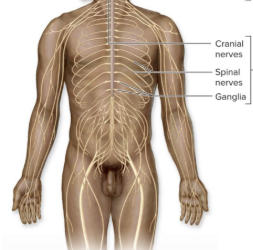
What structures make up the PNS?
cranial and spinal nerves, and ganglia

What is somatic sensory?
sensory input that is constantly perceived from receptors
What structures use somatic sensory?
eyes, ears, and skin

What is visceral sensory?
sensory input that is not constantly perceived from receptors of blood vessels and internal organs
What structures use visceral sensory?
heart
What is somatic motor?
motor output that is constantly or voluntarily controlled
What is the effector of somatic motor?
skeletal muscle

What is autonomic motor?
motor output is not consciously/is involuntarily controlled
What are the effectors for an autonomic motor?
cardiac muscle, smooth muscle, and glands

What is the most common neuron type?
multipolar neuron
Sensory neurons carries sensory signals to the?
CNS
Motor neurons carry CNS commands to?
muscles/glands
Sensory neurons are?
afferent
Motor neurons are?
efferent
Oligodendrocytes myelinates the?
CNS
Neurolemmocytes myelinates the?
PNS
Frontal lobe controls?
thinking, speech, emotion, and movement
Parietal lobe controls?
receiving and interpreting sensory messages
Temporal lobe controls?
emotion and speech
Occipital lobe controls?
receiving and interpreting visual input from the eyes
Corpus callosum function?
connects the left and right cerebral hemispheres of the brain
Pineal gland function?
receive information about light and dark from the environment and produce melatonin to regulate sleep-wake cycle
What does the superior colliculus process?
optic stimuli
What does the inferior colliculus process?
auditory stimuli
What is the function of the cerebellum?
coordination of movement, balance, and motor skills
What are the cranial meninges?
dura mater
arachnoid mater
pia mater
What is the Olfactory nerve (CN I) for?
smell
What is the Optic nerve (CN II) for?
sight/visual
What is the Oculomotor nerve (CN III) for?
eye movement
What is the Trigeminal nerve (CN V) for?
chewing/face muscles
What is the Facial nerve (CN VII) for?
facial muscles
What is the Vestibulocochlear nerve (CN VIII) for?
hearing
What is the Glossopharyngeal nerve (CN IX) for?
tongue/throat
What is the Vagus nerve (CN X) for?
trunk; upper thoracic cavity
What is the Hypoglossal nerve (CN XII) for?
innervation of other muscles/tongue
What does the phrenic nerve do?
helps control diaphragm – therefore, also, hiccups