Crime - Lecture 3
 Call Kai
 Learn
 Practice Test
 Spaced Repetition
 Match
 Flashcards
 Knowt Play
1/91

Earn XP
Description and Tags
genetics, crime and antisocial behaviour
92 Terms
genetic influence - several lines of evidence
behavioural genetics
adoption studies
identical and fraternal twin design studies
identical twins separated at birth
molecular genetics
XYY
candidate genes
twin: fraternal vs identical
2% of the population are twins
92% of all twins are fraternal twins (dizygotic)
they have about 50% of their genes in common
two separate eggs that are fertilised by 2 separate sperm
identical twins share virtually 100% of their genes
develop from a single egg-sperm pair up - a zygote - that malfunctions and splits into two
monozygotic
(identical) twin pairs share their common environment and 100% of their genes
dizygotic
(fraternal) twins share their common environment, and they share on average 50% of their genes
by comparing the resemblance for antisocial behaviour between monozygotic and dizygotic twins, the variance of antisocial behaviour can be divided into:
genetic factors (or heritability, h2)
shared environmental factors (c2)
non-genetic influences, e.g. general personality, parenting style, parental beliefs, socio-economic status
non shared environments factors (e2)
makes siblings more dissimilar
e.g. birth order, teachers, friends
can be the product of the characteristics of the individuals
measurement error - anything you cannot explain in your model
if genes influence ASB…
…MZ twins will be more similar to each other on ASB than DZ twins
twin studies on ASB - heritability
heritability for ASB ranges between .40 and .50
pretty stable across informants
teacher .40
parent .47
child .50
shared environment: 15-20%
nonshared environment: 30%
twin studies on ASB - different forms of ASB
reactive aggression (h = .39); proactive aggression (h = .50)
minimal influence of shared environment
meta-analysis of 103 studies on aggressive ASB (h = .65) vs nonaggressive ASB (h = .48)
shared environment: non-aggressive ASB (c2 = .18)
share environment: aggressive ASB (c2 = .50)
heritability of ASB is found across age groups and genders
BUT, heritability of ASB is strongest for early-onset ASB, occurs across many settings, is persistent and severe, and involves psychopathic tendencies (CU traits)
twin studies on ASB - ASB + CU traits
children
CU traits at 7 years: h2 = 67%
extreme CU traits
CU traits equally heritable at the extreme of the distribution at 7 years of age
non-shared environment also played a role

viding et al. (2009) - genetics, environment and CU traits
top diagram:
high level of CU traits
genetic influence is far greater (.81)
bottom diagram:
low levl of CU traits
only a third the variance can be explained by genetic factors
right hand diagrams
controlled for shared variance with hyperactivity
for the high CU traits, the reuslts were similar
high level of genetic influences
for the low CU traits, most variance is explained by non-shared E

TEDS data: aetiology of AB-CU relationship - phenotypic overlap
phenotype overlap - if you’re high in CU traits you’re likely to be high in antisocial behaviour

TEDS data: aetiology of AB-CU relationship - genetic overlap
the overlap between antisocial behaviour and CU traits is under substantial genetic influence

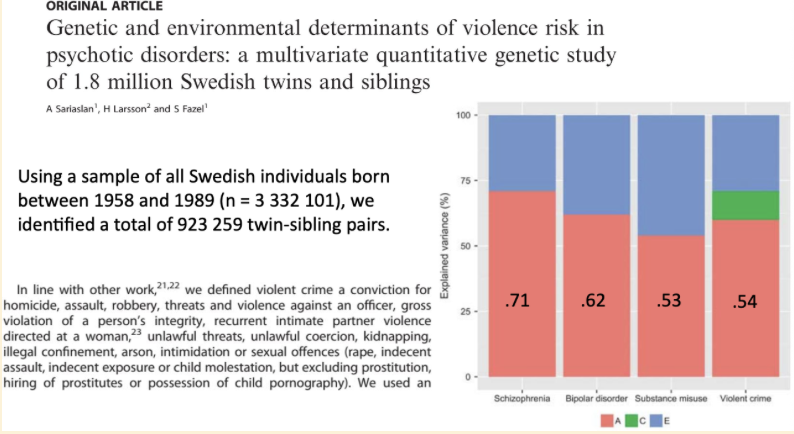
sarlaslan et al. - twin studies: violent crime
looked into different behaviours: schizophrenia, bipolar disorder, substance misuse, violent crime
found substantial genetic influence
langstrom et al. - sexual offending runs in families
strong family aggregation of sexual crime, among full brothers of convicted sexual offenders
lower in father-son dyads, among paternal half brothers, and maternal half-brothers
genetic factors (40%) and non-sahred environmental factors (58%) explained the liability to offend sexually more than shared environmental influences (2%)
genetic effects tended to be weaker for rape of an adult than for child molestation
pezzoli et al. - heritability estimate of ASB in quantitative genetics
genetic factors account for roughly 40% to 50% of the population variance in ASB
pezzoli et al. - heritability ranges for criminal convictions
42% to 48% of the phenotypic variance is attributable to genetic factors
pezzoli et al. - heritability range for ASPD
31% to 46% of the phenotypic variance is attributable to genetic factors
pezzoli et al. - heritability comparison: childhood-onset vs. adolescence-limited ASB
childhood-onset, life-course persistent ASB has much stronger genetic influence (61-76%) than adolescence-limited ASB
pezzoli et al. - heritability comparison: physical aggression vs non-aggressive rule-breaking
physical aggression shows higher heritability (~65%) than non-aggressive rule-breaking (~48%)
pezzoli et al. - effect of CU traits on ASB heritability
heritability is substantially elevated when ASB co-occurs with CU traits
pezzoli et al. - sex differences in the genetic aetiology of ASB
despite higher mean rates in males, twin studies find little evidence of sex differences
the sources of individual genetic variance are largely identical across sexes
pezzoli et al. - shared genetic risk in ASB
ASB exhibits substantial genetic overlap with ADHD, substance use, depression, impulsivity, and lower educational attainment
pezzoli et al. - primary limitations of early candidate gene studies for ASB
they suffered from inadequate statistical power due to small sample sizes, publication bias, and poor replication rates
pezzoli et al. - polygenic architecture of ASB revealed by GWAS
ASB is driven by thousands of common single-nucleotide variants across the genome, each exerting a very small individual effect
pezzoli et al. - first genome-wide significant locus identified in ASB meta-analytic GWAS
a meta-analysis GWAS identifed the first genome-wide significant locus within the FOXP2 gene
pezzoli et al. - first genome-wide significant locus identified in ASB meta-analytic GWAS
a meta-analysis GWAS identified the first genome-wide significant locus within the FOXP2 gene
pezzoli et al. - causes of ‘missing heritability’ between ASB GWAS and twin studies
small GWAS sample sizes, uncaptured rare variants, structural variatons, and complex gene-environment interplay
pezzoli et al. - relative contribution of shared vs nonshared environment in ASB
environmental variance is primarily accounted for by the nonshared environment, while the shared family environment contributes minimally
pezzoli et al. - monozygotic twin-difference studies and harsh parenting
MZ twin differences confirm that harsh, negative parenting is a true environmentally driven causal risk factor for conduct problems, beyond genetic confounding
pezzoli et al. - passive gene-environment correlation
apparent environmental risks reflect shared genes passed from parents
e.g. maternal smoking and child ASB are not linked in genetically unrelated IVF dyads
pezzoli et al. - evocative gene-environment correlation
an individual’s genetically influenced behaviour elicits specific environmental reactions, such as an aggressive child evoking harsh parenting
pezzoli et al. - active gene-environment correlation i
individuals actively seek out, select, or create environments matching their genetic liabilities, such as affiliating with delinquent peer groups during adolescence
pezzoli et al. - buffering effects of positive environments on genetic risk
supportive factors such as warm adoptive parenting, parental secondary education, and prosocial peers suppress or neutralise genetic propensities toward ASB
pezzoli et al. - clinical readiness of polygenic scores for ASB
polygenic scores are not clinically ready for individual screening or outcome prediction because genetic risk is probabilistic, not deterministic
pezzoli et al. - developmental scaffolding and ‘booster shots’ in ASB intervention
early intervention targeting self-regulation before deficits compound, reinforced with developmentally timed ‘booster shots’ across adolescence
pezzoli et al. - bidirectional parenting support rationale
because parents and children share genetic vulnerabilities, parents require stress reduction and reframing strategies to curb reactive responses to evocative child behaviours
pezzoli et al. - legal issues: genetic defences as a ‘double-edged sword’
presenting genetic vulnerability (e.g. low-activity MAOA) may decrease perceived moral blameworthiness while simultaneously increasing fears of dangerousness and recidivism
pezzoli et al. - application of genetic findings in criminal justice: rehabilitation vs retribution
findings should not predict recidivism, but rather support tailoring rehabilitative environments that mitigate biological risk rather than purely retributive punishment
pezzoli et al. - future methodological directions: phenotypic precision and multivariate environmental modelling
disentangling ASB sub-dimensions (aggressive vs rule-breaking, CU vs non-CU) and replacing single-risk tests with genome-wide environmental interaction studies
pezzoli et al. - intermediate neurocognitive phenotypes and funding parity in ASB
integrating neuroimaging/cognition to bridge genes to behaviour, and rectifying severe underfunding caused by stigma and parental blame
caspi et al. - the ‘cycle of violence’ paradox
severe childhood abuse and harsh parenting elevate adult crime risk by ~59%, yet most maltreated children do not develop antisocial behaviour
caspi et al. - hypotheiss
differential vulnerability to childhood maltreatment depends on genetic susceptibility - specifically, functional variation in the MAOA gene
caspi et al. - biological function of the MAOA enzyme
it degrades catecholamines and indolamines, specifically norepinephrine, serotonin, and dopamine
caspi et al. - chromosomal location of the MAOA gene
located on the X chromosome
caspi et al. - preclinical and clinical basis for choosing MAOA as candidate gene
animal knockouts are a rare human mutation (Brunner syndrome) linked complete MAOA deficiency to impulsive aggression and altered stress response
caspi et al. - biological mechanism linking early maltreatment, MAOA, and stress
early severe stress destabilises monoamine neurotransmitters
low MAOA enzyme levels fail to buffer this neurochemical fallout
caspi et al. - Dundein Multidisciplinary Health and Development Study cohort characteristics
a representative, non-clinical cohort of 1037 individuals (52% male) from New Zealand, followed prospectively from birth to age 26 with 96% retention
caspi et al. - methodological rationale for focusing primarily on males
because MAOA is on the X chromosome, males are hemizygous (carrying either low-activity or high-acitivty alleles), allowing clear genotype grouping
caspi et al. - properties of MAOA promoter VNTR genotypes in the male sample
63% high-activity allele and 37% low-activity allele
caspi et al. - classification and distribution of childhood maltreatment exposure (ages 3-11)
childhood maltreatment was classified as none (64%), probable (28%), or severe (8%)
caspi et al. - exclusion of gene-environment correlation
MAOA genotype did not predict exposure to maltreatment, proving the interaction was not confounded by passive or evocative rGE
caspi et al. - four antisocial outcome measures assessed
adolescent conduct disorder
violent court convictions by age 26
personality disposition toward violence
informant-rates ASPD symptoms
caspi et al. - adolescent conduct disorder assessment criteria and age range e
evaluated according to DSM-IV criteria covering ages 10-18
caspi et al. - court conviction indicator of adult criminality
official criminal court convictions for violent offences accumulated by age 26
mcaspi et al. - ain effect of MAOA genotype alone on ASB
no significant main effect
possessing the low-activity MAOA allele did not directly elevate ASB without maltreatment
caspi et al. - statistical significance of the GxE interaction across composite antisocial index
the interaction between MAOA activity and childhood maltreatment was statistically significant at p=.01
caspi et al. - odds ration for CD under maltreatment by MAOA genotype
maltreatment significantly elevated CD risk in low-MAOA males, but not high-MAOA males
caspi et al. - odds ratio for violent convictions under maltreatment by MAOA genotype
maltreatment low-MAOA males were nearly 10 times more likely to be convicted of violence vs non-significant risk in high-MAOA males
caspi et al. - public health dispropoertion of the maltreated & low-MAOA subgroup
low-MAOA maltreated males represented only 12% of the male cohort, but accounted for 44% of all violent convictions
caspi et al. - antisocial outcome penetrance in severely maltreated low-MAOA males
85% of males who had the low-activity MAOA allele and experienced severe maltreatment developed an antisocial outcome
caspi et al. - outcomes for severely maltreated males carrying high-acitivty MAOA
they were laregely resilient
high MAOA activity significantly buffered the criminogenic effects of severe maltreatment
caspi et al. - shift from genetic determinism to probabilistic vulnerability
genes do not detereministically cause criminality
instead, genotypes function probabilistically by moderating vulnerability or resilience to environmental trauma
caspi et al. - protective buffering concept of the high-activity MAOA allele
high MAOA expression serves as an endogenous protective buffer that mitigates trauma-induced neurochemical stress fallout
caspi et al. - methodological impact on candidate gene research
it established proof-of-principle that genetic effects may remain undetectable in general population samples unless evaluated within specific environmental contexts
caspi et al. - summary of three-way otucome pattern
low MAOA + severe maltreatment → high ASB
high MAOA + severe maltreatment → resilient/buffered
no maltreatment (either allele) → low baseline ASB
identical twins separated at birth
limitation of twin studies = equal environments assumptions
idea that MZ twins get treated more equally by their parents, friends, etc., than DZ twins
equal environment, instead of genetics, could explain why MZ are more similar to each other than DZ twins
solution = studies of MZ twins raised apart (very rare)
gov et al. (1990): 32 MZ twins separated shortly after birth
heritability ASB in children = .42
heritability ASB in adults = .28
genetic similarity of twins is what affects their ASB, not environment
role of the environment - twin studies?
twin studies tell us as much about environmental influences as about the genetic influence|: .50 of variance in ASB (the other 50% is the environment)
what type of environment?
family, parents, outside of family?
surprisingly, parents (shared environment) do not influence that much - less than non-shared
role of the environment - twin studies? - baker et al. (2007)
n=1210 twins aged 9-10y
shared influence (parent, teacher, child) = .22 (does not influence as much)
non-shared influence (parent, teacher, child) = .33
issues with twin studies
the measurement error gets placed into the non-shared environment grouo
overestimates genetic influence
one way around this is to use adoption studies
adoption studies
experimental group: offspring are separated from their criminogenic biological parents → fostered out to a different family
control group: childre fostered out soon after birth, but the biological not equal to criminals
genetic influence is shown if the experimental group shows hgiher levels of ASB than the control group
mednick et al. - adoption studies: property crime
n = 14,427 adoptees between 1927 and 1947 in Denmark
significant positive correlation between the adoptees and their biological parents for convictions of property crimes
this was not true for violent crimes
what to control for in adoption studies
selective placement (possibility adoptees were placed in a family with a similar lifestyle)
age at which the child was placed in foster care (more time with bio parents = more influence environmentally)

adoption studies: violent crime
very large sample
relationship (genetic) for violent crimes
environmental and genetic factors were implicated in both violent and non-violent crime
genetic risk factor for violent crime may be partially distinct
may be differences that play a role

adoption studies: robust findings
findings observed despite differences in:
age of study ppts (19 months or 70 years)
study periods - great depression, 21st century
countries
measures of ASB
include different study designs (twin, adoption)
use very large samples from the general population
randomised
can be generalised to the general population (representative)
jacobs et al. - molecular genetics (XYY)
on rare occasions and error can occur
instead of X being paired with Y, it is paired with YY
male receives an additional Y chromosome
197 patients; blood samples
4% were identified as XYY
finding XYY 4% of the time is 40 times higher than what you’d expect in the general population
1966 chicago massacre by richard speck
killed several nurses in a psychiatric hospital
rumours he suffered from chromosomal abnormality
individuals believed to be male, tall, lower IQ, severe acne, learning disability
witkin et al. - association between XYY and crime, but not violence
population-based study of 28,884 men in copenhagen
4,139 were > 6 feet
12 were XYY → compared to XY men
crime records checked
violent crimes: XYY (6.2%), XY (1.8%)
association between crime and XYY was high
for violent crimes, the association was high, but not higher than the general population

ross et al. - molecular genetics
more recent studies with larger samples of XYY individuals have supported the association between XYY, crime and delinquent behaviour
wanted to see whether there was a relationship between XYY and problems shown by the CBCL, and understand the heterogeneity within each group
showing the proportion who are scoring within the population mean for the different subscales
substantial proportion of individuals not scoring different to the control
e.g. for aggressive behaviour
XYY have the highest means of all groups
all p-values were significant
scored significantly higher
suggests that XYY is associated with an increased risk of difficulties rather than deterministic outcomes

molecular genetics: candidate genes
there are no ‘genes’ for crime or violence - rather, many genetics variants add a small increment of risk or vulnerability
these genetic variants bias the functioning of several brain and hormonal circuits, which mediate the body’s response to stress
genes code for neurotransmitter functioning
there are more than 100 neurotransmitters
neurotransmitters are brain chemicals that influence brain functioning
help transmit signals from one neuron to another
communicate information
levels of those neurotransmitters influence cognition, emotion and behaviour
70% of our genes are expressed in the brain
Monoamine oxidase A gene - Brunner syndrome (Brunner et al.)
sample
5 males from the family who acted aggressively when angry, fearful, or frustrated
control group: two carrier females and one non-carrier female
results
a base change in DNA structure of the MAOA gene was identified in all 5 males
men in a family across 4 generations engaged in criminal/violent behaviour
average IQ = 84 (low)
attempted rape, exhibitionism, arson
consequence = no functional MAOA gene

buckholtz & meyer-lindenberg (2008) - gene-envirnoment interactions (MAOA gene)
the MAOA gene is located on the X chromosome and encodes the MAOA enzyme
this enzyme degrades amine neurotransmitters, such as dopamine, norepinephrine, and serotonin
there are different forms of the gene: low activity and high activity
about 30% of population carry low-activity gene
but that doesn’t mean that 30% are antisocial/aggressive
less efficient clearing of amine neurotransmitters
high levels of serotonin have been associated with aggressive behaviour in both animals and humans

caspi et al. - gene-environment interactions
figure bottom left:
gene x environment interaction
relationship between childhood maltreatment and ASB is moderated by a genetic variant (MAOA activity)
paper hypothesis: genetic variations in MAOA influence the relationship between maltreatment and ASB
difference between low MAOA and high MAOA in the severe group of maltreatment
no maltreatment - low MAOA activity may allow them to be more responsive to a caring environment
negative in maltreatment, as they are more responsive to maltreatment, so more likely to commit ASB

MAOA gene: additonal evidence
caspi et al. fidnings supported by recent meta-analyses (e.g. Fricks & Waldman)
association between MAOA and antisocial personality characteristics, irrespective of maltreatment status (Williams et al., 2009)
in a lab setting, MAOA-low is associated with higher levels of aggression following provocation (McDermott et al., 2009)
students with MAOA-low show greater brain response following social exclusion (Eisenberger et al., 2007)
holtz et al. - MAOA gene: sex matters - methodology
extension of the work by caspi & moffitt
used functional MRI neuroimaging to look into MAOA x environment interaction
included both males and females
125 healthy ppts, recruited from community, followed up since birth
three key variables
childhood life stress (4-11 years, interview, parents asked to report)
genotype for MAOA gene
info about aggressive antisocial behaviour
when ppts were 25 they were invited to do fMRI
shown facial expressions (angry or fearful)
response to threats, particularly in the amygdala)
holtz et al. - MAOA gene: sex matters - results
male top left graph
a positive relationship between aggression in later life and amygdala responses in those with low MAOA activity (same for reactive aggression)
opposite for females
the interaction is between those carrying the high MAOA activity gene

molecular genetics: serotonin and dopamine genes
dopamine = car accelerator → drive and motivation
involved in reward-seeking behaviour
aggression → increasing dopamine → increases aggression, while lowering it decreases aggression
serotonin = mood stabiliser, biological brake for impulsive behaviour
affects mood and social behaviour (e.g. depression)
aggression → low serotonin turnover (higher levels of 5-HT) associated with aggression
serotonin (5-HTTLPR)
2 variants of the gene: short and long
short version associated with higher levels of serotonin in the synpatic cleft, high emotional response, and phenotypes characterised by impulse control problems and affective dysregulation
weeland et al. - underlying mechanisms of gene-environment interactions in externalising behaviour
reviewed literature associated with 5-HTTLPR and aggression
also whether it interacted with an environmental factor
4 studies found the effect of family adversity to be larger in individuals carrying the short allele
4 studies found the opposite
the other studies found nothing
possible that short and long alleles may lead to ASB after exposure to family adversity, but may do so through different pathways
equifinality
glenn - serotonin transporter gene as potential risk factor of psychopathy
short and long alleles of the serotonin transporter gene
findings relating to the long allele in behaviour and emotional responses pointed to the idea that maybe the long allele may be a risk allele for psychopathy
sadeh et al. - serotonin transporter gene and environment
interaction between environmental risk factors (SES), the serotonin transporter gene and CU traits
dark line: relationship between SES and CU traits
those carrying the long/long allele and exposed to low SES had a high risk of CU traits

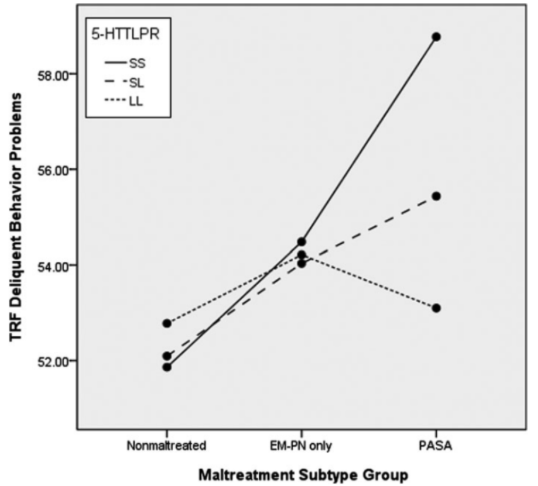
cicchetti et al. - child maltreatment on early antisocial behaviour, with effects of MAOA
looked at the serotonin transporter gene
if you look at self-reported CD symptoms or teacher reports, the interaction between maltreatment and the gene is the same
interactions seems to hold no matter who the informant is

considering the nature of MT
emotional maltreatment - no difference between three groups of genotype
clear differentiation in the last maltreatment sybtype
nature of maltreatment may be important
lecture summary
genetic (50%) and environmental (50%) influences on ASB
those influences differ from subtypes of antisocial youths (CU traits)
different forms of ASB under genetic influence
genetic and environmental factors interact to predict ASB
MAOA and maltreatment
sex effects
5-HTTLPR and SES