isomerism
 Call Kai
 Learn
Learn Practice Test
 Spaced Repetition
 Match
Match Flashcards
 Knowt Play
1/9

There's no tags or description
Looks like no tags are added yet.
Name | Mastery | Learn | Test | Matching | Spaced | Call with Kai | Chat |
|---|
No analytics yet
Send a link to your students to track their progress
10 Terms
what is isomerism
different compounds with the same molecular formula
what is stereoisomerism
isomers of identical consultation but differing in arrangement of their atoms in space.
what are enantiomers
Stereoisomers that are non - superimposable mirror images of each other (mirror versions that cannot be made identical)

how do we determine if an enantiomer is R or S for chiral centres/ explain how absolute configuration is determined
the 4 groups surrounding the chiral centres are ranked 1-4 using cahn-ingold-prelog rules
group 1 is going to have the highest priority
Group ranking is based on atomic number
lowest atomic number is going to be ranked 4 and it should point away from you
starting from 1 and go 2 to 3 if you go clockwise = R configuration
If you anti - clockwise you use S configuration
what is a racemic mixture
when both enantiomers are present in equal amounts
if you need to do R or S configuration and 2 atoms are the same what do you do

if H group is connected to wedge and not dashed line what happens to configuration
you work it out and then switch the answer you just got
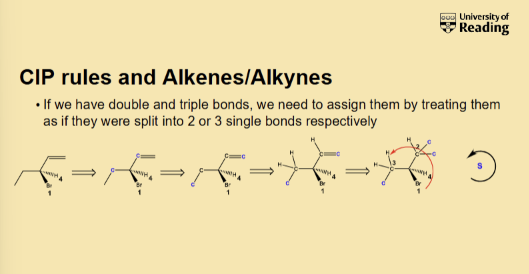
what are the CIP rules for alkenes and Alkynes
Describe the key types of isomerisation that could impact the pharmacological action of drug molecules.
Enantiomers are non superimposable mirror images of each other. They have the same molecular formula and connectivity but differ in their 3d arrangement around a chiral centre. As biological receptors are chiral the enantiomers may have different pharmacological effects
E/Z Isomerism - carbon to carbon double bonds where rotation is restricted. E isomers are highest priority groups
Z isomers are on the same side. The difference in shape can affect how a drug binds o biological target
Diastereomers are stereoisomers that are not mirror images of each other. They have different physical properties and may also differ in their biological activity.
Explain why carbon–carbon double bonds have stereochemistry and how we distinguish between the two stereoisomers. (4 marks)
Restricted rotation: A carbon–carbon double bond consists of one sigma (\(\sigma\)) bond and one pi (\(\pi\)) bond. The pi bond prevents free rotation around the double bond.
Different arrangements: If each carbon atom is bonded to two different groups, two distinct spatial arrangements are possible, giving rise to stereoisomers.
E/Z notation: The stereoisomers are distinguished using the Cahn–Ingold–Prelog (CIP) priority rules, which assign priority to the groups attached to each carbon.
Identifying the isomers: If the higher-priority groups are on the same side of the double bond, the isomer is Z (zusammen). If they are on opposite sides, the isomer is E (entgegen).