RESP 220 quiz 3 study guide
 Call Kai
 Learn
 Practice Test
 Spaced Repetition
 Match
 Flashcards
 Knowt Play
1/39

There's no tags or description
Looks like no tags are added yet.
40 Terms
what are the causes of neonatal bradycardia
apnea
hypoxia
heart conditions
tension pneumothorax
what are the 6 causes of tachypnea for neonatal assessment?
Causes:
Transient Tachypnea of the Newborn
(most common)
Meconium Aspiration Syndrome
Air Leak Syndrome
Respiratory Distress Syndrome (Premies)
Infectious PNA
Congenital Heart Disease
tachypnea differentials: TTN (transient tachypnea of newborn)
most common
Clinical:
Short labor
C-section delivery
Tachypnea onset:
At birth
not severe
CXR:
Fluid in fissures
central congestion
tachypnea differentials: MAS (meconium aspiration synfrome)
Clinical:
Meconium stained amniotic fluid
Tachypnea onset:
At birth
can be severe
CXR:
Infiltrates
tachypnea differentials: RDS (respiratory distress syndrome)
Clinical:
Premature
Tachypnea onset:
At birth
worsening gradually
CXR:
Ground glass
tachypnea differentials: air leak
Clinical
May be premature
or MAS
Tachypnea onset:
Sudden onset
severe
CXR:
Pneumothorax
pneumomediastinum
tachypnea differentials: infectious PNA
Clinical:
Prolonged rupture of membranes
maternal Group B Strep
prematurity
• Tachypnea onset:
May mimic any disorder
• CXR
Infiltrates
or hazy
may mimic RDS
tachypnea differentials: CHD (congenital heart disease)
Clinical:
Unremarkable
Tachypnea onset:
Minimal tachypnea
worsening w/ PDA closure
• CXR:
Normal
or CHF
heart may be unusual
what are the 4 mechanisms of heat loss and
conduction
convection
radiant
55% of all heat loss
evaporative
22% of all heat loss
also includes
sweating
vasodilation
defineconduction
definition: direct heat loss to cooler surface in contact with the baby
ex: x-ray plate
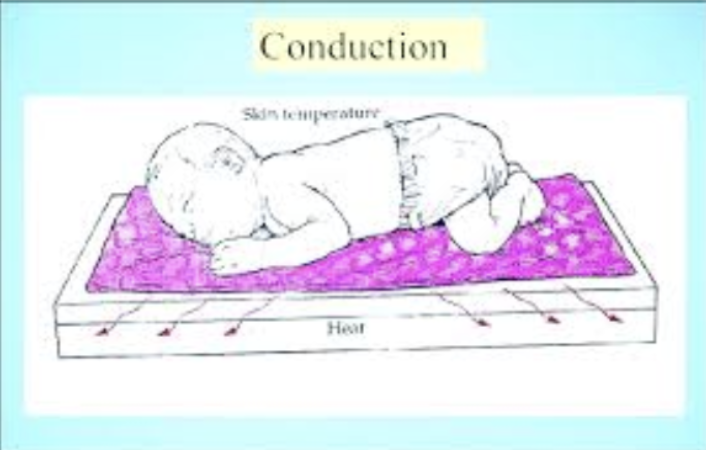
how do you prevent conduction
prevent:
Place warm blanket between infant and surface
Prewarm bed, scale
Porta-warm mattress
Plastic glove filled with warm water
defineconvection
Heat loss to cooler surrounding AIR (drafts, inspired air)

how do you prevent conduction
PREVENT!:
Keep delivery room and nursery warm
Keep infant from drafty areas
Keep sides of table up
Warm inspired gases!!
Cover infant’s head
Use sleeves on isolette portholes
defineradiant heat loss
Loss of heat to cooler surface NOT in contact ie: incubator walls
how do you prevent radiant heat loss
PREVENT:
Avoid putting baby near cold walls/windows
Heat shield over infant
Heat lamp (not much though, or you’ll dry the baby out!
Blanket over isolette
Line isolette with foil
Double-walled incubators

define evaporative heat loss
Occurs when a liquid becomes a gas (sweating)
AVOID:
Dry infant immediately after birth
how to prevent evaporative heat loss
Bathe infant after temp. has stabilized
Dry well after bathing
Warm all soaks/solutions placed on infant
what are the consequences of cold stress
Hypoxemia due ↑ O2 consumption
Hypoglycemia
Apnea
Metabolic acidosis
↑ calorie consumption = ↓ weight gain
what are the consequences of heat stress
Peripheral vasodilation
Apnea
↑ evaporative loss of fluid
↑ O2 consumption
I give you the disease, you tell me the type of x-ray abnormality: underinflation
PRDS
PNA
other diseases that cause atelectasis
Count the ribs!! T-8 or higher may be hypoventilation
T7 is definitely hypoinflation
I give you the disease, you tell me the type of x-ray abnormality: overinflation
Transient Tachypnea of the Newborn (TTN)
Overzealous mechanical ventilation
Lungs fields appear over expanded
Diaphragms are flattened
Intercostal spaces are wider
Heart margin may be narrowed
Pulmonary markings are forced back toward hilar areas
I give you the disease, you tell me the type of x-ray abnormality: asymmetrical
Pneumonia
Aspiration Pneumonia
Meconium Aspiration
Diaphragmatic Hernia
Extraventilatory Air
Pneumothorax
Pulmonary Air Leak Syndromes
I give you the disease, you tell me the type of x-ray abnormality: cardiac
Cardiomegaly
Various congenital heart diseases
what diseases in the power point may feature a pleural effusion.
Transudative:
Cardiac origin
Exudative:
Pneumonia
Cancer
MAS
how do you determine the appropriate ETT size
Use baby’s weight or gestational age – UNCUFFED tube in most instances for ETT size
a. <800 gms (22-25 wks) = 2.5 ET tube
b. 800-1200 gms (<28 wks) = 2.5 ET tube
c. 1201-2200 gms (28-34 wks) = 3.0 ET tube
d. >2200 gms (>34 wks) = 3.5 tube
how do you determine the appropriate ETT depth
ETT depth
Weight in kg + 6 cm at upper gum line
Measure from nasal septum to ear tragus and add 1 cm (NT length + 1 cm)
what are the indications for intubation
PPV
does not provide clinical improvement (HR remains < 100)
has gone on for more than a few minutes
Strongly recommended before chest compressions become necessary
Chest compressions are necessary
Baby has diaphragmatic hernia
Surfactant installation is required
Direct tracheal suction is required (meconium aspiration)
Blotchy, uneven color caused by decreased
perfusion
LMA may be used if ET intubation in a >2 kg newborn if intubation is unsuccessful
what are the descriptions and conditions indicated for the following dermal signs: Mottling
Blotchy, uneven color
caused by
↓ perfusion
what are the descriptions and conditions indicated for the following dermal signs: Ruddy
Deep, reddish skin color
caused by
polycythemia or
high hematocrit value
what are the descriptions and conditions indicated for the following dermal signs: Petechiae
Pinpoint hemorrhcagic areas
caused by
birth trauma
or thrombocytopenia
what are the descriptions and conditions indicated for the following dermal signs: Pallor
Pale or white skin
caused by
blood loss or
hypovolemia
what information can be obtained by palpating an infant’s pulse
Weak pulse:
low QT
Bounding pulse:
PDA
Weak or delayed femoral pulse
coarctation of the aorta
5 conditions of a newborn given, what is the Apgar Score
HR
Respiratory Effort
Color
Reflex irritability
Muscle Tone

Apgar: HR
HR
0
none
1
<100
2
>100
Apgar: RR or respiratory effort
Respiratory Effort
0
none
1
weak
irregular
2
strong cry
Apgar: color
Color
0
pale
blue
1
body pink
extremities blue
2
pink
Apgar: relex irritability
Reflex irritability
0
no response
1
grimace
2
cry
cough
sneeze
Apgar: muscle tone
Muscle Tone
0
limp
1
some flexion
2
well flexed
You have been called to the delivery room. There is a 41 week, 3.5 kg baby who just underwent csection
due to late deceleration of the heart rate during contractions. The baby is under the radiant
warmer. Initial steps of resuscitation have been done. There is no evidence of meconium. Baby has
acrocyanosis but is pink centrally with labored respirations and moderate, 3 point retractions.
SpO2 is 75% at 5 minutes of life. HR is 130. What should you do first?
A. Request a cardiac consultation
B. Give blow by oxygen with FiO2 titrated to normalize SpO2
C. Get a capillary blood gas
D. Get a chest X-ray
E. Give exogenous surfactant
F. Give mask CPAP of 5, titrate FiO2 to normalize SpO2
G. Auscultate breath sounds
H. Suction the baby.
You have just received a 3.5 kg (3500 gm) newborn s/p hypoxic event during delivery. The baby is
intubated and being ventilated in volume control. The baby has a 2.5 ET tube that is secured at 9.5
cm with the blue line midline. The ventilator keeps alarming for low minute volume. What should
you do first?
A. Get a chest X-ray
B. Auscultate breath sounds
C. Make sure the chest is rising
D. Use the CO2 detector
E. Check the baby’s vital signs
F. Switch to pressure control ventilation
G. Reintubate with a 3.5 or 4.0 ET tube
H. Adjust the blue line to the left