Maya - Dental Anatomy: Posterior Teeth, Occlusion & Tooth Morphology
 Call Kai
 Learn
 Practice Test
 Spaced Repetition
 Match
 Flashcards
 Knowt Play
1/61

There's no tags or description
Looks like no tags are added yet.
62 Terms
Which teeth are posterior teeth, and what are their 3 general characteristics?
Premolars + molars
1. Multi-rooted (except some premolars)
2. Used for chewing food
3. Have occlusal surfaces
Universal numbering system: what is it also called, and how does numbering run?
"American system (Universal/ADA)
#1 maxillary right 3rd molar → #16 maxillary left 3rd molar → #17 mandibular left 3rd molar → #32 mandibular right 3rd molar"
Universal numbers of the molars? (order: UR, UL, LL, LR)
"1st molars: #3, 14, 19, 30
2nd molars: #2, 15, 18, 31
3rd molars: #1, 16, 17, 32"
Universal numbers of the premolars?
"Maxillary 1st: #5 (R), #12 (L)
Maxillary 2nd: #4 (R), #13 (L)
Mandibular 1st: #28 (R), #21 (L)
Mandibular 2nd: #29 (R), #20 (L)"
Posterior eruption: which teeth erupt first and last, and what is the general sequence?
First: 1st molars
Last: 3rd molars
Sequence: 1st molar → premolars → 2nd molar → 3rd molar
(Know the sequence, not the age ranges)

Positive vs negative anatomy, and which is built first when restoring?
Positive: raised/convex areas (elevations)
.
Negative: depressed/concave areas (depressions)
.
Restoring: build positive anatomy first, which then properly displays the negative anatomy
Which posterior features are positive anatomy, and which are negative?
Positive: cusps, marginal ridges, triangular ridges, height of contour, transverse ridge, oblique ridge
.
Negative: fossa, pits, primary grooves, secondary grooves
What is the occlusal table, and which teeth have the largest?
"The surface of a posterior tooth that contacts the opposing tooth; the grinding surface that breaks down food
Largest on molars

Define a cusp and the rule for naming cusps.
Pointed elevation or mound on the crown
Name the proximal surface first, then the other axial surface (e.g., mesiobuccal)
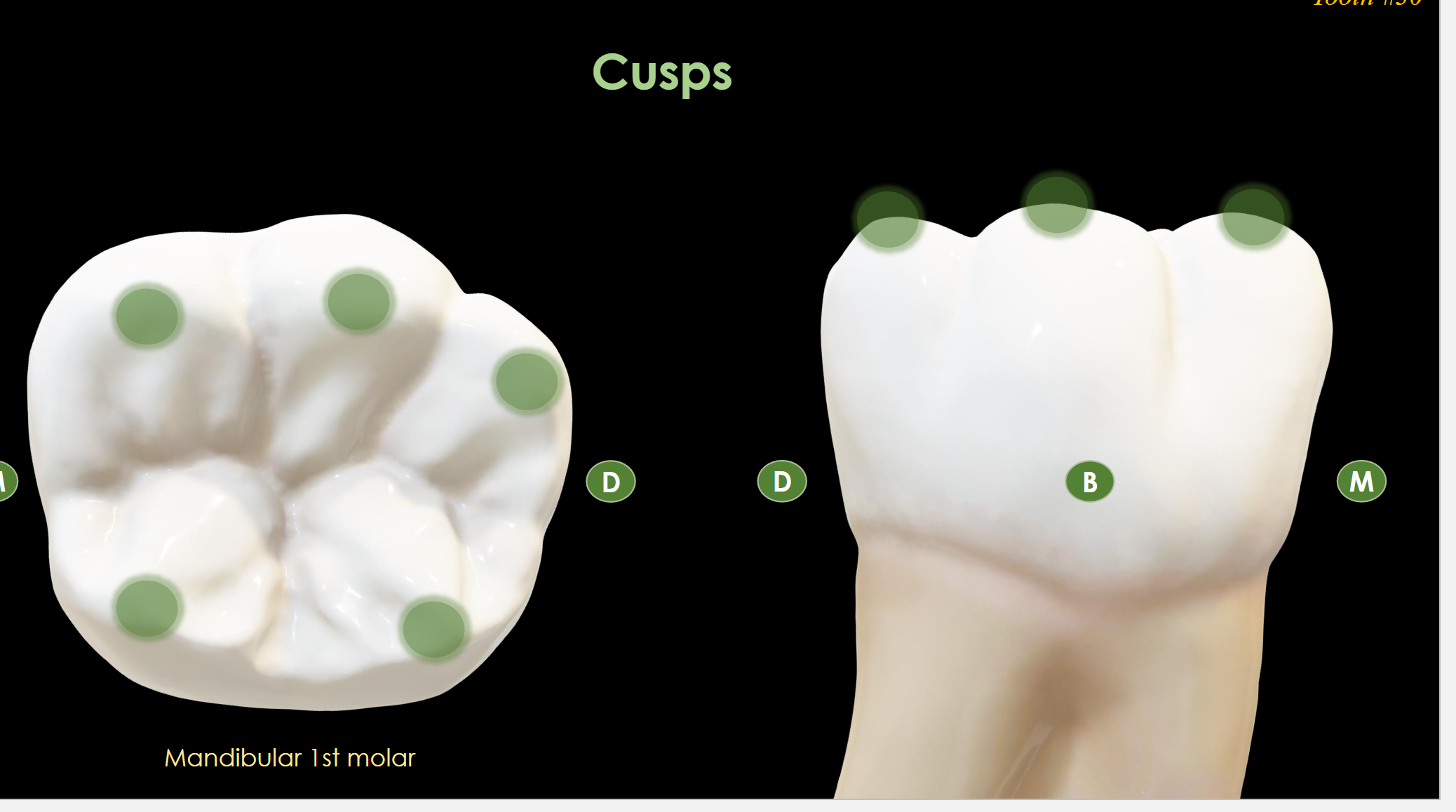
How many cusps do canines, premolars, and molars have?
Canines: 1 (cuspid)
Premolars: 2 (bicuspid)
Molars: 4-5
Cusp tip vs cusp slopes, and how many ridges support each cusp?
Cusp tip: highest (pointy) point
Cusp slopes/ridges: mesial and distal sides of the cusp
Each cusp is built by 4 ridges from the tip, like a 4-sided pyramid
Define a ridge and list the 5 types on posterior teeth.
"Linear elevation of positive anatomy on the crowns of all teeth
.
1) Cusp slopes/ridges,
2) triangular
3) marginal
4) transverse
5) oblique
What is a triangular ridge, and which cusps have one?
"Ridge descending from the cusp tip of molars/premolars toward the center (central groove) of the occlusal surface
Every cusp has one

What are marginal ridges, and where are they relative to the contact?
"Rounded enamel borders forming the mesial and distal margins of the occlusal surface
Located above the contact; they do not form it (teeth don't touch at the marginal ridges)

Restoring marginal ridges: common mistake, and what a Class II restoration must re-create?
Mistake: high contact at the marginal ridges → false contact + inability to floss
.
Class II prep restores the contact and embrasure along with the marginal ridge

What is a transverse ridge, and where is it found?
Union of 2 triangular ridges (buccal cusp + lingual cusp) crossing transversely
ONLY on posterior teeth; present in multiple posterior teeth
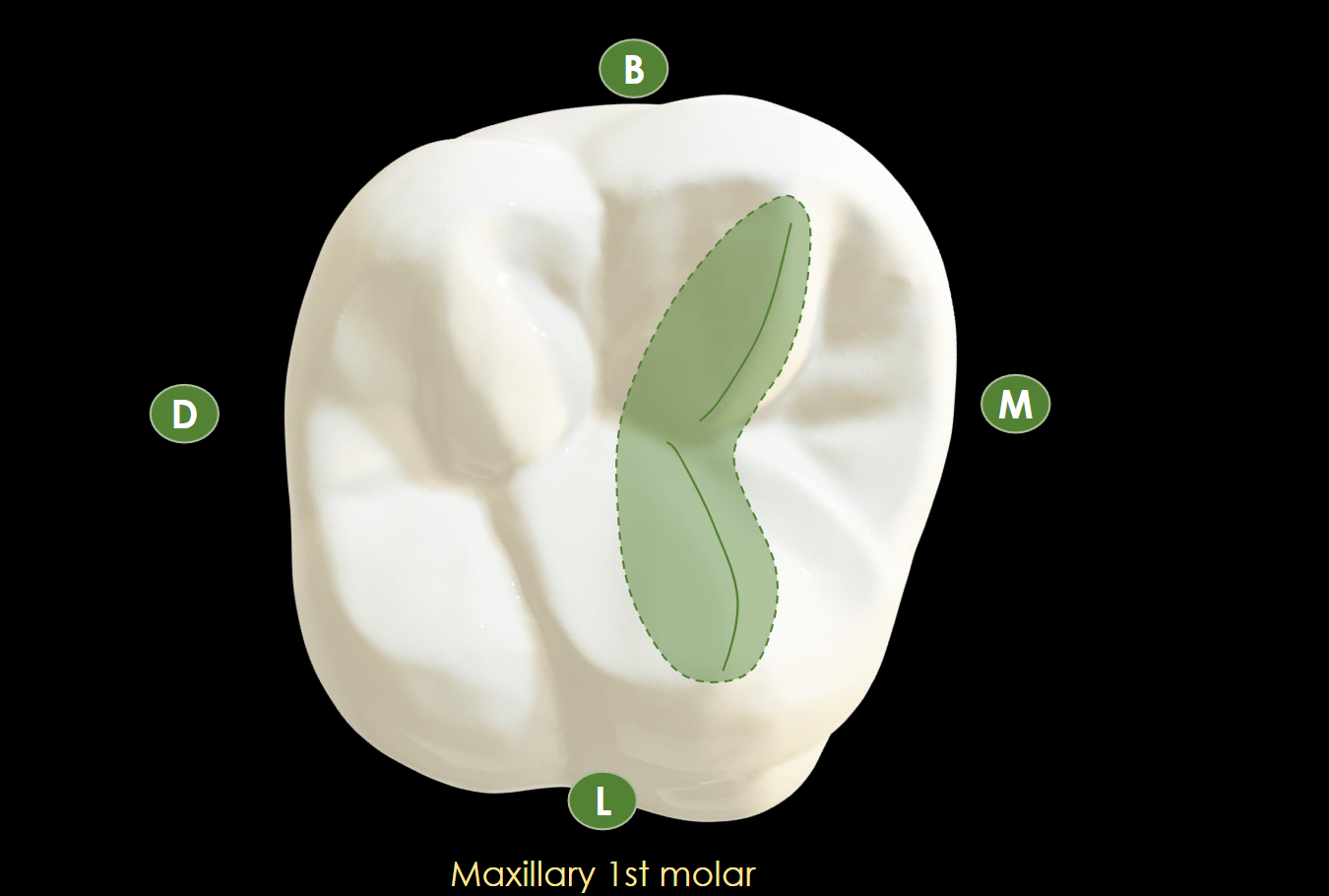
What is the oblique ridge, and where is it found?
"Unique to maxillary molars
Triangular ridge of the DB cusp + distal ridge of the ML cusp, crossing the occlusal surface obliquely

What is the height of contour, and why does it matter?
Crest of curvature: greatest convexity/bulge farthest from the root axis line
- Important for protecting the gingiva

Correct vs over-contoured vs under-contoured height of contour?
Correct: keeps food out of the gingival sulcus; proper gingival protection and stimulation
.
Over: food deflected away → under-stimulation of gingiva → breakdown
.
Under: food impaction + over-stimulation → trauma to gingival attachment

Fossa vs pit, and how do pits form?
"Fossa: irregular depression/concavity
.
Pit: pinpoint enamel depression at the bottom of a fossa, at the junction/end of a developmental groove (a groove usually ends in a pit)
.
Each cusp is a lobe; lobes fuse to form the pit

Define a groove, how developmental grooves are named, and auxiliary grooves.
Groove: linear occlusal depression dividing the primary parts of the crown (usually cusps)
.
Developmental grooves: named by location
.
Auxiliary grooves: branch off primary/developmental grooves

What is a line angle, and what are the line angles of a posterior tooth?
"Junction of 2 surfaces, named for both
Mesio-occlusal, disto-occlusal, bucco-occlusal, linguo-occlusal, mesiobuccal, distobuccal, mesiolingual, distolingual

What is a point angle, and what are the point angles of a posterior tooth?
"Junction of 3 surfaces
Mesiobucco-occlusal, distobucco-occlusal, mesiolinguo-occlusal, distolinguo-occlusal

Embrasures: definition, locations, and functions?
"V-shaped space formed by the contact between adjacent proximal surfaces; named by location
Occlusal, cervical/gingival, buccal (facial), lingual
Functions: spillway for food during chewing; part of self-cleaning

What do proximal contact areas do, and how do they look occlusally?
Maintain/stabilize arch form
Prevent food debris accumulation and impaction
Protect the interdental papilla
Occlusal view: convex contact areas
Where are posterior proximal contacts located, and what shape are they?
"Middle third occlusocervically
Slightly facial of center faciolingually (a few exceptions)
More circular than anterior contacts
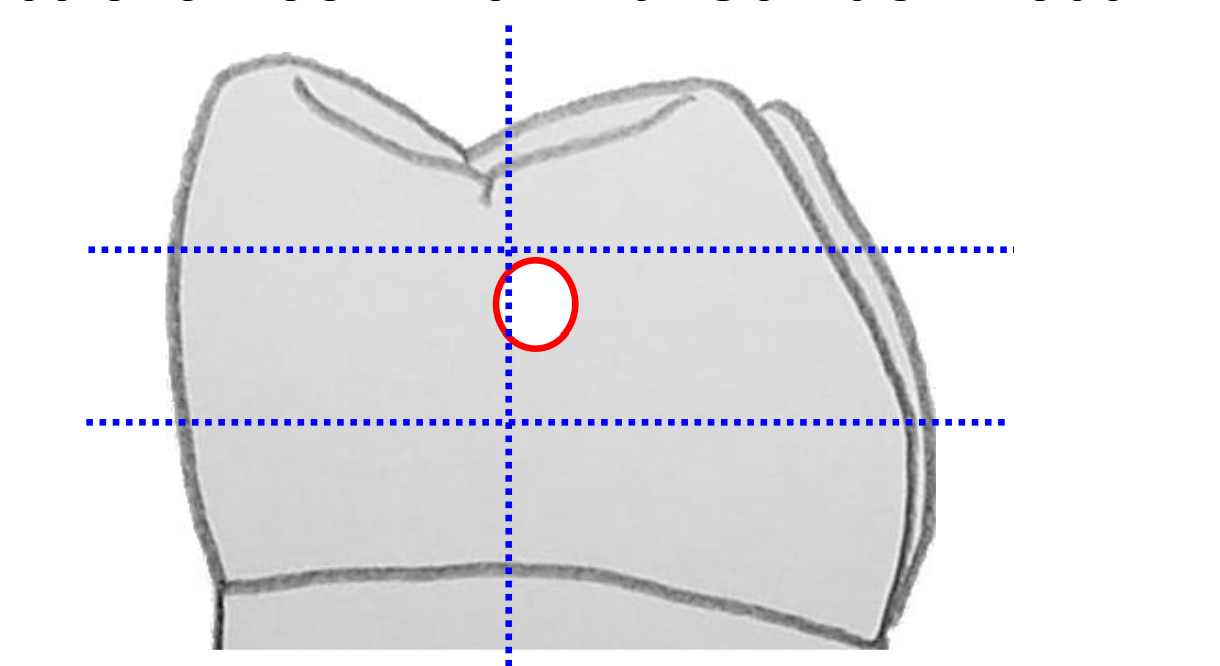
How do proximal contacts change moving posteriorly, and how do premolar vs molar contact heights compare?
They get wider and more gingival
Premolars have longer crowns, so molar contacts (still middle third) sit at a more occlusal level of the crown
Arch-specific posterior contact details (maxillary vs mandibular)?
"Maxillary: facial placement more evident on premolars; 1st-2nd molar contact almost centered
Mandibular: molar contacts slightly more facial than maxillary; distal contact of the 1st molar is made entirely by its distal cusp"
Surface terms: posterior vs anterior outer surface, and the back of maxillary teeth?
Posterior: buccal; anterior: facial
Maxillary back surface: lingual and palatal are interchangeable
"Maxillary 1st premolar (#5, #12): outline, crown, roots, cervical line, contact?"
"Hexagonal outline
Crown wider buccally than lingually
2 roots
Cervical line curves more on the mesial
Contact area more facial

Maxillary 1st premolar: cusps and mesial features?
"Buccal cusp long, pointy, higher than the shorter, rounded lingual cusp
Buccal slopes nearly equal; mesial slightly longer
Mesial marginal developmental groove (in enamel of the MMR)
Mesial concavity/depression to accommodate the canine
How do you tell right from left maxillary 1st premolar?
Mesial cusp ridge longer than distal
Mesial developmental groove in the mesial marginal ridge
Mesial developmental depression
Root tip points distally
"Maxillary 2nd premolar (#4, #13): outline, size, roots, cervical line?"
"Oval (no prominent line angles)
Greater distance between cusps → larger occlusal table
Shorter crown than 1st premolar
1 root
Cervical line curves more on the mesial"
Maxillary 2nd premolar: cusps and grooves?
"Buccal cusp less pointed; mesial slope shorter than distal
Buccal and lingual cusps almost equal in size/height
No mesial groove; shorter central groove; multiple auxiliary grooves"
Maxillary premolars: landmarks at each end of the central developmental groove, and the 2nd premolar's triangular grooves?
Mesial pit in the mesial triangular fossa; distal pit in the distal triangular fossa
2nd premolar triangular grooves: mesiobuccal, mesiopalatal, distobuccal, distopalatal
How do you tell right from left maxillary 2nd premolar?
Mesial slope of buccal cusp shorter than distal
Cusp tip slightly shifted mesially
Root tip points distally
"Mandibular 1st premolar (#21, #28): outline, cusps, occlusal surface?"
"Roughly diamond; crown tapers lingually
2 cusps: buccal larger; lingual small with pointed tip
Occlusal surface slopes lingually; central pit not defined
Prominent MB and DB line angles
Cervical line curves more on the mesial"
Mandibular 1st premolar: key groove and marginal ridge features?
"Mesiolingual developmental groove to the mesial fossa: the R/L identifier and an exam pick
MMR merges with the ML fossa and sits more cervically than the DMR
No developmental groove on the DMR"
"Mandibular 2nd premolar (#20, #29): what are its two forms?"
"2-cusp: rounded outline
3-cusp (1 buccal + 2 lingual): square outline, lingual groove between the lingual cusps, DL smaller than ML"
Mandibular 2nd premolar: how does it differ from the mandibular 1st premolar?
"Crown wider buccolingually
Buccal and lingual cusps almost equal
Outline square or triangular (not diamond)
Occlusal surface almost horizontal
Central pit defined (3-cusp form)
No mesiolingual groove"
Mandibular 2nd premolar: 3 central groove patterns?
"H, U, and Y"
How do you tell right from left mandibular 2nd premolar (3-cusp)?
DL cusp smaller than ML
Central fossa lies distally
Cervical line curvature less on distal than mesial
"Maxillary 1st molar (#3, #14): clinical significance?"
"First permanent tooth to erupt
Biggest tooth in the mouth
Cornerstone of the dental arch
Most caries prone (lower 1st molar even more so)"
Maxillary 1st molar: outline, cusps, roots?
"Rhomboidal; crown narrower distally than mesially
Cusp size: ML > MB > DB > DL (MB broader than DB; buccal cusps equal height)
3 roots: mesiobuccal, distobuccal, palatal"
Maxillary 1st molar: ridges, fossa, and grooves?
"Oblique ridge (prominent): distal ridge of ML + triangular ridge of DB
Transverse ridge: triangular ridges of ML + MB
Central fossa mesial to the oblique ridge
Buccal groove ends in middle third of buccal surface (buccal pit); lingual groove present"
What is the cusp of Carabelli, and where is it found?
Small extra (5th) cusp at the mesiolingual line angle, ~2 mm cervical to the ML cusp
Usually on maxillary 1st molars; progressively less likely on 2nd and 3rd
How do you tell right from left maxillary 1st molar?
Carabelli on the lingual side of the ML cusp
ML is the largest cusp
Oblique ridge runs from distal ridge of ML to DB cusp
"Maxillary 2nd molar (#2, #15): how does it differ from the 1st molar?"
"Crown shorter and narrower
Usually 4 cusps; no Carabelli
MB larger than DB (DB slightly smaller); buccal groove separates them
DL shorter/smaller
Oblique ridge less prominent
More auxiliary/supplemental grooves"
How do you tell right from left maxillary 2nd molar?
ML is the largest cusp
Small DL cusp
Occlusal surface tilts from mesial to distal
3rd molars: maxillary vs mandibular shape and cusps?
"Maxillary: heart-shaped, irregular, generally 3 cusps
Mandibular: round, irregular, generally 4 cusps
(Lecture note: won't be asked about wisdom teeth)"
Molar crown dimensions: maxillary vs mandibular?
Maxillary: wider buccolingually than mesiodistally
Mandibular: the opposite
"Mandibular 1st molar (#19, #30): outline and cusps?"
"Hexagonal; wider buccolingually on the mesial; larger MD than 2nd molar
5 cusps: 3 buccal (MB widest, DB, D smallest) + 2 lingual (ML wider than DL)"
Mandibular 1st molar: grooves, ridges, roots?
"2 buccal grooves + lingual groove; Y-shaped pattern; central pit not centered
No transverse ridges
2 roots (mesial, distal); mesial more curved"
How do you tell right from left mandibular 1st molar?
MB cusp widest; distal cusp smallest
Occlusal surface tips slightly distally
Roots tipped distally
"Mandibular 2nd molar (#18, #31): outline and cusps?"
"Rectangular; crown shorter and narrower; smaller MD than 1st molar
4 cusps; DB shortest"
Mandibular 2nd molar: grooves, ridges, roots?
"Buccal + lingual grooves form a cross (+); no DB groove; central pit centered
Transverse ridges: MB + ML and DB + DL triangular ridges
2 roots (mesial, distal)"
How do you tell right from left mandibular 2nd molar?
"Prominent enamel at the mesiobuccal corner
Crown tilts distally, so the occlusal surface slopes cervically from mesial to distal"
"Practice: Arch, tooth, side, number?"
"Maxillary, 1st molar, left → #14"
"Practice: Arch, tooth, side, number?
"
"Mandibular, 2nd premolar, right → #29"
"Practice: Arch, tooth, side, number?"
"Maxillary, 1st premolar, left → #12"
"Practice: Arch, tooth, side, number?"
"Mandibular, 1st molar, left → #19"
"Practice: Arch, tooth, side, number?"
"Mandibular, 1st premolar, right → #28"