UNIT 6 - dental materials fundamentals
 Call Kai
 Learn
Learn Practice Test
 Spaced Repetition
 Match
Match Flashcards
 Knowt Play
1/265

There's no tags or description
Looks like no tags are added yet.
Name | Mastery | Learn | Test | Matching | Spaced | Call with Kai | Chat |
|---|
No analytics yet
Send a link to your students to track their progress
266 Terms
What are dental materials?
The necessary elements for practising the profession related to teeth, that is, dentistry.
What is biocompatibility?
The ability of a material to elicit an appropriate biological response in a specific application within the body.
What does toxicity describe in relation to a dental material?
The potential, related to the dose of a material, to cause cell or tissue death.
What is the earliest date mentioned in the historical overview of dental materials, and what happened then?
since 3000 BC, various materials have been used.
What evidence of dental materials is mentioned from 700 BC?
Documentary evidence involving the Etruscans.
What did Pfaff do in 1756 in the history of dental materials?
He made oral impressions with waxes.
What dental material development occurred in 1816?
Taveau placed the first dental amalgam.
What did Charles Goodyear invent in 1839?
Vulcanised rubber.
What happened in 1919 regarding dental amalgams?
The US military requested specifications for the evaluation and selection of dental amalgams.
What dental material was introduced in 1935?
Acrylic resins.
What did Bowen introduce in 1956?
The Bis-GMA particle, as stated in the source.
What is the role of the International Organization for Standardization (ISO) in relation to dental materials?
It creates standards and certifies products that meet specifications.
Which three categories of properties are considered when assessing a product for CE marking
Biological, physical and chemical properties.

classification of dental materials
According to the diagram, what are the six categories of dental materials classified by function?
Auxiliary materials, restorative materials, preventive materials, materials that stimulate tissue formation, and filling materials.

classification of dental materials
How are restorative materials subdivided in the classification diagram according to function?
Into direct and indirect restorative materials.
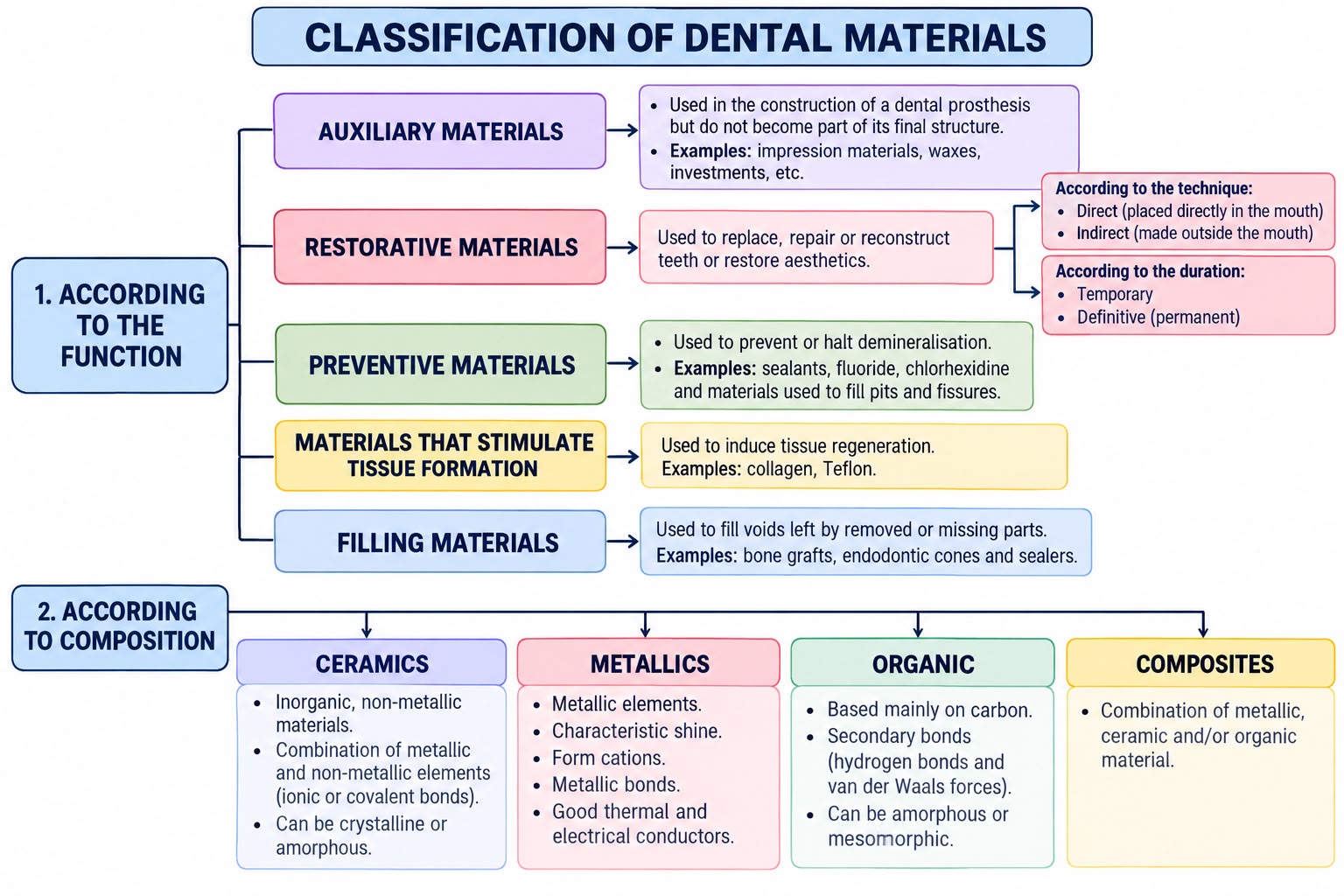
classification of dental materials
According to the classification diagram, what are the four categories of dental materials classified by composition?
Ceramics, metallics, organic materials and composites.

classification of dental materials
READ
DONE
Auxiliary materials
What are auxiliary dental materials?
Substances used in the construction of a dental prosthesis that do not become part of its final structure.
Auxiliary materials
What are three examples of auxiliary dental materials?
Impression materials, waxes and investments.
Auxiliary materials
Do auxiliary materials become part of the final structure of a dental prosthesis?
no
Restorative materials
Which four material types are identified as restorative material
Metal, ceramic, metal-ceramic and resin.
Restorative materials
What are the purposes of restorative dental materials?
To replace, repair or reconstruct teeth and/or restore their aesthetics.
Restorative materials
What are restorative dental materials?
Metal, ceramic, metal-ceramic or resin substances used to replace, repair or reconstruct teeth and/or restore their aesthetics.
classification of restorative materials
What are the four categories of restorative material
Direct restorative materials,
indirect restorative materials,
temporary restorative materials
and permanent restorative materials.
classification of restorative materials
Which categories of restorative materials are distinguished according to how they are used?
Direct and indirect restorative materials.
classification of restorative materials
Which categories of restorative materials are distinguished according to how long they are intended to be used?
Temporary and permanent restorative materials.
Direct restorative materials
What are direct restorative materials made from
Cement, metal or composite resin.
Direct restorative materials
How are direct restorative materials used to restore teeth or enhance aesthetics?
They are shaped and applied intraorally.
Direct restorative materials
Where are direct restorative materials shaped and applied?
Inside the mouth (intraorally).
Direct restorative materials
What are the two purposes of direct restorative materials?
To restore teeth or enhance aesthetics.
Indirect restorative materials
What materials can be used to make indirect restorative materials?
Cement, metal, porcelain or composite resin.
Indirect restorative materials
Where are indirect restorative materials used to construct prosthetics?
Extraorally, outside the mouth.
Indirect restorative materials
What are the three purposes of prosthetics made using indirect restorative materials?
To replace missing teeth, restore damaged teeth or enhance aesthetics.
Indirect restorative materials
What distinguishes indirect restorative materials from direct restorative materials in terms of where they are used?
Indirect restorative materials are used extraorally to construct prosthetics, whereas direct restorative materials are shaped and applied intraorally.
Temporary restorative materials
What materials are used for temporary restorations
Cement or composite resin.
Temporary restorative materials
How long may temporary restorative materials be used?
From a few days to several months.
Temporary restorative materials
What is the purpose of temporary restorative materials?
To restore or replace missing teeth or dental structure until a more durable reconstruction or prosthesis can be made.
Definitive restorative materials
Which materials can be used for definitive restorative materials?
Cement, ceramic, metal, metal-ceramic or composite resin.
Definitive restorative materials
What is the purpose of definitive restorative materials?
To permanently restore or replace missing teeth or dental structure.
Preventive materials
Which materials are included in the unit's classification of preventive dental materials?
Cement, sealants and restorative materials
Preventive materials
What are cement, sealants and restorative materials used for in dental prevention?
They are used to fill dental pits and fissures.
Preventive materials
Which two release agents are given as examples of preventive dental materials?
Fluoride and chlorhexidine.
Preventive materials
What is the purpose of release agents such as fluoride or chlorhexidine in preventive dental materials?
To prevent or halt the demineralisation of dental structure.
Materials that stimulate tissue formation (biomaterials)
What are materials that stimulate tissue formation also called
biomaterials
Materials that stimulate tissue formation (biomaterials)
What is the purpose of materials that stimulate tissue formation?
To induce tissue regeneration.
Materials that stimulate tissue formation (biomaterials)
Which two examples of bone regeneration materials are given
Collagen and Teflon.
Filling materials
What are filling materials used for?
To fill voids left by removed or missing parts, ensuring their integrity or complementing them.
Filling materials
What are examples of filling materials
Bone grafts, and cones and sealers for endodontics.
Filling materials
What is the purpose of filling materials in relation to voids left by removed or missing parts?
To fill the voids while ensuring the integrity of the remaining structure or complementing it.
Metallic materials
How does the unit describe metallic materials in terms of heat and electrical conductivity?
They are chemical elements that are good conductors of heat and electricity, with titanium stated as an exception.
Metallic materials
What characteristic appearance do metallic materials have according to the unit?
A characteristic shine.
Metallic materials
What is the physical state of metallic materials at room temperature
They are solid at room temperature, except for mercury.
ceramic materials
What are ceramic materials composed of
A metal and a non-metal.
ceramic materials
What types of bonds link the metal and non-metal in ceramic materials?
Ionic or covalent bonds.
ceramic materials
What types of structures can ceramic materials form?
Crystalline or amorphous structures.
Organic materials
What type of bonds form organic materials
Secondary bonds, forming molecules.
Organic materials
Which element is the primary constituent of organic materials?
Carbon.
Organic materials
What types of structures can organic materials form?
Mesomorphic and amorphous structures.
Composite materials
How are composite materials formed
By combining a metal, a ceramic and/or an organic material.
Composite materials
What example of a composite material
Dental composites.
solid
What is a solid
A body in which its particles, due to strong cohesion, maintain a defined position relative to those around them, preserving a constant shape and volume.
solid
Why do the particles in a solid maintain a defined position relative to the surrounding particles?
Because of strong cohesion.
solid
What two properties remain constant in a solid
Shape and volume.
Structures of solids
What determines the different structures that solids can have?
The relationship between their particles.
Structures of solids
What are the three types of solid structures
Crystalline, amorphous and mesomorphic.
Crystalline structures
What is a crystalline structure?
A geometrically ordered and regular distribution of particles, with a pattern that repeats in three dimensions.
Crystalline structures
How are particles arranged in a crystalline structure?
In a geometrically ordered and regular distribution.
Crystalline structures
In how many dimensions does the particle arrangement pattern repeat in a crystalline structure?
Three dimensions.
What is an amorphous structure?
A structure in which the particles are not geometrically ordered but are arranged randomly.
Amorphous structures
How are particles arranged in an amorphous structure?
Randomly, without geometric order.
Mesomorphic structures
What is a mesomorphic structure?
A structure observed in bodies that exhibit some level of particle arrangement, but on a very reduced scale.
Mesomorphic structures
To what extent are particles arranged in a mesomorphic structure?
They show some degree of arrangement, but only on a very reduced scale.
liquid
What happens to the shape of a liquid when it is placed in a container?
It adapts to the shape of the container.
liquid
What happens to the molecules in a liquid in terms of cohesion?
They have very little cohesion.
liquid
What remains constant in a liquid
Its volume.
liquid
What do liquids tend to do when placed in a container?
They tend to level out.
liquid
What is a liquid
A substance with a constant volume whose molecules have so little cohesion that they adapt to the shape of the container and tend to level out.
Gas
What is a gas
A fluid that tends to expand indefinitely and is characterised by its low density.
Gas
What are the two characteristics of gases
They tend to expand indefinitely and have low density.
Physical properties used to characterise dental materials - IMPORTANT
What are the two main categories of physical properties used to characterise dental materials?
Extensive properties and intensive properties.
Extensive properties - IMPORTANT
What are extensive properties?
Properties that depend on the quantity of matter making up the body.
Extensive properties - IMPORTANT
Which three extensive properties
Weight, volume and density.
Extensive properties - IMPORTANT
weight
What is weight
The force with which the Earth attracts an object.
Extensive properties - IMPORTANT
volume
What is volume
A physical quantity that expresses the extension of a body in three dimensions: length, width and height.
Extensive properties - IMPORTANT
volume
Which three dimensions describe the volume of a body?
Length, width and height.
Extensive properties - IMPORTANT
volume
What is the International System unit of volume?
The cubic metre ( m3 )
Extensive properties - IMPORTANT
Density
What is density
A quantity that expresses the relationship between the mass and volume of a body.
Extensive properties - IMPORTANT
Density
Which two quantities are related when calculating density?
Mass and volume.
Extensive properties - IMPORTANT
Density
What is the International System unit of density?
Kilograms per cubic metre ( kg/m3 )
Intensive properties -IMPORTANT
What are intensive properties?
Properties that do not depend on the quantity of matter.
Intensive properties -IMPORTANT
What are all the intensive physical properties used to characterise dental materials
Temperature
Heat of fusion
Specific heat
Thermal conductivity
Coefficient of thermal expansion (CTE)
Thermal diffusivity
Sag-resistance
Electrical conductivity and resistivity
Intensive properties -IMPORTANT
temperature
What is temperature
A physical quantity that expresses the degree or level of heat of bodies.
Intensive properties -IMPORTANT
temperature
What is temperature directly related to
The kinetic energy of the particles that make up the bodies.
Intensive properties -IMPORTANT
heat of fusion
What is heat of fusion
The amount of heat invested in a phase change without changing the temperature of the receiving body.
Intensive properties -IMPORTANT
heat of fusion
Which phase changes are given as examples of heat of fusion
A solid transitioning to a liquid, or a liquid turning into a gas or vapour.
Intensive properties -IMPORTANT
specific heat
What is specific heat?
The amount of heat per unit mass required for a substance to raise its temperature by one degree Celsius.
Intensive properties -IMPORTANT
thermal conductivity
What is thermal conductivity?
The property of bodies to transmit heat.

Intensive properties -IMPORTANT
thermal conductivity
read
done
Intensive properties -IMPORTANT
Coefficient of thermal expansion (CTE)
What is the coefficient of thermal expansion (CTE)?
The relationship between the change in length that a material experiences and the increase or decrease in temperature.
Intensive properties -IMPORTANT
Coefficient of thermal expansion (CTE)
What happens to a material's length when its temperature changes, according to the CTE concept?
Its length can increase or decrease as the temperature increases or decreases.