Expectations of the Profession, Practice Settings, and Career Pathways
 Call Kai
 Learn
Learn Practice Test
 Spaced Repetition
 Match
Match Flashcards
 Knowt Play
1/23

There's no tags or description
Looks like no tags are added yet.
Name | Mastery | Learn | Test | Matching | Spaced | Call with Kai | Chat |
|---|
No analytics yet
Send a link to your students to track their progress
24 Terms
What are three questions that help us understand OT practice settings?
- who runs the facility?
- what level of care is provided?
- who do we serve?
What are the three administration types?
**EXAM Q** and know what they provide and examples
- Public
- Private nonprofit
- Private for-profit
What is included in a public administration and what are some examples?
- federal (VA) **KNOW THIS**
- state
--> Cherry Hospital, Caswell Developmental Center, N.C. Dept. of Adult Correction
- county
--> local health department
What is included in a private nonprofit administration and what are some examples?
- reinvests revenue into services
- ECU Health, Atrium Health, etc.
- uninsured, underinsured, big traumas
What is a private for-profit administration and what are some examples?
- generates profit while providing healthcare
- HCA Healthcare-owned hospitals
Ex: Mission Hospital (Asheville), Blue Ridge Regional Hospital
Levels of Care (visual from slides)

Where do occupational therapists work across the continuum of care/what are the traditional settings?
- Early Intervention
- School
- Acute
- Inpatient Rehab
- SNF/Subacute
- LTAC
- Home Health
- Outpatient
- Long-term care
Early Intervention:
- Who are the clients?
- What is the OT focus?
- What is the primary goal?
- clients: infants and toddlers (birth-3yrs) with developmental delays or disabilities
- OT focus: development through play, daily routines, feeding, sensory processing, caregiver coaching
- primary goal: support participation in everyday family routines
*usually in home*

School:
- Who are the clients?
- What is the OT focus?
- What is the primary goal?
- clients: students receiving special education services
- OT focus: classroom participation, handwriting, self-care at school (feeding, toileting, etc.), assistive technology, environmental modifications, equipment management
- primary goal: support access to the educational environment

Acute Care:
- Who are the clients?
- What is the OT focus?
- What is the primary goal?
- clients: medically unstable or newly hospitalized patients
- OT focus: early mobilization, ADLs (usually basic ADLs), functional cognition, discharge planning
- primary goal: prepare for the next level of care
--> usually only a few goals
--> helping with immediate needs and determining what patient needs next
--> medical stability

Inpatient Rehab:
- Who are the clients?
- What is the OT focus?
- What is the primary goal?
- clients: medically stable patients with potential for significant functional improvement
- OT focus: intensive rehabilitation, ADLs, functional mobility, caregiver education
- primary goal: return home safely
*CAN TOLERATE AT LEAST 3 HOURS OF THERAPY PER DAY (OT, PT, SLP)*

Subacute Rehab:
- Who are the clients?
- What is the OT focus?
- What is the primary goal?
- clients: medically stable adults who still need rehabilitation but cannot tolerate inpatient rehab
- generally older patients
- OT focus: ADLs and functional mobility, strength and endurance, fall prevention, caregiver education, safe discharge planning
- primary goal: improve function to maximize independence and return to the least restrictive environment whenever possible
*don't quite have tolerance for 3 hours yet*
*typically housed within a SNF*

Outpatient Rehab:
- Who are the clients?
- What is the OT focus?
- What is the primary goal?
- clients: individuals who are medically stable and living in the community; seen after discharge from the hospital or referred by a provider
- OT focus: restore participation in meaningful occupations, improve strength, endurance, ROM, and functional use, address higher-level ADLs and iADLs, return to work, school driving, leisure, patient and caregiver education
- primary goal: help clients maximize independence and safely return to their desired roles and daily activities

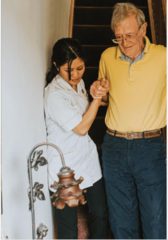
Home Health:
- Who are the clients?
- What is the OT focus?
- What is the primary goal?
- naturalistic environment
- clients: individuals who are medically stable but have difficulty leaving home due to illness, injury, or disability; receiving skilled services in their home environment
- OT focus: ADLs and iADLs in the home, home safety and fall prevention, functional mobility and transfers, adaptive equipment recommendations, caregiver education
- primary goal: promote safe, independent participation in daily occupations while allowing the client to remain in their home
What are some non-traditional and emerging practice settings?
- sometimes insurance will not cover these because they are not as established/evidenced
- Community and Population Health:
--> homeless shelters
--> senior centers
--> community wellness programs
- Work and Industry:
--> industrial rehabilitation
--> ergonomics
--> return-to-work programs
- Justice and Public Safety:
--> correctional facilities
--> community re-entry programs
- Specialty Practice:
--> hospice and palliative care
--> aquatic therapy
--> hippotherapy/equine
--> driver rehabilitation
--> assistive technology
What are some reasons why you should join a professional organization?
- stay current with evidence and best practices
- build your professional network
- advocate for the profession
- access continuing education
- develop leadership opportunities
American Occupational Therapy Association (AOTA):
- primary role?
- what does it provide?
- why should students care?
- optional but encouraged organization in the U.S.
- primary role: advances the occupational therapy profession in the United States
- what it provides: practice resources, continuing education, evidence-based publications, advocacy for the profession, national conference (INSPIRE)
- why students should care: student membership, networking, career resources, NBCOT exam preparation resources

National Board for Certification in Occupational Therapy (NBCOT):
- primary role?
- responsibilities?
OTR/L
- how we get registered as OTs
- primary role: protects the public by certifying entry-level occupational therapy practitioners
- responsibilities: develops and administers the certification exam, maintains the certification requirements, promotes continuing competency

World Federation of Occupational Therapists (WFOT):
- primary role?
- focus?
- primary role: represents occupational therapy WORLDWIDE
- focus: international collaboration, education standards, global advocacy, international conferences

North Carolina Occupational Therapy Association (NCOTA):
- primary role?
- what does it provide?
- why should students care?
- primary role: supports and advances the OT profession in NC
- what it provides: professional networking, continuing education opportunities, annual conference, leadership and volunteer opportunities, state advocacy for the profession
- why students should care: connect with OT practitioners across NC, develop leadership skills, access professional development opportunities

North Carolina Board of Occupational Therapy (NCBOT):
- primary role?
- responsibilities?
OTR/L
- primary role: protects the public by regulating OT practice in NC
- responsibilities: issues and renews licenses, establishes rules for practice, investigates complaints, enforces the NC OT Practice Act
What are some career pathways that can be taken after graduation?
- clinical practice
- academia
- research
- leadership and administration
- program development
- advocacy and policy
- private practice
What are the possible pathways for us after our MSOTs?
- post-professional OTD
- PhD
- EdD
- MBA
What are some areas where you can get speciality certifications?
- Certified Hand Therapist (CHT)
- seating and mobility
- low vision rehabilitation
- lymphedema
- Certified Brain Injury Specialist (CBIS)
- Assistive Technology Professional (ATP)