Parametric tests: Unrelated and related t-tests
 Call Kai
 Learn
 Practice Test
 Spaced Repetition
 Match
 Flashcards
 Knowt Play
1/5

There's no tags or description
Looks like no tags are added yet.
6 Terms
what are parametric tests?
when are unrelated t-tests use?
when are related t-tests use?
Parametric tests are statistical tests that assume the data is normally distributed and use interval or ratio data (actual numerical values).
Unrelated t-tests (independent t-tests) are used when you are comparing the means of two different groups of participants (independent design).
Related t-tests (paired t-tests) are used when you are comparing the means of the same participants in two conditions or matched pairs (repeated measures or matched pairs design).
Why the unrelated t-test?
The unrelated t-test is a test of d____ between two sets of data. It is used with i____ level data only.
When an i____ groups design is used, the test selected is the unrelated t-test.
In this worked example, we are looking for a difference in the time taken to complete a jigsaw puzzle between boys and girls. The type of design is independent groups (unrelated) because one group were girls and the other group were boys. The criteria for a parametric test were fulfilled: the level of measurement is interval as time taken to complete a jigsaw puzzle is measured on a safe scale (a scale of public measurement) made up of equal units. It is assumed that the participants are drawn from a normally distributed population and there is homogeneity of variance as the standard deviations in both groups are similar.
Why the unrelated t-test?
The unrelated t-test is a test of difference between two sets of data. It is used with interval level data only.
When an independent groups design is used, the test selected is the unrelated t-test.
In this worked example, we are looking for a difference in the time taken to complete a jigsaw puzzle between boys and girls. The type of design is independent groups (unrelated) because one group were girls and the other group were boys. The criteria for a parametric test were fulfilled: the level of measurement is interval as time taken to complete a jigsaw puzzle is measured on a safe scale (a scale of public measurement) made up of equal units. It is assumed that the participants are drawn from a normally distributed population and there is homogeneity of variance as the standard deviations in both groups are similar.
An investigation of gender looked into whether there was a difference in visuo-spatial ability between boys and girls. Ten girls and ten boys took part in the test which involved completing a simple jigsaw puzzle in the shortest time possible. The time it took for each participant was recorded and compared.
The hypotheses
what is the Alternative hypothesis?
what is the null hypothesis?
An investigation of gender looked into whether there was a difference in visuo-spatial ability between boys and girls. Ten girls and ten boys took part in the test which involved completing a simple jigsaw puzzle in the shortest time possible. The time it took for each participant was recorded and compared.
The hypotheses
Alternative hypothesis: There is a difference in the time taken by boys and girls to complete a jigsaw puzzle. (non-directional, two-tailed)
Null hypothesis: There is no difference in the time taken by boys and girls to complete a jigsaw puzzle.
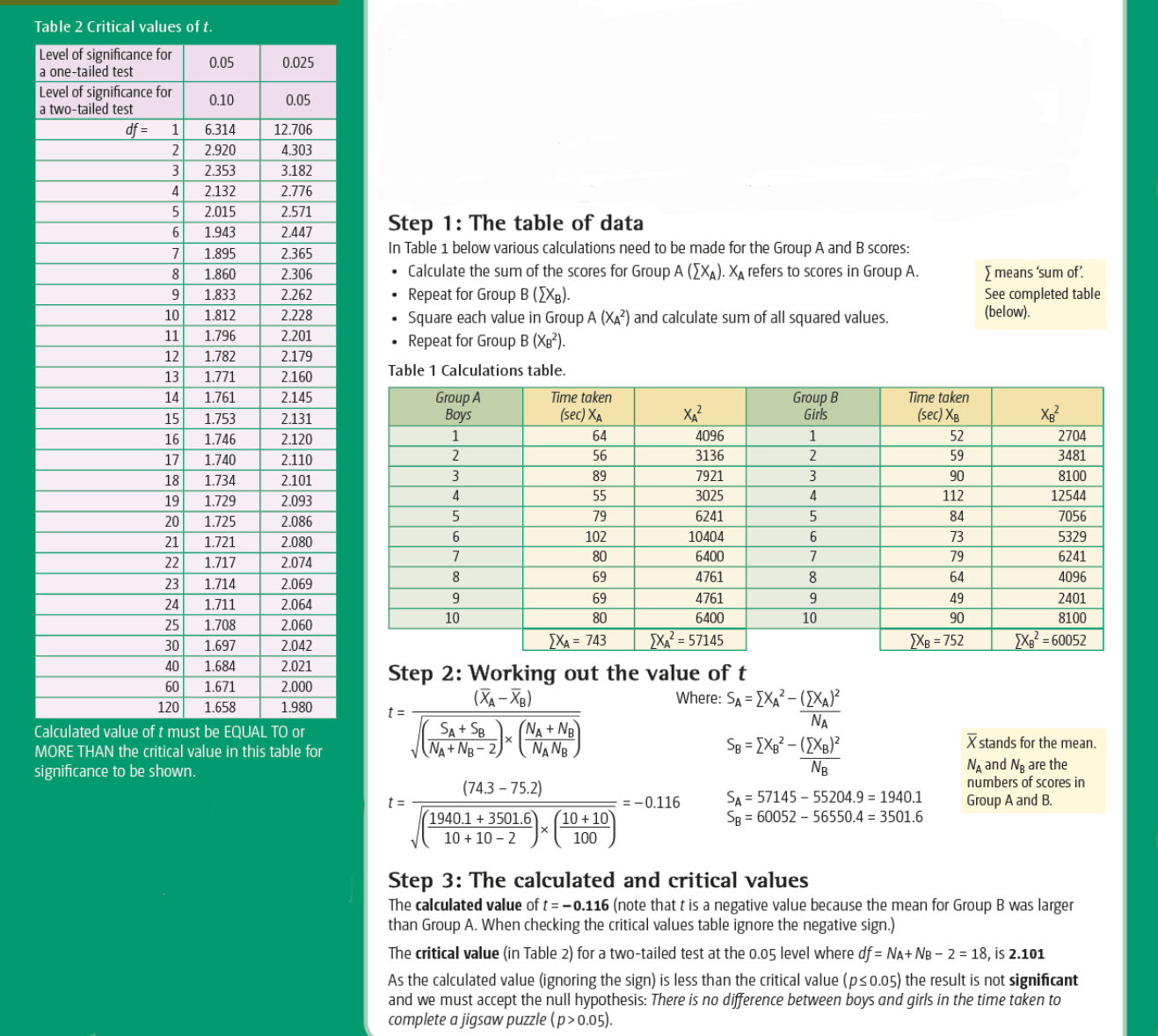
what are the steps to accepting or rejecting the null hypothesis?
Why the related t-test?
Related t-test is used with a r_____ design
Here, we are looking for a difference in the average heart rate before and after treatment (CBT). The type of design is repeated measures (related) because the same participants were tested t____.
The level of measurement is interval why?
The hypotheses
what is the alternative hypothesis?
what is the Null hypothesis?
Why the related t-test?
Related t-test is used with a repeated design
Here, we are looking for a difference in the average heart rate before and after treatment (CBT). The type of design is repeated measures (related) because the same participants were tested twice.
The level of measurement is interval as measurements of heart rate (beats per minute, bpm) are based on a 'safe scale (a scale of public measurement) made up of equal units. Let us assume for the purpose of this test that participants were drawn from a normally distributed population and homogeneity of variance between the two data sets is assumed as this is a related design.
The hypotheses
Alternative hypothesis: There is a reduction in heart rate activity when comparing heart rate before and after CBT. (directional, one-tailed)
Null hypothesis: There is no difference in heart rate activity comparing heart rate before and after CBT.
what are the steps to reacting or accepting the null hypothesis
