Economics (Micro) Sem 1
 Call Kai
 Learn
 Practice Test
 Spaced Repetition
 Match
 Flashcards
 Knowt Play
1/135

There's no tags or description
Looks like no tags are added yet.
136 Terms
What are 4 main assumptions of microeconomics?
Individuals aim at maximising personal satisfaction / utility
Decisions involve trade-offs
Opportunity cost exists
People respond to incentives
What is the total surplus?
The monetary measure of the value created by the exchange
Name some factors demand depends on:
Income
Trends/preferences
Price of substitutes
Availability of the good
Quality
Macroeconomic context e.g. recession
Credit availability
Taxes
How do we represent demand mathematically as a function
QDi = D(Pi, other factors)
for good i
What is an eNDOgenous variable?
iNternal to the function. e.g. price and quantity demanded
Changes in reaction the model
What is an eXOgenous variable?
eXternal to the function e.g. consumer incomes / weather
Imposed on the model as fixed
Name some factors that quantity supplied depends on
The demand
The price of inputs e.g. raw materials + labour
Competitors
Taxes/subsidies
Credit available
Natural events
How to write the inverse demand and supply functions
When instead of having Q as the subject of the demand and supply functions, you make P the subject
Define a consumption bundle
A list of goods/services that an individual consumes over a period of time
What is the ranking principle of bundles?
Given two bundles, the consumer always knows the ranking (A>B, A~B, A<B)
What is it called when if A<B and B<C then A<C?
preferences are negatively transitive
What is the more-is-better principle (non-satiation)?
A>B if the quantity of good x is larger in A than B and good y is larger or equal in A than B
What is the preference for variety or convexity?
If B>A and C is obtained as an average of B and A, C>A → consumers like variety
Goods can be of 2 kinds: (divisible)
Indivisible (a movie)
Divisible (you can buy fractions of kg, litres)
Define an indifference curve
A curve that contains all bundles that are indifferent with respect to A
What are three properties of indifference curves?
They are thin - if they were thick then a point above point A could be seen as the same utility as A, however, xA < xB and yA<yB so the indifference principle tells us the curve must be thin
They do not slope upwards - again, if they went upwards, a bundle with greater X and Y quantities would be seen as A~B which is impossible
They are convex - due to preference for variety
What are two properties of families of indifference curves?
They do not intersect
Indifference curves closer to the origin correspond to lower satisfaction

What is the utility function U used for
To express consumer preferences
U is an ___ ____ that tells us if a bundle …
U is an ordinal concept that tells us if a bundle gives more or less welfare than another
What do the variables in the Stone-Geary U function mean? u(x,y) = (x + σ)α (y + σ)β
x,y = quantity of each good
α,β = importance given by the consumer to goods x and y
σ = substitutability between x and y
What does a high σ mean and what does it look like on a graph?
The consumer has little preference for variety → he is willing to substitute and the two goods are substitutes (not complements)
On the graph, indifference curves have less convexity (at σ=∞, goods are perfect substitutes and indifference curves become straight lines.)
How do we demonstrate the relative importance of the two goods?
α
—-
b
When does a Cobb-Douglas Utility Function occur?
When σ=0 and the utility function just looks like u(x,y) = xα yβ
What happens when σ=0?
The consumer wants to consume a positive quantity of both goods and the indifference curve never touches the axis
What does the slope of the indifference curve signify?
The rate at which the consumption of y must change as x changes to keep utility equal
(△y / △x)
What is the Marginal Rate of Substitution (MRSxy)
The rate at which a consumer must adjust y when x changes by a small amount to keep utility unchanged
How can you calculate MRSxy mathematically based on the indifference curve?
The magnitude of the slope of the indifference curve
| △y / △x |
What is the economic meaning of the MRS?
It indicates the maximum number of units of y that you’re willing to give up to have one more unit of x, keeping utility equal
e.g. MRS=2, to get 1 more x, you give up 2 y
How does a low MRSxy look on an indifference curve?
Flatter curve - willing to give up less y for 1 more x
How else can you calculate MRSxy mathematically?
MUx
—
MUy
Define MUx
The change in utility as the consumption of good x changes by little, holding the other good fixed
How can we mathematically calculate marginal utility? (in words)
MU is the partial derivative of the U function wrt the consumption of the good
How can we calculate marginal utility (formal formula)

How can we calculate marginal utility by derivation?
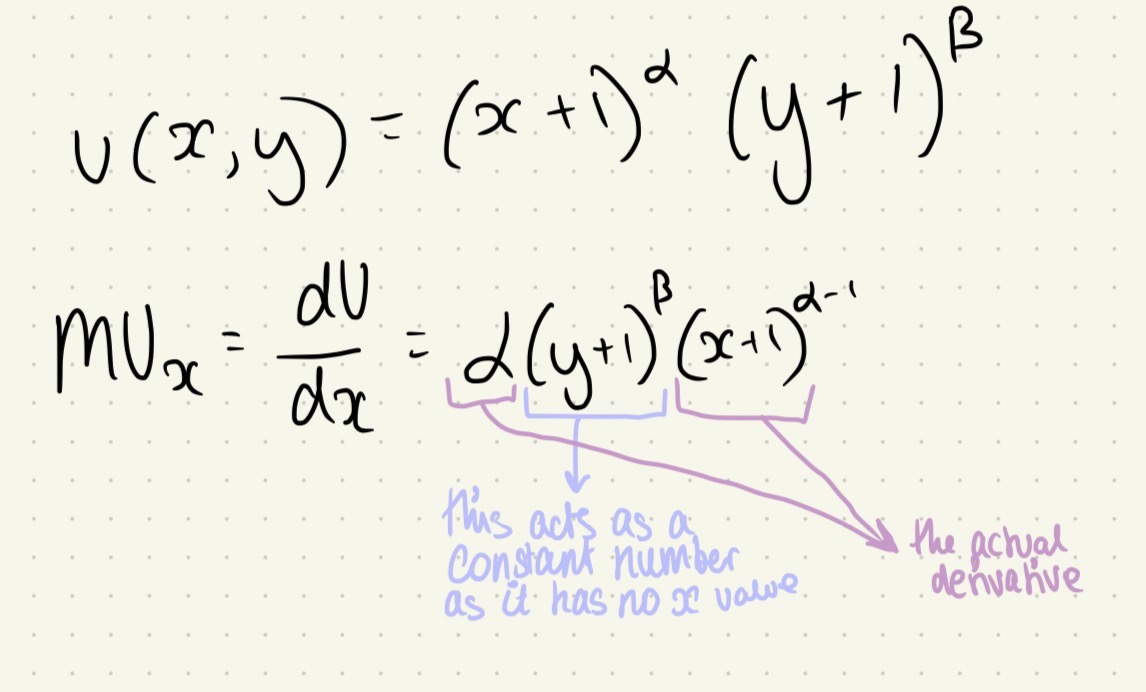
What’s the mathematical way to tell if a bundle is affordable?
Px • X + Py • Y ≤ M
Why is it ≤?
If goods are indivisible, you might not be able to spend all of your M
What is the formula for the budget line?
Px • X + Py • Y = M
What are two definitions of the slope of the budget line (- Px / Py)
The rate at which the market allows you to trade good X with good Y
The opportunity cost of good X in terms of good Y
Define the optimal choice
The preferred bundle among the affordable bundles
Where is the optimal choice on a graph (in words)?
At the point where indifference curve and budget line are tangent, they have the same slope
What is the mathematical formula for the optimal choice?
When MRS = Px / Py
How else can MRS = Px / Py be written
MUx Px
—-— = -—-
MUy Py
What does it mean if MRS > Px / Py
For you, one unit of X is worth more than what it’s worth for the market, so you’ll increase X and decrease Y
What to do if when solving for the optimal choice you get a negative quantity for the good
You set the quantity to zero
What’s the formula to calculate optimum quantity of x with cobb-douglas (not to do in exam, but just to check answer)

What does the individual demand curve do?
Indicates the quantity demanded of a good for each possible price level, holding everything else constant.
How do we calculate the individual demand curve for good X from M and Py

How to tell based on the utility function if x and y and homogenous goods?
when alpha = beta (aka goods have the same importance) and sigma → infinity
What happens if goods x and y are homogenous
If Px = Py , You consume any combination of x,y given your budget constraint
If Px ≠ Py , you consume only the cheaper of the two → a corner solution
Define a corner solution
When an optimal choice occurs at the boundary limit of a constraint, and a consumer spends all income on one good and zero on the other
Define Equivalent Variation
The amount of money that would need to be taken away (or given) BEFORE the change to leave the consumer with the same level utility as after the change.
Aka, we consider prices/income before the change and utility after the change
Define Compensating Variation
The amount of money needed, AFTER the change, to bring the consumer back to the original level of utility (compensation happens after the event)
aka we consider prices/income after the change, and utility before the change
What does k̄ (k with a line) mean
means k is not variable and cannot be changed
e.g. k̄ = 1 means k is fixed at 1
What does a firm’s production function look like?
Q = F(L)
Gives the max Q you can obtain given the L you use
What is the general production function?
Q = A • Lα
where A = productivity, technology
α can be any number, but ebook usually considers it to be <1, usually 1/2
What does α measure in the general production function
The output elasticity of labour - measures how responsive total output (Q) is to a percentage change in the labour input (L)
What is the mathematical formula for the average productivity of L
APL = Q / L
→ = ALα / L
→ = ALα - 1
What is a reason that α may be 1 in the general production function?
Q = A • L
APL = Q / L = AL / L = A
APL is constant - the job is so basic no matter who you hire the work is always the same
What is the marginal product of labour (MPL)
It measures the extra output produced by the last minimal quantity △L employed
this number is always positive
How do we mathematically calculate the MPL
Through partial derivatives
MPL = dQ / dL
MPL = A • αLα - 1
How do APL and MPL look on a graph?

What is the inverse production function
When L is the subject of the formula
L = (Q/A) 1/α
Define a fixed cost
A cost that doesn’t depend on the quantity of output produced
Define a variable cost
Depends on the quantity produced - for us its the cost of L as we are only looking at labour
What is the calculation for VC (given that we only have labour)?
VC(Q) = W • L = average wage • number of workers
How do we then make VC(Q) an actual function in terms of the variable Q?
W • Q1/α / A1/α
How do C(Q), VC(Q) and FC look together on a graph?

How do we compute AVC(Q)
VC(Q) / Q - then substitute so everything is in terms of w, q, and a
also
W / APL
How do we compute APL connecting it with AVC(Q)
AVC(Q) = W / APL
AC =
AVC + AFC
Define marginal cost
Cost paid on average to produce one of the last △Q units of output
What are the two ways of computing MC
Partial derivative of the cost function wrt Q
W / MP
△WL / △Q
Define MPL
The quantity of output obtained, on average, by one of the last △L units of L
MPL and MC are ___
MPL and MC are inversely related
ACmin occurs at the lowest point of AC where..
MC=AC
What is the function for revenue in terms of Q
R = P(Q) • Q
What does the demand curve look like for a price-taking firm

In the SR, FC is a…
is a sunk cost. It has no opportunity cost and no impact on the optimal choice → we ignore it
What is the profit maximisation condition
MR = MC
How to find MR by differentiation
dR
—
dQ
What is the LR profit maximisation rule
R(Q) = C(Q)
2 choices: shut down or produce, either way profit = 0
In the LR you produce if:
P > ACmin
How is PS calculated in the short and long run
Short run: PS = R - VC
Long run: PS = R - Avoidable costs (vc and fc) = R - C = profit
vc are the only avoidable costs in the sr
How else can we calculate PS in the short run?
PS = π + FC
Where are avoidable costs on a SR price-taking firm diagram

What are some characteristics of competitive markets?
A large number of sellers and consumers
Good is homogenous
Each buyer is a tiny fraction of the market
capital N is the number of ___
capital N is the number of consumers
What is market demand
The horizontal summation of all the individual consumers’ demand functions
What is the individual demand function for a competitive market
qD = fD(pequ)
A LR equilibrium is ___ a SR equilibrium. The opposite is ___ true.
A LR equilibrium is also a SR equilibrium. The opposite is not true (when sr profits > or < 0.)
Define total surplus
The overall benefit for society due to the consumption / production of a certain quantity of a good at a certain price
How do we calculate total subsidies
TS = CS + PS + Taxes - Subsidies
last two are market interventions — government revenue and government expenses, for the moment we ignore them so TS = CS + PS
Under perfectly competitive markets, TS is ___
Under perfectly competitive markets, TS is maximised
The competitive market outcome is ___-___, which means __
The competitive market outcome is pareto-efficient, which means it is not possible to increase the welfare of one agent without making the other worse off
What are three things the price elasticity of demand depends on?
Whether the good has no, perfect, or close substitutes. If the good has no substitutes, its demand curve will be steeper and inelastic
How much the purchase of the good affects income: the less it affects income, the more inelastic the demand (conn’s toothpaste)
The time frame: in the short run, demand is more inelastic than in the medium and long run
How does ED change along the demand line?

What are the categories for elastic, inelastic, unit elastic?
Elastic: 1 < |ED| (p rises by 1% your Q decreases by more than 1%)
Inelastic: 0 < |ED| < 1
Unit elastic: ED = -1
What is TE and how is it calculated
Total expenditure
TE = p • Q = R (total revenue collected by the firm)
How does TE change when there is an increase in price for a good with elastic demand
TE decreases bc although p increases, q decreases by more, so p x q is lower
What are three reasons why a monopoly may arise?
A firm may acquire exclusive control over essential resources
Barriers to entry such as high initial costs or patents may exist
May be created by state policies that grant a single firm the exclusive right to produce and distribute