Exam2 Foundations of MSE
 Call Kai
 Learn
 Practice Test
 Spaced Repetition
 Match
 Flashcards
 Knowt Play
1/25

There's no tags or description
Looks like no tags are added yet.
26 Terms
Multicomponent Material
Material whose composition involves more than one atomic element
We denote the number of components/elements by C
how many components does LiMn2O4 have?
C=3, ternary
Chemical potential (μi)
Energy cost of adding 1 mole of component i to a system
μi =

For example, for LiMn2O4, what is the chemical potential of μMn?
μMn = (𝜕𝑈/𝜕𝑛Mn)S,V,nLi,nO
Internal Energy for multicomponent system (U) is a sum of what 3 contributions?
Work
Heat
Mass Transfer
dU for multicomponent systems
dU = -PdV + TdS + ∑μidni
What is the expression of the differential of the free energy for LiMn2O4 ?
dU = -PdV + TdS + μMndnMn + μLidnLi + μOdnO
What are the conditions for thermodynamic equilibrium?
Intensive variables should equalize across a system, and so for all phases and components (where a and b are different phases and i is the number of components):
Ta = Tb = …
Pa = Pb = …
μa,i = μb,i = …
Without thermodynamic equilibrium, what would happen to a system?
Heat, atoms, etc. would flow to equalzie
Conditions for thermodynamic equilibrium

For a 1-component (C=1) and 2 phase (a, b) system, when are a and b in equilibrium?
Ta = Tb
Pa = Pb
μa = μb
For a 2-component (C=2) and 2 phase (a, b) system, when are a and b in equilibrium?
Ta = Tb
Pa = Pb
μ1,a = μ1,b
Gibbs Phase Rule tells us what?
About the possible dimensionality of regions of a phase diagram depending on how many phases can coexist there?
What is the Gibbs Phase Rule?
DoF = C – φ + 1
for condensed phases
On a T-x phase diagram, the phases present at a given point on a phase diagram should __________ the GFE
minimize
What does T and x represent on T-x phase diagram
T = temperature
x = composition of each phase
g(x) =
G(x) / n
Molar GFE
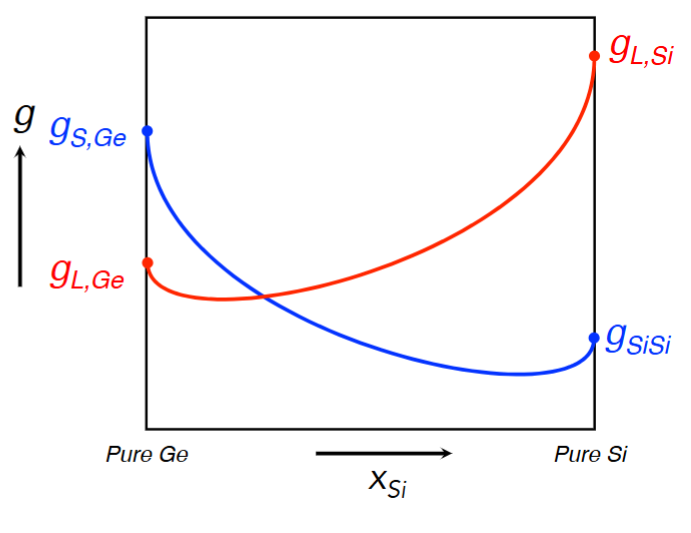
What is the equilibrium mixture closer to pure Si?
Mostly solid b/c want to minimize g

What is the equilibrium mixture closer to pure Ge?
Mostly liquid
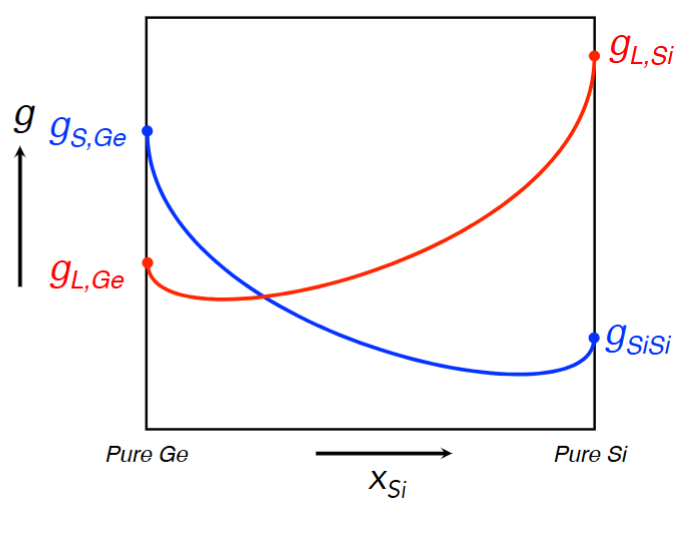
Where should you take the tangent of both curves to tell you the equilibrium phase compositions?
At the lowest point of each curve and connect a line
g(x) =
h(x) - Ts(x)
Why does the -Ts(x) component on a T-x curve up?
Because you introduce configurational entropy, and how many ways you can arrange the molecules in the crystal
h(x) component on T-x curve - when will it curve up?
If the two molecules “dislike” each other
h(x) component on T-x curve - when will it curve down?
If the two molecules “like” each other