Chemical biology
 Call Kai
 Learn
 Practice Test
 Spaced Repetition
 Match
 Flashcards
 Knowt Play
1/13

There's no tags or description
Looks like no tags are added yet.
14 Terms
Describe the Khorana method
The first synthetic DNA methods were based on phosphate chemistry and mimicked natural DNA synthesis.
The main problem is that phosphates are relatively unreactive electrophiles. The phosphorus is surrounded by four oxygens, whose lone pairs can donate electron density towards phosphorus. This makes phosphorus less electrophilic.
Other problems include:
The secondary 3′-OH is a relatively poor nucleophile (yield around 80%).
Protecting groups can undergo side reactions or hydrolysis.
Multiple purification steps are required.

Describe the Letsinger method
The solution was to use phosphites instead of phosphates.
A phosphite has three oxygens instead of four, so there is less electron donation towards phosphorus. Therefore, phosphorus is more electrophilic and reacts much more readily with an alcohol nucleophile.
Under acidic conditions, phosphite coupling is approximately 10¹² times faster than phosphate coupling. The reaction proceeds through a phosphonium intermediate. After coupling, the phosphite is oxidized to a stable phosphate.

What are applications of synthetic DNA?
Synthetic DNA is useful for making, for example, primers, oligonucleotides, and DNA fragments for research or therapeutic applications.
What are the steps in DNA synthesis for building in the next nucleotide? and what do the metal ions do?
from 5’ to 3’

How does modern DNA synthesis occur?
Modern DNA synthesis combines phosphite/phosphoramidite chemistry with solid-phase synthesis.
The growing DNA strand is attached to a solid support, usually controlled pore glass (CPG).
The main advantage is that soluble reagents and by-products can simply be washed away after each reaction.
This gives:
easier purification
efficient use of excess reagents
automation
high-throughput synthesis
high yield and purity
What is the direction of modern synthetic DNA synthesis and why is this used?
It also changes the chemistry compared with natural DNA synthesis. The growing strand is attached through its 3′ end, leaving the 5′-OH available for reaction. The 5′-OH is a primary alcohol, which is a better nucleophile than the secondary 3′-OH used in the Khorana approach.
Give the different steps of the phosphoramidite synthesis cycle
Each nucleotide addition consists of several steps:
1. Detritylation
The 5′-OH of the growing strand is protected by a DMT group.
DMT is acid-labile, so acid removes it and exposes the 5′-OH for the next coupling.
2. Coupling
An incoming phosphoramidite reacts with the free 5′-OH.
The phosphoramidite contains an activated phosphorus, making it electrophilic. The alcohol attacks phosphorus and the leaving group is displaced.
The new nucleotide is therefore incorporated through a phosphite linkage.
3. Capping
Not every DNA strand reacts completely during coupling.
Unreacted 5′-OH groups are therefore capped, commonly using acetic anhydride.
This prevents these incomplete strands from reacting in later cycles. Without capping, they would continue growing and produce deletion products that are difficult to separate from the desired sequence.
4. Oxidation
The newly formed phosphite is converted into a stable phosphate.
This is important because phosphites are highly reactive and could undergo unwanted reactions during the next cycle.
Iodine in aqueous THF is used for the oxidation, with 2,6-lutidine acting as a base to neutralize HI. A pentavalent phosphorane intermediate is formed.
5. Repeat
The cycle is repeated for every nucleotide in the sequence.
DMT is removed after every cycle, while the protecting groups on the bases and the cyanoethyl group remain until the end.

Draw the cycle for phosphoramidite synthesis

What protecting groups are used for modern DNA synthesis? and how and when are what groups removed?
Protecting groups prevent functional groups from reacting at the wrong time.
DMT: protects the 5′-OH and is acid-labile.
Base protecting groups: protect nucleophilic groups on the nucleobases.
Cyanoethyl: protects the phosphate and is base-labile.
At the end of synthesis, the DNA is treated under basic conditions, commonly with ammonia. This removes the base protecting groups and the cyanoethyl group.
The DNA is also cleaved from the solid support, giving the final free oligonucleotide.

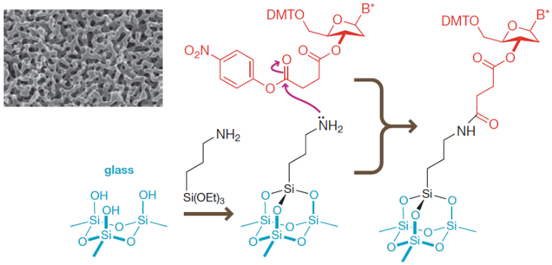
How is the DNA chain connected to controlled pore glass (CPG)
The solid support is typically glass.
The glass surface is modified with 3-aminopropyltriethoxysilane.
This creates an aminopropylsilane surface.
The first nucleoside is attached through a nitrophenyl ester linker.
The growing DNA strand remains attached to the glass throughout synthesis.
At the end, treatment with ammonia cleaves the linker and releases the DNA.
How does agarose gel electrophoresis work?
DNA moves through a crosslinked agarose network.
Smaller DNA fragments move more easily and therefore migrate faster/further.
Higher agarose concentrations give a denser network and are useful for smaller fragments.
Lower agarose concentrations are used for larger DNA fragments.
DNA can be visualized using a DNA stain.
How does capillary electrophoresis work?
Capillary electrophoresis works on the same principle as gel electrophoresis but uses a very narrow, long capillary. It provides much higher separation efficiency and can distinguish DNA fragments that differ by only one nucleotide.
This is particularly important for Sanger sequencing.
How does Sanger sequencing work?
Sanger sequencing determines the DNA sequence using dideoxynucleotides (ddNTPs). The reaction contains a DNA template, primer, DNA polymerase, normal dNTPs, and small amounts of fluorescently labelled ddNTPs. When a ddNTP is incorporated, DNA synthesis stops because it lacks a 3′-OH. This produces DNA fragments of different lengths, each ending with a specific fluorescent ddNTP. The fragments are separated according to size by capillary electrophoresis, with shorter fragments reaching the detector first. At the end of the capillary, a single laser excites the fluorescent labels. Each label consists of a light-absorbing part that is excited by the laser and a fluorescent part that emits light at a specific wavelength. The four ddNTPs therefore produce four different emission wavelengths, allowing the detector to identify whether the terminal base is A, T, C, or G. Reading the detected bases from the shortest to the longest fragment gives the DNA sequence.